Faith Can Move Mountains... But Dynamite Works Better
Showing posts with label Kenneth Branagh. Show all posts

Monday, November 13, 2017

Murder And The Belgian Detective


“Would you mind if I join you? You’re the world famous detective, Hercule Poirot. Avenger of the innocent. Is that what they call you in the papers?” ~ Edward Ratchett 
“And are you innocent?” ~ Hercule Poirot

“Some men have a good look. All they have to do is keep their mouth shut and they can take home any prize they want. Still the mouth opens.” ~ Mrs. Hubbard

“I’m sleeping here, where everyone can see me, and where I can see everyone.” ~ Mary Debenham

“We’re surrounded by lies!” ~ Edward Masterman

“And who are you?” ~ Gerhard Hardman 
“I am Hercule Poirot, and I am probably the greatest detective in the world.” ~ Poirot


Agatha Christie remains one of the literature world’s leading lights in mystery fiction, with her works frequently adapted for stage and screen. Her creations include the iconic Belgian detective Hercule Poirot, who appeared in a wealth of stories that have provided readers- and viewers- with suspenseful entertainment in a variety of ways. One of her most acclaimed tales, Murder On The Orient Express, has been previously adapted in film and on television, pitting the detective into a case of a murder on the lavish title train. It has now been adapted into a new film version by the actor and director Kenneth Branagh, with an outstanding cast.


Poirot (Branagh), the esteemed and eccentric detective, is looking to unwind and relax after a case in 1930s Europe. This being a murder mystery story, unwinding and relaxing are not going to happen, and he is summoned back to Europe on a case, boarding the Orient Express to swiftly return. He meets a number of other passengers on board, each with their own secrets and reasons for being on board. Some are wealthy and well known, others are of more common stock. One of them, Edward Ratchett (Johnny Depp), asks for his assistance, fearing for his own safety. Murder ensues, and the detective finds himself caught up in the task of narrowing down suspects and identifying the killer.


The screenplay comes from Michael Green, adapting the original story by Christie. Green has been behind films like Logan, Blade Runner 2049, and Alien Covenant, and his screenplay tweaks the story with some details- nationalities of certain characters, for instance. But the screenplay follows the story’s methodical sifting through secrets, the detective’s relentless pursuit of the truth, and the tension of a situation where a murderer lingers among passengers on a train, marooned in winter. I like that the story plays those secrets close to the vest, giving the audience a chance to get used to the characters at a distance before murder and mayhem bring everything in a different direction.


Branagh comes from a background in Shakespeare on the stage, and he’s adapted several of the Bard’s works for film (he’s just about the right age now for a cinematic Macbeth). That theatricality shows itself in this film, with how he works with actors, how he stages the action, and how he performs in the lead role himself. He has a great eye for detail, which shows itself through the film- the luxury of the train is well rendered, with its furnishings providing a lavish setting for those with money to spare and a wish to be seen on one of the great symbols of class. Branagh’s crew keeps that attention to detail in other ways, evoking the period through costume and prop details; we feel like we’ve just stepped back in time and are unseen passengers on board. And Branagh’s style as a director works well with the material, slowly driving up the tension as things go along, with this machine of luxury stranded in the wilderness- while a murderer lingers among its passengers.


With a cast like this, part of the draw of the movie is just watching them at play, and Branagh goes with a diverse selection of fine actors, some of whom he has worked with before, others who are new collaborators. Depp himself has spent the last few years known for bad behavior and playing eccentrics to no end; here he plays the ill-fated Ratchett in an understated way (understated for the actor, anyway). He’s anxious, but tries to hide that behind a smarmy kind of charm, and his character is an unpleasant man whose past carries many secrets and acts of criminality. The actor plays off that well, and needs to play more subtle characters like this for awhile rather than return to over the top mischief.


Derek Jacobi has been a frequent collaborator with Branagh over the years, and this time plays a butler, Edward Masterman, whose ties to others play out through the film. Judi Dench, another occasional collaborator with Branagh, plays Princess Dragomiroff with an occasionally arrogant quality that you might expect of royalty. Josh Gad turns up as Ratchett’s assistant Hector MacQueen, turning out to be as corrupt as his boss. Willem Dafoe, Penelope Cruz, Daisy Ridley, and Leslie Odom Jr. all turn up as passengers- the professor, the missionary, the governess, and the doctor in that order- and suspects in ways that require them to play their emotions and agendas hidden. This is true of the rest of the suspects. Michelle Pfeiffer gets a lot to do as Mrs. Hubbard, the widow with her own reasons for being aboard the train, a forceful personality as the story unfolds. She brings a sultry, cynical air to her performance.


Part of the fun of a murder mystery is watching the detective prove how brilliant he is by unravelling the secrets and circumstances of the murder, and Branagh has a lot of fun playing Poirot. The character has been played before in film and television by actors like Albert Finney, Alfred Molina, and David Suchet, and Branagh slips into the eccentric, salty-mustached Belgian detective effortlessly. When we meet him, he’s eager only for rest, but a man of his skills is never allowed to relax, and Branagh plays off that sense of irritation early. He’s also a man of principle, finding it distasteful to work in a bodyguard capacity for a career criminal, and yet obliged to investigate the murder that ensues. Branagh’s take on the character is a good one, a doggedly determined and brilliant mind that works to seek out a solution, unearthing secrets as he goes along.


Murder On The Orient Express turns out to be a good deal of fun, watching an outstanding cast in a period film deal with a murder mystery. One could watch a cast like this reading the phone book and still enjoy it. It brings to life one of the genre’s great figures, as Poirot confronts an enigmatic puzzle of a mystery, and sifts through its intricate connections. Adding in a dash more action than the prim and proper Agatha might have expected, the film is a fine lark built around blood and death- and proper manners along the way.

Saturday, November 4, 2017

The Daring Escape Of An Lunatic Scientist


Mad Scientist Escapes Custody, Vows Revenge On Enemies

Berlin (Reuters) The world is reeling from news of the escape from prison of a notorious mad scientist in Germany. Magnus Von Malice, the super villain alumnus of the Zeppelin Von Blood Academy For The Ethically Challenged, the sociopathic and egomaniacal scientist whose attempts at world domination have run the gauntlet from bringing z-list celebrities back from the dead, stealing million dollar coins, arms dealing, and endless tirades, was arrested several months ago after a previous escape from prison. He and his minions stole a million dollar Canadian coin from a German museum, and Von Malice’s plans and threats against the world were thwarted thanks to the timely intervention of the world’s most relentless lawman.


Von Malice and his associates had been charged with multiple counts and imprisoned pending trial in Germany. Von Malice himself had been spending several months in a body cast after an epic beat down, still recovering in recent weeks while his body was mending. Police are still investigating the means of his escape after a daring breakout achieved by an unknown number of intruders at the hospital wing of the prison where he had been held pending trial.


While Von Malice is on the run, numerous figures around the world have responded to the crisis. Chancellor Merkel seemed dismayed and irritated, which might well be her default setting. “I want answers about how this could have happened,” she told reporters. “How hard is it to keep such a man confined? This man still had broken bones mending! Now he’s out there making threats and making more plans and doing whatever mad scientists do! Do I have to remind you he’s built death rays and interfered with time itself to resurrect pointless celebrities? What else is he capable of?”


Actor- if you want to call him an actor- David Hasselhoff, who was one of the z-list celebrities resurrected by Von Malice, had his own statement on the matter. He was still mending himself, after an altercation with Sharknado co-star Ian Ziering at a promotional event for the latest sequel left the former television heart throb with facial injuries still mending. “People need to just back off and leave Magnus alone!” Hasselhoff said. “He’s not a bad guy! He brought the Hoff back from the dead, after all, and the Hoff being in the world is a great thing!”


Russian president and sometime super villain himself, Vladimir Putin, was evasive about Von Malice when asked if he was giving sanctuary to the mad scientist. “Look, it is very simple, da? One does not give straight answers when one is asked about old poker playing friend and occasional lunatic? Magnus Von Malice may or may not be in Russian territory, da? How should I know? Do you think I know everything that happens in Mother Russia? That would mean I would have spies everywhere reporting on everything, and that is just silly.” He laughed, and not in a good way, but more in the kind of way that made you think he was considering the brutal death of someone who had cut him off in traffic.


The current occupant of the Oval Office (for the moment, anyway) has been busy tweet-screaming at military widows, football players, and pretty much anyone else who’s been irritating him, not to mention contending with looming indictments and the Mueller investigation. And yet that hasn’t stopped him from issuing Twitter statements on the matter. “Manhunt on Magnus very unfair!” Trump wrote at three in the morning yesterday. “Magnus is a very fine guy! Good guy! Gave my campaign lots of money, bigly covfefe!” Another tweet following that noted: “Blame Crooked Hillary and Obama! Lock them up! Lock them up! Fake news!” The tweets that followed that became even less coherent until ending at four thirty with a final one: “Lyin’ Ted hates rabbits!”


In the morning, a press briefing was very brief, with White House Press Secretary Sarah Huckabee Sanders coming in and telling reporters, “The President’s Twitter account was hacked. We believe Hillary Clinton did it, and we are demanding she be arrested and perp walked by the FBI before the entire world. That’s what the president told me to say. Now off the record, if any of you can think of any places that might hire me in a month or two, let me know. I don’t think this job is going to last much longer. Thanks, no questions, bye.”


The supervillain himself made contact with the world at large through a video transmitted from an unknown location. He was sitting in a large arm chair in a comfortably furnished room, petting a ferret. His long black and silver hair was disheveled, and he was dressed in dark slacks and a turtleneck. “People of the world! It is I, the unparalleled genius that is Magnus Von Malice! Only I, the greatest mind this world has ever produced, could have escaped from custody! Only I, the leading figure of the age, could be so audacious! You cannot keep me contained. No one can stop me! For I, Magnus Von Malice, am utterly unstoppable!” He began to laugh, until his face seemed to strain in pain and he clutched his side. “Oh, damn…. My ribs. Still healing up, you see. But that does not matter! For I have demands to make!”


For another thirty minutes, Von Malice went on and on, bragging about himself and his intellect, to the point where one might think he needed to seriously dial back on the ego. Finally he got to the demands. “In the past I have insisted on sole ownership of entire countries and massive amounts of money or I would wreck havoc with the world. You refused. Instead you sent that… policeman after me. Now I will not be satisfied with just getting my hands on France, or turning the people of Denmark into playing the part of my personal chess set. I will not be satisfied with trillions of dollars handed over to me.”


He paused, glared at the screen, petting the ferret. “I will give the governments and the people of the world precisely two weeks from today. You will surrender all control of your countries to me. You will surrender all wealth to me. There is to be no negotiation, no conditions. Only I, Magnus Von Malice, can lead the world forward into the future. I will be satisfied with nothing less than total and complete world domination!” He laughed again, until the pain of mending ribs stopped him. “Ah…. Ah, that’s better. And one more thing. I want that Mountie. I want Lars Ulrich. I want revenge. I want him handed over to me. I want to strap him to a rocket and send him into the sun. You will hand him over to me so that I can end his existence. Is that clear? Welcome to the new age. The Age of Von Malice!” He started laughing, until the ferret leapt out of his hands and started clawing his face. “Owww! Somebody get Hugo off me! Stop that! Stop it, Hugo! Stop! Bad ferret!”


The video ceased at that point. Governments of the world began to debate the demands. The president of France recommended an immediate surrender. The American president tweeted, “Crooked Hillary!” The Russian president looked addled after viewing the rant and was said to have run away to the nearest reinforced bunker. 

And at an RCMP detachment in the Alberta foothills, a gruff Mountie was cautiously approached by reporters for comment. Upon being reassured that the reporters knew full well that he was not that other Lars Ulrich, the Inspector’s glare lessened. “It’s on my to-do list,” Inspector Lars Ulrich simply stated. “1: Find Magnus Von Malice. 2: Kick the crap out of Magnus Von Malice. And 3: make Magnus Von Malice cry. Now if you’ll excuse me, I’ve got to get at it.” In the opinion of this reporter, Von Malice might be in a world of trouble.


Monday, July 24, 2017

A Miracle In The Midst Of A War


It might well be a surprise that the story of what happened at Dunkirk early in the Second World War has never been brought to the big screen. Some of that might have to do with the fact that Americans weren't involved- this was a year and a half before Pearl Harbor, after all. And yet that didn't stop the film Battle Of Britain from coming out back in 1969 to great acclaim. Now that's been rectified by director Christopher Nolan (The Dark Knight trilogy, Inception, The Prestige) in a new feature film that has just been released to theatres, telling a harrowing war tale of the survival and evacuation of thousands of men in the face of oncoming danger.


The film sticks with the facts of what happened. With the collapse of the French army in 1940 and the fall of other European countries to the Nazi blitzkrieg, Allied soldiers from Britain, Canada, France, Belgium, and hold outs from other occupied countries find themselves running out of space for retreat. They are trapped along the French coast at Dunkirk, and between May 26th and June 4th, with German forces pressing in, the coastal beaches and town become a possible last stand for an army of hundreds of thousands of men, and a miracle because of what transpires.


Aside from directing the film, Nolan wrote the screenplay, with roots that date back a quarter century during a crossing of the English Channel with his wife Emma Thomas, who produced the film with him. He set the idea aside until he had experience directing big action films, but envisioned telling a war story from three points of view- land, sea, and air. The story is not conventional fodder for Hollywood- no involvement of Americans, and what happened was a retreat, not a victory- though it can be said that the saving of an entire army from the shores of France proved to come back to haunt the Germans when many of those men returned during the D-Day operations four years later.


The story is told from the point of view of those involved- we don’t see politicians or generals in a war room back across the Channel; in fact, we get perspective views from the commanders down to the privates all stuck together on the beach. It’s interesting that Nolan’s story keeps the Germans at a distance- we don’t really see German soldiers up close, but feel their presence as a looming threat. Instead we get the personal point of view of mostly young men, inexperienced boys, really, facing the dread of possible annihilation. Some are shaken by it, others come into their own. We see the bravery and resolve of civilian sailors crossing the Channel straight into danger. The characters are largely composites as to historical personalities, representing in a general sense those men who were at Dunkirk. The film’s narrative does come across as authentic- those of us familiar with the story of the evacuation can see that Nolan’s very careful about keeping to the timeline.


And it turns out that Nolan was wise to decide to leave this film until he was well established. As a director, he’s taken on the intimate and personal in films like Memento, Insomnia, and The Prestige, while establishing himself in larger epic films with his work on the three Batman films he did with Christian Bale, or the meta-scale of films like Inception or Interstellar. Nolan has established himself as a compelling storyteller, capable of character studies and powerful action, and the result is a war film that rates as one of the greats of the genre, telling a story that deserves to be told on the big screen.


Nolan and his crew worked extensively on location, not only on the beach at Dunkirk where it happened, but other spots in the United Kingdom and the Netherlands, with some work done in the United States for the interiors of a sinking ship. A French destroyer was even used, kitted out like other warships to look more like a throwback to the time. Period planes were brought into the production, along with model work- Nolan chose not to rely on computer generated effects.


From the director’s point of view, Nolan and his camera team have great instincts in telling a war film. Some of that comes from previous experience- take for example, The Dark Knight Rises, which has the tone of a war film in many ways. But it shows itself in the ferocity of combat that comes across on the screen, or the harrowing, claustrophobic feel of sequences throughout the film. It shows itself in the characters, some of whom are shaken or broken by what they’re going through, others who push on through. War is hell, and Nolan gives the audience the chaos, horror, and tension of it throughout the film.


In preparing for the film, Nolan spent time with some of the surviving veterans of Dunkirk, hearing their stories, and some of the things that were impressed upon him was how young they all were at the time. The director chose to go with young actors, most of them unknown, for the rank and file members of the cast, and it was a wise decision. With the exception of one of them (Harry Styles, the singer, who at least doesn’t humiliate himself as a first time actor), who’s famous in a completely different entertainment genre, most of the younger cast members are not known to the public at large. Going for the unknown turns out to be the right call- these young actors like Tom Glynn-Carney or Jack Lowden allow the audience to get to know their characters on their own terms.


That’s not to say there aren’t well known actors involved. Cillian Murphy, who has worked with Nolan on several films- including his memorable take as the Scarecrow in the Batman films- is particularly poignant in his performance as a soldier suffering from post traumatic stress disorder. James D’Arcy, who appeared in Agent Carter as Edwin Jarvis, and in the British series Broadchurch, appears as a British colonel, preoccupied with the fate of those men under his command. Mark Rylance, who recently won a Best Supporting Actor Oscar for his role in Bridge Of Spies, appears as Mr. Dawson, an experienced civilian sailor who takes his boat into peril and faces it with steadiness and quiet courage.


Tom Hardy gets a good deal to do as Farrier, a pilot with the Royal Air Force whose point of view we get into from action in the air as the RAF duels with Luftwaffe pilots. The actor worked with Nolan in The Dark Knight Rises for his memorable take as Bane, and here his character is calm, sympathetic, and methodical.


Kenneth Branagh, the great Shakespearean actor of stage and screen, gets a terrific part as Bolton, the senior commander on the beach. Like his men and those of the other Allied forces finding themselves in peril, Bolton shares the danger. He worries about what’s to come, hopes for rescue, and keeps calm and measured in how he handles his men. Branagh gives the character stoicism and resolve.


Nolan’s main point of view character is, until now, an unknown actor. Fionn Whitehead plays Tommy, a British private, one of thousands of his kind. The young actor has some previous experience in Britain, but not a lot, and here gets a role that makes a serious impression. He embodies the young man who went off to war against the greatest evil human beings have ever come up with. Men like him might not have known what they were quite getting into, but rose to the occasion, despite what fear they might have felt. Whitehead becomes our eyes and ears, and the actor conveys the experiences and perspective of a soldier facing great peril in just the right way.


Dunkirk does not rely on manipulating drama to tug at the heart strings. Yes, it can be moving at times, but never in a way that feels forced. Instead it conveys the tension and suspense of war, the steady sense of unshakable fortitude, the danger of the situation, and the immediacy of the soldier’s point of view. In telling the story of an evacuation and retreat, Nolan gives us a film that sticks with the events as they happened, a harrowing war film that might well stand as one of the best of its genre... and it's the best film of the year.

Wednesday, May 24, 2017

Murder Among Two Lifetimes


“The man I bought it from explained to me that when a man gives it to his wife, they become two halves of the same person. Nothing can separate them... not even death.” ~ Roman Strauss

“Well, I’m not going into hiding, Mr. Baker. I’m just getting married.” ~ Margaret Strauss

“Aren’t you afraid of dying?” ~ Gray Baker

 “Karmically, self-defense is quite cool.” ~ Cozy Carlisle

“Oh, and you don’t have to worry about forgetting her name. She’s already forgotten it for you.” ~ Pete

“This is fate we’re talking about, and if fate works at all, it works because people think that this time, it isn’t going to happen.” ~ Madson

“Grace? That’s what the teabag says? That my name is Grace?” ~ Grace

“I’m not looking for Miss Right. I’m looking for Miss Right Now.” ~ Mike Church


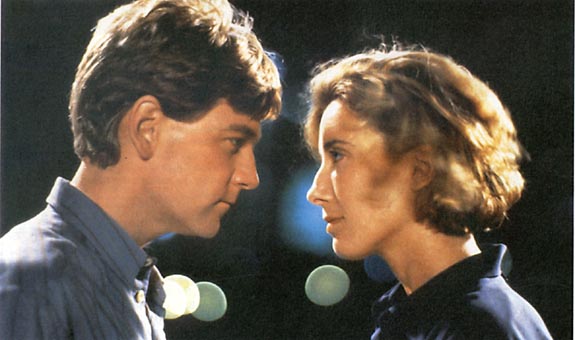
Dead Again is an unlikely mix of genres, bringing together elements of romantic fantasy and the supernatural with a good deal of film noir influences in this 1991 film from director Kenneth Branagh. The director stars in dual roles opposite his then wife Emma Thompson, who was also playing a dual role in a story that combines the mystery of an amnesiac woman with the notion of connections to past lives. With a good supporting cast, the film is quite entertaining, romantic, thrilling at times, stylish, and clever.


The film opens with newspaper headlines through the opening titles, detailing the 1949 murder of Margaret Strauss (Thompson), a classical musician stabbed during a robbery at her home. Her composer and conductor husband Roman (Branagh) is arrested and put on trial in the months that follow. Found guilty, he is sentenced to be executed. Before his execution, he is visited by a reporter, Gray Baker (Andy Garcia), who was acquainted with the couple.


Forty years later, an amnesiac woman (Thompson) has turned up at an orphanage, unable to speak, and plagued by nightmares. The priest who runs the place calls in a private detective who grew up in the orphanage, Mike Church (Branagh) to determine who she is. Church asks his friend Pete (Wayne Knight) to publish her photo in the newspaper to see if her family is looking for her. An antique dealer, Madson, with a sideline in hypnosis, approaches Church with an offer to help, and the first session determines that she can in fact speak- and is able to relive in third person the story of Roman and Margaret. It seems the tragedies of the past are coming back into the present through past lives.


The story is by Scott Frank, whose other work includes Get Shorty, Out Of Sight, Heaven’s Prisoners, The Wolverine, and Logan. The story weaves back and forth between past and present, primarily acting as a mystery, with elements of the familiar private eye genre as a strong influence. The cynical detective, the mysterious woman, the oddball characters, these are all aspects that nod back to the Forties era of hard boiled private eyes in cinema, as does the somewhat dark sense of humour throughout the film. And the narrative weaves in a love story (two, actually) and more to the point the unusual premise of past lives influences the current day, particularly in the sense of the inevitability of fate.


Branagh was already well established as a Shakespearean actor and director on stage and screen at this point- his masterpiece adaptation of Henry V was two years behind him when he directed this film. It has a theatrical quality in its pacing, fitting Roman’s character, since the man is a composer of dramatic opera. The theatrical quality carries over in the rest of the film, as the mystery unfolds, and particularly in the climactic aspects of the film, and Branagh’s directing style plays to that. I particularly like the use of black and white for those scenes set in the past (which mostly unfold in flashback through hypnosis) and colour for the present day sequences, as well as how he uses several scenes that are extended single take scenes. 


The production values are particularly effective in the past sequences, with a palatial residence well outfitted to look like a place out of the 1940s, or a masquerade party at the time looking quite at home in the past. And one of the prevailing visual themes- scissors- are carried over into the present in a creative way. Branagh uses some actors to play smaller parts in both past and present, including his frequent music collaborator Patrick Doyle, whose score for this film mixes together romantic, mysterious, and highly theatrical themes along the way.


The cast are exceptional in their roles. Hanna Schygulla appears mostly in flashbacks as the Strauss housekeeper Inga, who escaped from Germany with Roman and her son during the darkest days of the Second World War and has been loyal ever since. She has to play the character with a certain degree of distance as the film goes along- the audience isn't meant to get inside her head.


Another character who spans both past and present is Gray Baker, played by Andy Garcia. When we first meet him, he’s a young reporter with a cynical world view, fondness for smoking, and a womanizing attitude. This carries over into his interactions with Margaret and Roman, as he doesn’t show much respect at all for boundaries. Garcia makes him thoroughly jaded in his performance, and when we see him in the present day, he’s a wreck of a man, ruined by smoking, but still as jaded as ever. His present day appearance could be said to be the best cinematic argument against smoking.


Robin Williams gets a cameo appearance as Cozy Carlisle. Where Baker is jaded, Carlisle is bitter and acerbic in a way that makes the reporter seem happy. A disgraced therapist who comes into the plot as the subject of a routine search by Church early on, he’s a man with little in the way of scruples, no ethics, unconventional ideas, and the source of much of the dark humour of the film’s present day sequences. Williams gives the character a bleak, serious air in the way he plays it- Carlisle’s not a pleasant person, nor does he pretend to be.


Wayne Knight is best known for a couple of roles, the opportunistic hacker Dennis in Jurassic Park and as the perpetual irritant Newman in the Seinfeld series. Here he plays a very different character as Pete Dugan, the newspaper staffer who’s best friends with Church. He’s loyal and friendly, a genuinely likable guy, with an ironic sense of humour and something of a speech impediment. Knight gives the character a lot of levity as he goes along.


Derek Jacobi is a frequent collaborator with Branagh, having had co-starred with him in films like Henry V and Hamlet, as well as being in the cast for Branagh’s directed Cinderella. He gives the role of the antique dealer Madson a dry air. When we first meet him, he’s hypnotizing a woman at his shop for one reason, while gathering information on potential jackpots for himself. It’s a bit underhanded but amusing, the act of a grifter, but a good way to introduce a character. Madson explains his interest in past lives and how they can influence present day actions. Past life regression through hypnosis is key to unlocking the secrets of the story, and the actor plays the character with dignity but secrecy, playing things close to the vest.


Emma Thompson gets the challenge of two roles- Margaret Strauss in the past and the woman known as Grace in the present. Her Margaret is playful but professional, quickly falling for the conductor Roman, and the bond between them becomes believable as their story unfolds. Grace is a different story- she starts out as plagued by nightmares, in a vulnerable state, not knowing who she is or what’s happening to her. And yet under that, as the story goes along, the actress gives Grace a different kind of playfulness, mixed with uncertainty as she falls for the private detective who’s trying to determine what’s happened to her. The chemistry between the actors, in both eras, works very well indeed.


Branagh also gets to play two roles, giving Roman a certain amount of distance when we first meet him- we’re meant to wonder at his guilt. The character has his stormy, frustrated side that seems to fit in with his composer profession. Mike Church is a different character altogether, a private eye who tends to see the worst in people. He’s a cynic, but not above taking in a stray- a true cynic might be inclined to leave the amnesiac in a mental hospital, but he doesn’t, so this cynic has principles. Branagh plays the two characters in different ways, and Church, who finds the supernatural idea of past lives to be laughable at first, must come to terms with the idea of it as it becomes less implausible and fate closes in on him.


Dead Again got mostly positive reviews and box office at the time, and the film itself is stylish, moody, smart, entertaining, and dramatic, fitting the acting credentials of its leads. It’s a well paced film that skilfully goes back and forth between past and present, giving two lead actors the chance to play two roles across two lifetimes. It’s a hidden treat you might not know of personally, but it’s well worth seeing.