Faith Can Move Mountains... But Dynamite Works Better
Showing posts with label Emma Thompson. Show all posts

Wednesday, May 24, 2017

Murder Among Two Lifetimes


“The man I bought it from explained to me that when a man gives it to his wife, they become two halves of the same person. Nothing can separate them... not even death.” ~ Roman Strauss

“Well, I’m not going into hiding, Mr. Baker. I’m just getting married.” ~ Margaret Strauss

“Aren’t you afraid of dying?” ~ Gray Baker

 “Karmically, self-defense is quite cool.” ~ Cozy Carlisle

“Oh, and you don’t have to worry about forgetting her name. She’s already forgotten it for you.” ~ Pete

“This is fate we’re talking about, and if fate works at all, it works because people think that this time, it isn’t going to happen.” ~ Madson

“Grace? That’s what the teabag says? That my name is Grace?” ~ Grace

“I’m not looking for Miss Right. I’m looking for Miss Right Now.” ~ Mike Church


Dead Again is an unlikely mix of genres, bringing together elements of romantic fantasy and the supernatural with a good deal of film noir influences in this 1991 film from director Kenneth Branagh. The director stars in dual roles opposite his then wife Emma Thompson, who was also playing a dual role in a story that combines the mystery of an amnesiac woman with the notion of connections to past lives. With a good supporting cast, the film is quite entertaining, romantic, thrilling at times, stylish, and clever.
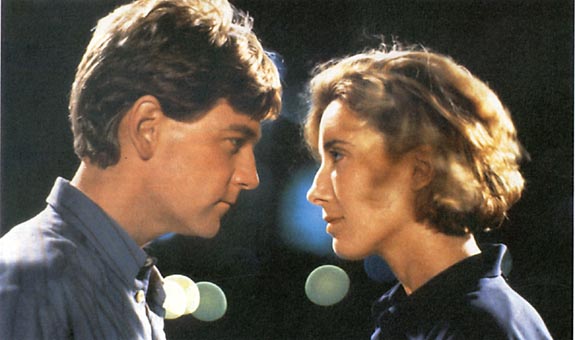

The film opens with newspaper headlines through the opening titles, detailing the 1949 murder of Margaret Strauss (Thompson), a classical musician stabbed during a robbery at her home. Her composer and conductor husband Roman (Branagh) is arrested and put on trial in the months that follow. Found guilty, he is sentenced to be executed. Before his execution, he is visited by a reporter, Gray Baker (Andy Garcia), who was acquainted with the couple.


Forty years later, an amnesiac woman (Thompson) has turned up at an orphanage, unable to speak, and plagued by nightmares. The priest who runs the place calls in a private detective who grew up in the orphanage, Mike Church (Branagh) to determine who she is. Church asks his friend Pete (Wayne Knight) to publish her photo in the newspaper to see if her family is looking for her. An antique dealer, Madson, with a sideline in hypnosis, approaches Church with an offer to help, and the first session determines that she can in fact speak- and is able to relive in third person the story of Roman and Margaret. It seems the tragedies of the past are coming back into the present through past lives.


The story is by Scott Frank, whose other work includes Get Shorty, Out Of Sight, Heaven’s Prisoners, The Wolverine, and Logan. The story weaves back and forth between past and present, primarily acting as a mystery, with elements of the familiar private eye genre as a strong influence. The cynical detective, the mysterious woman, the oddball characters, these are all aspects that nod back to the Forties era of hard boiled private eyes in cinema, as does the somewhat dark sense of humour throughout the film. And the narrative weaves in a love story (two, actually) and more to the point the unusual premise of past lives influences the current day, particularly in the sense of the inevitability of fate.


Branagh was already well established as a Shakespearean actor and director on stage and screen at this point- his masterpiece adaptation of Henry V was two years behind him when he directed this film. It has a theatrical quality in its pacing, fitting Roman’s character, since the man is a composer of dramatic opera. The theatrical quality carries over in the rest of the film, as the mystery unfolds, and particularly in the climactic aspects of the film, and Branagh’s directing style plays to that. I particularly like the use of black and white for those scenes set in the past (which mostly unfold in flashback through hypnosis) and colour for the present day sequences, as well as how he uses several scenes that are extended single take scenes. 


The production values are particularly effective in the past sequences, with a palatial residence well outfitted to look like a place out of the 1940s, or a masquerade party at the time looking quite at home in the past. And one of the prevailing visual themes- scissors- are carried over into the present in a creative way. Branagh uses some actors to play smaller parts in both past and present, including his frequent music collaborator Patrick Doyle, whose score for this film mixes together romantic, mysterious, and highly theatrical themes along the way.


The cast are exceptional in their roles. Hanna Schygulla appears mostly in flashbacks as the Strauss housekeeper Inga, who escaped from Germany with Roman and her son during the darkest days of the Second World War and has been loyal ever since. She has to play the character with a certain degree of distance as the film goes along- the audience isn't meant to get inside her head.


Another character who spans both past and present is Gray Baker, played by Andy Garcia. When we first meet him, he’s a young reporter with a cynical world view, fondness for smoking, and a womanizing attitude. This carries over into his interactions with Margaret and Roman, as he doesn’t show much respect at all for boundaries. Garcia makes him thoroughly jaded in his performance, and when we see him in the present day, he’s a wreck of a man, ruined by smoking, but still as jaded as ever. His present day appearance could be said to be the best cinematic argument against smoking.


Robin Williams gets a cameo appearance as Cozy Carlisle. Where Baker is jaded, Carlisle is bitter and acerbic in a way that makes the reporter seem happy. A disgraced therapist who comes into the plot as the subject of a routine search by Church early on, he’s a man with little in the way of scruples, no ethics, unconventional ideas, and the source of much of the dark humour of the film’s present day sequences. Williams gives the character a bleak, serious air in the way he plays it- Carlisle’s not a pleasant person, nor does he pretend to be.


Wayne Knight is best known for a couple of roles, the opportunistic hacker Dennis in Jurassic Park and as the perpetual irritant Newman in the Seinfeld series. Here he plays a very different character as Pete Dugan, the newspaper staffer who’s best friends with Church. He’s loyal and friendly, a genuinely likable guy, with an ironic sense of humour and something of a speech impediment. Knight gives the character a lot of levity as he goes along.


Derek Jacobi is a frequent collaborator with Branagh, having had co-starred with him in films like Henry V and Hamlet, as well as being in the cast for Branagh’s directed Cinderella. He gives the role of the antique dealer Madson a dry air. When we first meet him, he’s hypnotizing a woman at his shop for one reason, while gathering information on potential jackpots for himself. It’s a bit underhanded but amusing, the act of a grifter, but a good way to introduce a character. Madson explains his interest in past lives and how they can influence present day actions. Past life regression through hypnosis is key to unlocking the secrets of the story, and the actor plays the character with dignity but secrecy, playing things close to the vest.


Emma Thompson gets the challenge of two roles- Margaret Strauss in the past and the woman known as Grace in the present. Her Margaret is playful but professional, quickly falling for the conductor Roman, and the bond between them becomes believable as their story unfolds. Grace is a different story- she starts out as plagued by nightmares, in a vulnerable state, not knowing who she is or what’s happening to her. And yet under that, as the story goes along, the actress gives Grace a different kind of playfulness, mixed with uncertainty as she falls for the private detective who’s trying to determine what’s happened to her. The chemistry between the actors, in both eras, works very well indeed.


Branagh also gets to play two roles, giving Roman a certain amount of distance when we first meet him- we’re meant to wonder at his guilt. The character has his stormy, frustrated side that seems to fit in with his composer profession. Mike Church is a different character altogether, a private eye who tends to see the worst in people. He’s a cynic, but not above taking in a stray- a true cynic might be inclined to leave the amnesiac in a mental hospital, but he doesn’t, so this cynic has principles. Branagh plays the two characters in different ways, and Church, who finds the supernatural idea of past lives to be laughable at first, must come to terms with the idea of it as it becomes less implausible and fate closes in on him.


Dead Again got mostly positive reviews and box office at the time, and the film itself is stylish, moody, smart, entertaining, and dramatic, fitting the acting credentials of its leads. It’s a well paced film that skilfully goes back and forth between past and present, giving two lead actors the chance to play two roles across two lifetimes. It’s a hidden treat you might not know of personally, but it’s well worth seeing.

Wednesday, March 15, 2017

Of Quiet Wisdom And Fierce Willpower

In previous years, in the lead up to St. Patrick's Day, I have occasionally reviewed a movie with an Irish aspect to it. Such is the case again this year, with a  masterful film from the 1990s that has a darker theme.


“You’re not looking me in the eye when you’re speaking to me. You see, I know how to look at people without blinking as well. In all my god forsaken life I have never known what it was like to want to kill somebody until now. You’re a brave man, Joe. A brave man.” ~ Gerry Conlon

 “Next time you see Belfast, they’ll be flying day trips to the moon.” ~ Detective

“Well, I think they should take the word compassion out of the English dictionary.” ~ Gareth Peirce

“Don’t you be comforting me when I can see the truth staring me in the face. I’m scared I’m gonna die in here.” ~ Giuseppe Conlon

“I’m a free man, and I’m going out the front door.” ~ Gerry Conlon


In 1993, director Jim Sheridan (My Left Foot, The Field, The Boxer) brought a biographical courtroom drama to the big screen, telling the story of a grave injustice, of the relationship of a father and son, and of a man finding himself after a wrongful conviction and incarceration. The film, In The Name Of The Father, is based on the case of the Guildford Four and Maguire Seven out of Great Britain and Northern Ireland, people wrongfully sent to prison over terrorist acts. While it does dramatize aspects of the story, the film itself tells a powerful tale of redemption and personal growth, and boasts great performances by its three leading actors. Nominated for seven Academy Awards, in a year with Schindler’s List as competition, the movie is a masterpiece of acting.


The film opens with a bang in 1974, with a pub blown up one evening in Guildford, causing the deaths of five people and injuries to many others. We meet Gerry Conlon (Daniel Day-Lewis), a Belfast youth and petty criminal, content to strip lead from roofs, drink and get high, and occasionally get involved in riots against the occupying British security forces. His father Giuseppe (Pete Postlethwaite), a peaceful man who can’t seem to reach his rebellious, careless son, intervenes when the IRA is annoyed with Gerry, and dispatches his son to stay in London with his aunt, for Gerry’s own safety.


Gerry instead falls in with a friend, Paul Hill (John Lynch), and the two explore hippie life among other like minded people, content to be petty criminals. One night, Gerry steals money from a prostitute’s apartment, chats with a man in a park, and that night the bomb goes off. It’s not long after that he stands accused of the bombing, along with Paul and two others. Giuseppe is caught up in arrests afterwards as one of several accused supporters, and the two find themselves wrongfully convicted, incarcerated for long terms in a British prison, with seemingly no hope of clearing their names.


Sheridan not only directed the movie, but co-wrote the screenplay with Terry George. It’s based on Gerry Conlon’s book, Proved Innocent, though there are dramatic licenses taken and fictional aspects to the film. The Conlons were not incarcerated in the same cell, and in fact were mostly in separate prisons. The legal process as we see it in the film is different from the events that led to the exoneration of all parties- the real process was a good deal more complicated. And yet the film’s story captures the sense of injustice of the case in a stark way- from the use of torture and intimidation in the interrogation scenes to seeing these characters robbed of years of their lives for something they had no part in. The story strongly emphasizes the notion of a son really getting to know his father, of getting past the endless friction between them. It’s a personal growth story as well, as a careless youth, spending fifteen years behind bars, matures and becomes invested in the idea of justice, and righting a terrible wrong.


The film feels quite claustrophobic, even before we find ourselves in prison. The atmosphere of the mid-seventies Belfast, with its seething tension, violence, and stark mood, is well captured by the director in early sequences, rendering the place a warren of dark streets and narrow passages. That transfers well over to the prison sequences, where life in jail is rendered in the inhuman, hard way you’d expect. Some guards are more sympathetic to others, particularly to the increasingly frail Giuseppe, who, while becoming ever more unhealthy physically, shows a quiet inner strength of character that his son comes to see. Violence of prison life is not overlooked either- rioting or an attack on a guard is depicted in a harsh way, as is the hard attitude of an IRA man who knows full well that the Conlons are innocent. Even the final act of the film, set inside a court, has a somewhat claustrophobic air, filled with tension as things go along.


Emma Thompson appears in the film as Gareth Peirce, the lawyer who works to overturn the convictions. She is sympathetic and idealistic in her approach, particularly with Giuseppe, and then with Gerry. Her first encounters with Gerry find him bitter and cynical, loathing the very idea of the justice system, and yet her words do get through to him. Much of the film is told through the framing of recorded remarks Gerry makes to her, telling her his story. The character’s integrity and determination comes through very clearly in Thompson’s performance- this is a person of inherent decency who sees an injustice and seeks to make it right. It’s a role that scored her a Best Supporting Actress nomination that year at the Oscars.


The film also scored a nomination for Best Supporting Actor for Pete Postlethwaite, and really exposed him to North American audiences. His role as Giuseppe is a revelation to watch on screen. The peaceful father who’s frustrated with the carelessness and disregard of his son might be easily underestimated when we first see him, but there’s strength and resolve beneath all that. Giuseppe is a man who can talk the IRA out of punishing his son, and when he finds himself in prison, wrongfully convicted and fearing he won’t come out alive (an accurate fear), we begin to see the quiet personal strength that more than compensates for his increasing ill health. Gerry starts to see that too, getting to know his father and respect him for the first time in his life. It’s a marvel to watch these two actors interact on screen, to see Giuseppe’s hopes and fears, the way he copes with the injustice he’s living in, and Postlethwaite conveys that resolve of the man perfectly through his performance. You have these two magnificent actors together, one conveying quiet wisdom, the other a fierce sense of will, and it's a pleasure to watch.


Daniel Day-Lewis was also nominated for his work here as Best Actor, and well deserved. I would argue that this was the best performance by any actor that year (the Academy disagreed and gave the Oscar that year to Tom Hanks for Philadelphia). Day-Lewis has a history of really preparing for a role; in this case he lost weight he didn’t need to, spent three days and nights in a jail cell, was prevented from sleeping during that time by bangs on the door every ten minutes, and was interrogated by actual Special Branch officers. Apparently he also insisted crew members verbally abuse him on set. The result is astonishing to see- his Gerry Conlon goes from a careless, thoughtless, selfish, cynical youth on a path to self destruction, gets subjected to injustice, and comes alive in a fierce way, devoting himself to making a terrible wrong right again. It is character growth in a way that’s mesmerizing to watch on screen as Gerry matures, and it makes for a compelling performance. Day-Lewis is arguably the best actor alive today, and this is one of his best, if not his best, performances of his career.


The real Gerry Conlon had problems adjusting to civilian life at first, but then wrote about his experiences, and advocated for other wrongfully convicted people not only in Britain but around the world. His life came to an end in 2014 after a long fight with lung cancer, but his story, along with those wrongfully convicted in the case, makes a compelling argument against things like the death penalty as well as a harsh condemnation of the system that so flagrantly violates rights. The film, which does take liberties with the original story, maintains the tone of outrage at injustice, gives great actors a chance to shine in roles that are increasingly sympathetic as the story goes along, and proves to be a testament to willpower and resolve, with a tremendously cathartic ending. An argument can be made that the film might well have deserved the Best Picture Oscar that year- I think it’s just as good as that year’s winner, Schindler’s List, but unlike the latter film, In The Name Of The Father is a film you can realistically see more than once, admiring the raw power of its actors along the way.