Faith Can Move Mountains... But Dynamite Works Better

Wednesday, April 10, 2013

A Day In The Life Of A Dog


8:05 AM. I appear to have slept in. Big stretch and a yawn to start the day.


8:06 AM. First look out the windows. I do believe a good deal of snow has melted. I wonder if I can find any big puddles to splash through on my morning excursions. Where's the human? I'd like to get out and about...


8:15 AM. The human comes downstairs. Hello, human. Do you see outside? Spring has come! The snow's going away for another year. Assuming we don't get surprised by four feet of snow by month's end. No, that wouldn't happen, right? As I understand it, that would only make one lunatic in the Ottawa Valley happy for some reason. So, tell me, when's breakfast? Because I'm hungry. And how soon after breakfast can I go outside?


8:22 AM. The human gives me a nice big bowl of kibbles! Yummy!!!!


8:23 AM. As is my custom, I have wolfed down the entire bowl of kibbles inside of thirty seconds.


8:30 AM. Human lets me out the back door. I'm sprinting off the deck. Somewhere behind me she's calling. Something about staying in puddles. Or out of puddles. I'm not sure which was which, so I'll just have to go with my best instincts.


8:40 AM. Sprinting like a lunatic through the backfields. Barking my head off as I run by a robin. More ground open today than yesterday... less snow. Looks like Old Man Winter finally threw in the towel.


8:55 AM. Continuing my explorations. Sniffing at everything. Have found big stick poking out of melting snow. Oh boy! A prize!


9:05 AM. Proudly carrying around big stick as I continue my walk. Wait... is that a mud puddle? It is! It is a mud puddle!


9:06 AM. Oh, I'm in heaven. Rolling around in the first mud puddle of the spring is so much fun!


9:15 AM. Continuing my excursion after the celebratory rolling around in mud. Carrying my stick. Feeling as happy as I can be.


9:30 AM. Hey, it's that cat that seems to dislike me for some reason. I think I'll try one more time to make friends with her.


9:31 AM. Hello, cat. How are you doing today? Isn't this an impressive stick I'm carrying? Tell me, why don't cats seem to care about sticks?


9:32 AM. Ouch!!! The cat clawed me! Hey! You call those manners, lady?

Oh, sure, walk away in a snit like that...


9:55 AM. Home at last with my stick. Wagging my tail as I come up towards the house. The human comes out, frowns, and tells me that I'm filthy.

But human! If one doesn't get a bit dirty, where's the fun in that?


10:00 AM. The human breaks out the garden hose. Isn't it a bit too early to be doing anything with the garden?

Oh wait... the garden hose is meant for me.


10:05 AM. Enduring the humiliation and the travesty that is a garden hose bath. Human, it might be spring, but that water is cold.


10:10 AM. Human applies the Towel of Torment to dry me off. Wonderful. I go from the pure pleasure of a roll in the mud to being tortured by the Towel of Torment in a single hour.


12:35 PM. Waking up from nap. Hearing human in kitchen. Investigating sounds. She's washing dishes. Hey, wait... human, did you have lunch without me?

I missed out on a chance to mooch?


1:45 PM. Still depressed over lost chance to mooch. Staring outside, wondering what the meaning of... ooo! Look! There's a groundhog walking through the yard.


1:50 PM. What was I thinking about before that groundhog passed by?


3:35 PM. The human is having tea. I give her the sad eyes look, and sure enough, she gives me a cookie.

Oh boy! Oatmeal!


6:45 PM. Human finishing making dinner. Sitting dutifully. No, my hungry stomach has nothing to do with my taking station here.

Really. I swear.

Stop laughing!


6:55 PM. The human gives me a plate of beef. Human, just in case I haven't mentioned it a thousand times today, I love you lots and lots!


8:50 PM. The human is watching a movie. Human, you do realize this movie is based on a Nicholas Sparks novel? So why are you watching it? Come on, surely there's something else on...


10:50 PM. The human has turned off the movie. Weepy eyed. For some reason these tedious movies do that to her. Human, they're all the same, you know. This Sparks guy writes the same book over and over and over again.

Oh well, she's off to bed. Good night, human. I'll stay down here awhile.

And dream of rolling in mud puddles.


Monday, April 8, 2013

Jurassic Park: Or, How Newman Ruined Everything


"See, the movie is about this genius computer programmer. Guy by the name of Dennis. Works for this eccentric businessman who's opening up a theme park on an island. Not a Disney sort of theme park. Well, for one thing, this businessman isn't evil like Walt was. Just misguided. He doesn't really appreciate everything Dennis does for him, and he's a bit sanctimonious about it. For another, the theme park involves cloning dinosaurs. Hey, trust me, we'll make a fortune marketing this one to the kids, right? Kids love dinosaurs. Well, Dennis is our hero, but he's a guy with money problems. So he gets this idea about how to score a big payday, but it's going to take some huge risks. That's just the kind of guy Dennis is. Real stand-up fellow, sort of guy who won't let you down. So what do you think?" ~ early pitch to the studios by Steven Spielberg for Jurassic Park, 1991.


Dennis Nedry, the real hero of Jurassic Park

When I was a child, on occasion I'd go to the Royal Ontario Museum in Toronto. There they had (and still have) a collection of dinosaur fossils and reproductions on display. The sense of awe and wonder I got from seeing that stayed with me, because these days I can still walk into the Museum of Nature in my home town, check out the fossil gallery, and be humbled by the notion of reaching back through time and seeing these creatures that once walked the earth.

Twenty years ago, director Steven Spielberg, who had already long since established a record with action, epic spectacle films, changed the face of moviemaking with Jurassic Park. Based on the novel by Michael Crichton, the film tells the story of a planned theme park on a tropical island where instead of rides... the attractions are dinosaurs. Businessman John Hammond (Sir Richard Attenborough) and his team of scientists have found a way to clone dinosaurs, and he believes the concept will draw visitors from around the world. His investors are nervous, and so he brings in professionals to help him get the project finally approved. Two of them work in the field of paleontology, Doctors Alan Grant and Ellie Sattler (Sam Neill and Laura Dern). Another is a mathematician, a chaos theorist with a flirtatious streak and a tendency to talk a lot, Doctor Ian Malcolm (Jeff Goldblum).


The group arrive on the island, in the company of an overly anxious attorney (Martin Ferrero, soon to meet an untimely demise) and are quickly whisked off into the interior. There the visitors see what Hammond has done for the first time, and we as an audience see it too for the first time: brachiosaur dinosaurs eating. The sheer awe of both Alan and Ellie is something we share: unlike the traditional stop motion tactic of Ray Harryhausen, most of these dinosaurs through the film (with largely the exception of an animatronic or two) are CGI creations, and yet they look so real. We're convinced the actors and the dinosaurs are sharing the same space, though our brains know that's not possible.

CGI had been used in earlier films, like The Abyss and Terminator 2, both films by James Cameron, though in those cases, the effects leaned towards the alien and the robot, concepts that were very much sci-fi in their setting. This time CGI was being used to depict something that had walked the earth once, and the effect of that first moment where we see the dinosaurs is stunning and utterly majestic, even after years of seeing the film, as fresh as the first time.


Hammond explains the technique to Alan, Ellie, and Malcolm, each of them deeply disturbed by the ethical violations and consequences of the science; Malcolm reminds Hammond that nature selected dinosaurs for extinction. They are sent out with Hammond's two grandchildren, Lex and Tim (Arianna Richards and Joseph Mazzello) into the park for a proper tour. Of course this being a movie, things start going very, very wrong. It never seemed to occur to Hammond and his team of scientists that just because they could do something automatically meant they should do that. The film unfolds as disaster strikes, both in the form of nature breaking through the fences of the island and in the form of human sabotage, caused by one Dennis Nedry (Wayne Knight, before he'd go on to annoy Jerry Seinfeld; side note: annoying Jerry Seinfeld is a noble cause).


The visual effects of the film remain as potent today as they were in 1993. The actors definitely seem to share the same space as these ancient creatures. The danger feels much more true than if animatronics or stop motion had been the relied upon special effect. When things go wrong on the island, the production values continue to pay off; an encounter with an angry tyrannosaurus rex and two cars remains a chilling sequence in the film. The raptors, smaller and yet ruthless hunters, are rendered well, stalking in places through the story where they were never meant to walk, and unnerving the audience. The film has been re-released as a 3D film to studios; avoid that if possible; unfortunately all of the theatres in my area were showing it in 3D. It's just a gratuitious thing that isn't needed, and if you're like me, you hate 3D. Hopefully someday the studios get the message and stop releasing in that infernal technology.


Spielberg shoots the film with his usual good standards in cinematography. Out in open plains on the island or in a jungle, we have commanding views and a sense of where we are. Inside dimly lit corridors or rooms as the film moves towards its conclusion and raptors hunt, we're still given enough light to see details, to feel the looming menace. Spielberg tends to be known for spectacle, and that's certainly the case with this film, but there's more. The story itself works better than the novel (it's been a long time since I've read it), and at the heart of it is an underlying debate about ethics, about how terribly a seemingly good idea can go wrong. The story never drags, allowing us to feel a sense of awe one moment, a sense of terror seemingly the next, and leaves us breathlessly entertained. And Spielberg's longtime collaborator John Williams offers up one of his best scores, a mixture of majesty and sweeping epic music that perfectly fits the subject matter.


Regardless of just how well the production values, special effects, and story are, it's really the cast that is the bedrock of the film. It starts with the smaller character roles. Wayne Knight is a weasel as Dennis, and deserves what he gets. Bob Peck plays a game warden in the park who's wary of the animals, knows just how dangerous they can be, how clever they are. Samuel L. Jackson (before he really hit it big) is a systems operator, typically cynical and jaded in his role. The kids, who have since grown up, keep the annoying kid syndrome (yes, it's a term) to a minimum. Arianna Richards, who in recent years has become an artist, is the wiser sister, finding herself in a trauma. Joseph Mazzello, all grown up now and recently co-starring in the miniseries The Pacific, starts off overly chatty, though he seems to quiet down after a couple of near death experiences.

Richard Attenborough has a long record as an actor and director on both sides of the Atlantic, and he inhabits the role of Hammond well. His take on the businessman is that of a showman, a tycoon utterly confident of his own abilities, and who sees all too late the error he's made. Jeff Goldblum as Malcolm steals the entire movie with some of the best lines, a talent he really has as an actor. As insufferably flirtatious and snarky as he can be, we can't help but like the character. And Sam Neill and Laura Dern make such appealing leads. They're grounded and so believeable as a couple, both strongly principled and yet so human at the same time. They're not perfect... but that makes them such good characters. Both of them are characters of personal strength and fortitude, and easy to like.  

Go and have a look at Jurassic Park in the theatres again. You'll enjoy it. Just try to avoid 3D. It's for your own good. Maybe we can train a raptor to attack anyone in the industry who advocates for 3D....


Early studio still for Jurassic Park IV

Saturday, April 6, 2013

The Balcony Is Closed

“If we identify strongly with the characters in some movies, then it is no mystery that Casablanca is one of the most popular films ever made. It is about a man and a woman who are in love, and who sacrifice love for a higher purpose. This is immensely appealing; the viewer is not only able to imagine winning the love of Humphrey Bogart or Ingrid Bergman, but unselfishly renouncing it, as a contribution to the great cause of defeating the Nazis… Seeing the film over and over again, year after year, I find it never grows over-familiar. It plays like a favorite musical album; the more I know it, the more I like it. The black-and-white cinematography has not aged as color would. The dialogue is so spare and cynical it has not grown old-fashioned. Much of the emotional effect of Casablanca is achieved by indirection; as we leave the theater, we are absolutely convinced that the only thing keeping the world from going crazy is that the problems of three little people do after all amount to more than a hill of beans.” ~ Roger Ebert


"Deuce Bigalow: European Gigolo makes a living prostituting himself. How much he charges I'm not sure, but the price is worth it if it keeps him off the streets and out of another movie. Deuce Bigalow is aggressively bad, as if it wants to cause suffering to the audience. The best thing about it is that it runs for only 75 minutes.... Speaking in my official capacity as a Pulitzer Prize winner, Mr. Schneider, your movie sucks."  ~ Roger Ebert


Two vastly different films (and this is about the only time you'll see those side by side), but one memorable film critic. Roger Ebert, who rates as the best film critic there ever was, has passed away, after a years long struggle with cancer that robbed him of his ability to speak and took part of his jaw... but which never took away his sharp mind or his love of a good movie. The long time critic for the Chicago Sun-Times was just as comfortable on television, co-hosting movie reviews for years on end first with his long time friend and colleague Gene Siskel, until Siskel's death in 1999, and later with Richard Roeper.

He seemed so familiar to us, reading his work or seeing him on television down through the years that it seemed natural just to think of him as Roger. He brought a common touch to his work, mixed with a writer's gift of always finding just the right words, a dash of humour, and a joy for the experience of watching movies. As much pleasure as he could take in a good movie, he seemed to relish the chance to skewer a bad film in a review, developing a talent for zingers that cut down movie bombs when they showed themselves.

Of Valentine's Day, he told us, "I think it's more of a first date movie. If your date likes it, do not date that person again. And if you like it, there may not be a second date." About the train wreck that was Battlefield Earth, he noted it was "like taking a bus trip with someone who has needed a bath for a long time. It's not merely bad; it's unpleasant in a hostile way."  Of the 1998 remake of Godzilla (in which he and Siskel had been subjected to thinly veiled insults by two lookalike characters), he remarked that "going to see Godzilla in the Palais of the Cannes Film Festival is like attending a satanic ritual in St. Peter's Basilica. It's a rebuke to the faith that the building represents... It was the festival's closing film, coming at the end like the horses in a parade, perhaps for the same reason." And in regards to Transformers Revenge Of The Fallen, he wrote that "if you want to save yourself the ticket price, go into the kitchen, cue up a male choir singing the music of hell, and get a kid to start banging pots and pans together. Then close your eyes and use your imagination." He was, in short, a master at skewering awful films.

Ebert started out in the business in the sixties, writing for the Sun-Times. Aside from work as a critic, he was a master at interviews and at essays, and even won the Pulitzer, a rare feat for a critic. That same year, he moved into television, regularly sparring with his crosstown colleague Siskel in the first of many shows to come, the two talking about movies, giving their thoughts on the latest releases. There were times they'd agree, giving thumbs up to something they liked, or raking a bad film over the coals. Other times they saw a film differently, and the two would get to arguing over it, wondering if they had seen the same film. The natural bantering and chemistry between the two friends drew audiences, who enjoyed their wit and their disagreements. They became the go-to critics in the field.

Siskel's death hit Ebert hard; he later said that Gene had been the closest he'd ever have to a brother. After awhile, he settled in with a new partner. Ebert and Roeper had some of the same bantering going on, though their time working together wouldn't be nearly as long as with Siskel. Ebert was diagnosed with cancer, and the disease soon cost him his distinctive voice, and disfigured his face after surgeries. He kept on with the reviews though, both in the newspapers and at his online site, always writing, always taking in movies. His wife Chaz had a lot to do, I expect, with keeping him going. Reading any introductions from the books that followed that diagnosis, and you'll see that Roger gives her all the credit for helping him to continue moving forward. And he kept his hand in the show behind the scenes, as Roeper continued on with guest co-hosts... at least until the production company pulled the plug on both Ebert and Roeper.

I remember reading Roger's books, compiling reviews, essays, and more, starting as a teen. I remember watching he and Gene bantering and bickering over the latest release. These were two men who clearly loved what they did for a living... even if that meant taking in awful movies at times. They loved movies, and they made us love movies all the more because of that. Roger's reviews were often more entertaining than the movies themselves (especially bad movies), and had a streak of humor and a careful craftmanship in their writing. He never lost those abilities, never lost that keen mind, still there pretty much to the end. His last post confirmed that the cancer that had taken much of his energy away years ago had returned, but left us with the thought that movies could even transcend him past the illness.

Rest in peace, Roger. You showed us not just that we could trust your judgment, but just how infectious the love of a good film can be. You kept us not only informed, but entertained. It was next to impossible not to like you. I saw movies I wouldn't have otherwise sought out because of you, and even picked up things as a writer through reading your work.

Thanks for the memories. And thumbs up.


Wednesday, April 3, 2013

When In Doubt, Kill A Zombie

Before getting to the subject at hand today, I thought I'd point you in the direction of some blogs. My partner in crime Norma wrote a blog about her late parakeet Sam. If you're not already familiar with the bird, take a look, and you'll get to like him. She also wrote a blog about a thin skinned writer burning bridges. Finally, over at Lyn Fuchs' blog Sacred Ground, I did a guest blog on the California Gold Rush. Check them all out!


With my back against the fence, I stared through my strands of shoddy raspberry-colored hair and into the dead faces in front of me. Ten of them. Slow and stupid, but large in numbers....

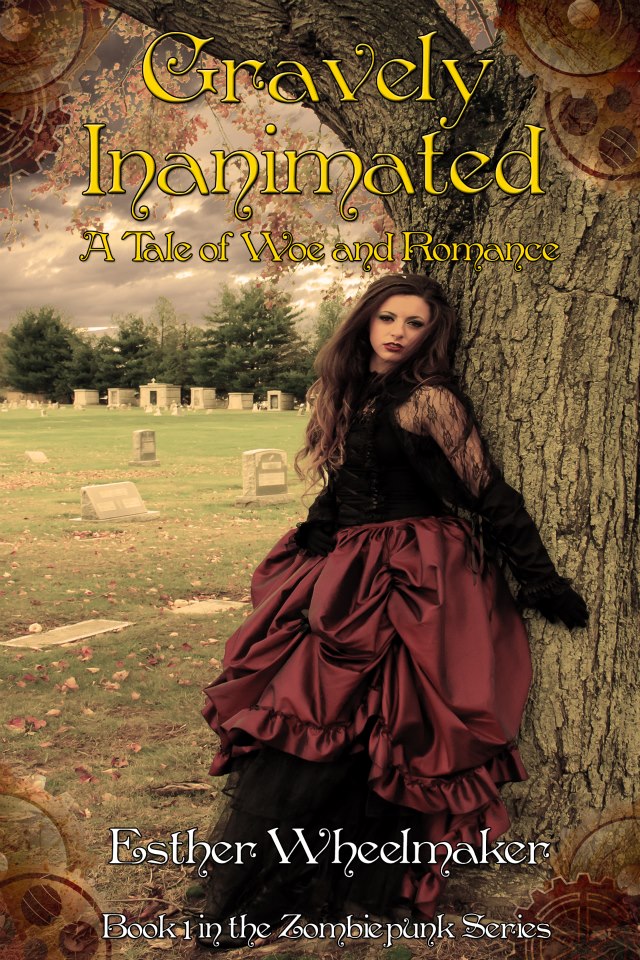
And so we step right into Gravely Inanimated, by Esther Wheelmaker, the first in a zombie-steampunk hybrid series. The author goes squarely into the zombie side of the horror-paranormal genre with this book, all the while putting her own spin on things. This is a good thing for me; normally I don't care for the zombie genre in film, television, or books, but when a good twist is added into the mix, it takes the theme in another direction entirely.

Lucille Knight is a young woman in Victorian England, though it's a very different England than the one we know from history books. In this world, the dead have been walking the earth for years, rumored to be the workings of a voodoo queen. Queen Victoria's armies do their best to keep the zombies at bay, as does an esteemed inventor, whose mechanical marvels and weapons, some of which are called automatons, are quite adept at zombie killing. 

We meet Lucy in the midst of trouble, on her way home in the evening when she is pursued by a pack of zombies. She is saved by a mysterious man calling himself Aeron, a masked fighter with a particular talent for bringing down the walking dead. She finds herself both drawn to and annoyed by her rescuer, and we begin to get to know her as a person; her relationship with her widowed father, who seems more anxious to see her married off to a respectable suitor, her close bond with her best friend Emily, and the fact that Lucy has been burned in love before. Burned is a vast understatement, all told. The cad and his new wife turn up in the book, and one feels compelled to strangle the jerk.

Lucy concerns herself more with her own amusements early on, and at a restaurant- and then a social party- meets Lord Garrett Ashdown, son of the Countess and the Earl Ashdown. The Earl is the aforementioned inventor, a genius with steampowered engineering, automated devices, and weaponry. The Countess at first seems emotionally distant. Garrett himself is a dashing and charming fellow, drawing Lucy's attention.

A pivotal moment changes everything, and Lucy finds herself given a new purpose in the wake of a tragedy, learning the ways of how to fight zombies. The book explores her growth as a character, her transition from being a society belle to a role she would have never expected. The bonds and relationships she has change fundamentally over the course of the book, and the changes she undergoes really form the core of the book.

As mentioned before, I don't normally care for the zombie genre... and yet in this case it works. Instead of the usual dystopian future of the genre, the author is wise to take us back in time and tell the story there. It's a good twist on the genre. And incorporating steampunk elements into the story is another good twist. The technology made by the Earl Ashdown feels both plausible in a Victorian era, and also feels capable of the task that it's required to undertake. And the author understands the essentials in the genre. Her zombie sequences have the attention to detail, the horrific and the dreadful as the hordes of walking dead advance on key characters or the passerby. There's not an excess of it, but just enough; it's grisly without being gory. By extension, the previously mentioned voodoo queen does finally turn up in the book, in control of the zombie hordes. The author wisely conceals the voodoo queen when the reader finally meet her, giving us shadowy glimpses, really, never quite the entire picture. She leaves that to our imagination, which when horror is done properly is much more effective.

Characterization throughout the book is strongly rendered. I felt sympathetic to Lucy very early on, when the writer shows us the circumstances of how she was badly hurt in love. Her transition from society belle to a fighter against the zombie curse is paced well, with her character developing naturally throughout. It never feels forced. She has a sparkling personality that undergoes trials, but that spark never goes out.

Emily is a character that's very likeable; she has a fierce loyalty and a bit of what in the current day we'd call a smartass personality. Lucy's father is an enigma, distant at times and cold... though it also makes him come across as authentic, particularly after a painful tragedy.

As the reader gets to know more about the Ashdowns, the characters come into their own. The Countess is initially hard to pin down, rather distant, but slowly the layers are revealed, and the reader gets to understand what makes her the way she is, and gets to like her. Earl Ashdown, the Inventor, is wonderfully eccentric. And Garrett himself is a charming sort of rogue with manners... and a few secrets. The bond that gradually forms between he and Lucille works well, developing at just the right pace.

Gravely Inanimated does a splendid job mixing together the zombies of horror with the tech of the steampunk genre in a Victorian world rather unlike our own. It's the first of a series, and while it brings its story to a close, it also leaves room for future revisitings. There's well drawn action, good characterization, a sense of humour, and a dash of romantic passion thrown in for good measure. As someone who'd normally avoid zombies in my fiction tastes, I enjoyed it.

***

You can find Gravely Inanimated at Amazon.com as an ebook for Kindle.


Monday, April 1, 2013

Extended Families And Lone Wolves

"People are pretty forgiving when it comes to other people's families. The only family that ever horrifies you is your own." ~ Douglas Coupland

"Insanity runs in my family. It practically gallops." ~ Cary Grant

"Blood relatives often have nothing to do with family, and similarly, family is about who you choose to make your life with." ~ Oliver Hudson

"The other night I ate at a real nice family restaurant. Every table had an argument going." ~ George Carlin

"Family quarrels are bitter things. They don't go according to any rules. They're not like aches or wounds. They're more like splits in the skin that won't heal because there's not enough material." ~ F. Scott Fitzgerald


Yes, I know. It's April Fool's Day, and you might have thought, surely William will mark it with some splash of inappropriate humour, right? Well, no, not really. Today I'm going to pull an April Fool's joke by being serious. Though I can direct you over to our joint blog, where we did precisely that, marking the day with a Without A Word image blog. Head on over and take a look.

Today I thought I'd touch base on a few things writing wise. One of the blogs I follow is from JE Fritz. At Still Writing, she often blogs about word origins, and back in March, she was writing about the origins of the letter N. It seems that in its earliest roots, the letter was symbolized as nahas. Incidentally, that word also means snake. This surprised me, of course. You see, in Heaven & Hell, one of my characters has the surname Nahas. He's a Palestinian politician, who's an exceedingly rare thing for someone of that profession: an inherently decent and honourable man. Whose name means snake. Oh well. Too late to change it now, right?

Another blogger I follow, Tracy Krauss, posted back in March a writing exercise that I liked. Check out that link for her original look at this. I'll paraphrase the terms she's used...

1. Think of the story you have written or are writing, and define it with a single word.

I'll cheat here a bit by saying that I'll use two words, but they're bound together. For my protagonists, the events of Heaven & Hell are about justice. For the antagonists, the story is one of revenge.

2. Focus in on this by asking a question about that word. The question ought to be as specific as possible.

Where is the fine line between revenge and justice? Can a terrible wrong be made worse by giving in to vengeance?

3. What is the answer to that question? This is the message or idea the reader's going to take away from your book or story.

This has been a theme that's shown itself through the book time and again as I've written and revised. For my protagonists, justice is about stopping a greater evil, defusing a crisis, even if that requires violence. For my antagonists, violence is a tool to indulge their anger, their need for revenge. Justice is restorative. Vengeance is destructive.


I've been reading a novel by Carla Neggers lately. That Night On Thistle Lane is a romance with a dash of mystery to it, set in New England, in a small town called Knights Bridge. She's written about this place before, and characters from that book turn up here again, though in this book another couple finding their way together take the forefront of the novel. I was first introduced to Carla's work through Norma, and have read quite a bit of her novels since. One of the things that she often uses in her novels is the theme of family- mostly family by blood, but also the friendships that form close enough to count as family. As an author, it allows you to continue to use the same settings and characters in future books if you like (with this book, she has twin sisters who could always turn up in future books of her own). It's been typical of her earlier books, where family dynamics play a big role in the relationships Carla writes. It would seem to be a reflection of her own life, as from everything I've seen of her online, she seems to have a large, close family.

I contrast that sense of family bonds in her work with my own work, which I would use the term lone wolf for. In Heaven & Hell, my two spy protagonists, Tom Stryker and Meredith Devon, are both only children. Stryker's parents are deceased, and he has no other family. Devon's father is dead; relations between she and her mother are strained. Her mother doesn't particularly approve of her profession, but that's just the surface of things, which I'll no doubt explore in future books. It leads me back, so to speak, to the recent James Bond film Skyfall, with the observation of how orphans seem to make good spies. Bond lost his parents years ago, and the loss hardened him. The film fleshes out that background, giving us more insight into the man. Likewise, in my work, Stryker is an orphan, and for all intents and purposes, so is Devon. These are two people who have been stripped of family, alone in the world. They're lone wolves.

This also reflects itself in our joint work in Same Time Tomorrow. There I write the point of view of our male protagonist, Gabriel Miller. He's an orphan too, his parents killed by a drunk driver when he was eighteen. In the book, his closest family is his grandmother Bridget; his friendships form the rest of his family. Our female protagonist, Chloe Masters, whose point of view is written by my partner in crime Norma, is also an only child, her father no longer part of the picture, her mother facing a crisis. Both of these characters have something of that lone wolf sensibility about them, the lack of extended family. It's a touch we extend to some of the supporting characters in the book; Dana Butler, Chloe's best friend, never speaks of family, so there's a friction where that's concerned. Olivia Shaw, Gabriel's close friend, is an only child and orphan whose parents were emotionally distant. And Rachel Mitchell, Olivia's fiancee, has been disowned by her family when she came out of the closet. What family ties these characters lack, they make up for by making family of the people they choose to consider as such.

I know where this comes from, of course. A good dose of who we are as people works its way into our writing. I think having characters who are isolated in terms of family dynamics is reflected in part from my own family history. No, I'm not an orphan, and I do get along with my parents. Sibling relationships are a different story, however, and that's why only children seem to be a recurring theme in my writing. I've come to think that family can be the people you're closest to and who you choose to think of as family, even if that relationship is based in friendship. It doesn't always mean those you were brought up with. Sometimes you can be hurt the worst by those you were brought up with. These past two years, I've had to learn that the hard way. Cathartic moment coming. Ready? Here we go.

I have from time to time referenced the strained relationship where my sisters are concerned, more often than not in comments in other blogs. Two and a half years ago, they did something awful to my parents, and never apologized. It was the last straw after years of keeping my mouth shut to keep the peace in the family, years of patiently putting up with their barbs and thorny personalities, years of the less than savoury men in their lives (we're talking complete sleaze, racists, alcoholics, just the real dregs of society). Where one used hard words like a blunt sledgehammer, the other was more likely to use her words like a dagger, stabbing deep. The effect of their words was the same: painful. It amounted to verbal abuse and bullying. And I internalized all of it, and when that last straw happened, all of the negativity and resentments I'd kept in check came pouring out. I ended up in a very dark place; I hit rock bottom, but that's what I needed to seek out help.

You can only be hurt so many times before you say enough. No more. My sisters have never done the slightest thing to make amends to my parents, and now so much time has gone by that it would just feel hollow. I can't trust them not to do something equally awful someday. They remain the same bitter, vindictive, toxic people they were. And the cost of letting them in is more than I can bear. So the end result is that I have no more sisters. They're strangers to me. 

I'm in a better place now. They'll never change, and I've dramatically lowered my expectations that they ever will. It's not going to happen. I do have some good sibling dynamics. My brothers and I get along quite well, and the same applies to my sisters-in-law. Still, all those years of walking on proverbial eggshells, biting my tongue, and hiding the effects of that verbal abuse took its toll, and it reflects itself in my writing lone wolf characters. It's wishful thinking, I'd say, writing characters without siblings. Strained families in my fiction are influenced by my own strained sibling dynamics. The good thing about writing.... it's cathartic.

Lots to get off my chest. Thanks for letting me vent. Now you're no doubt thinking, "he's like that???"


Saturday, March 30, 2013

Revenge Of The Easter Bunny


"Answer the question, damn it. Where are the Easter eggs?"

"Look, Doc, you've got it all wrong. I'm not the Easter Bunny. I'm Bugs Bunny. You know, eater of carrots, annoyer of Elmer and Yosemite Sam, beloved by millions? I don't spend my time delivering Easter eggs. You're looking for some other rabbit. Now why don't you just let me go and we'll forget this ever happened?"

"Shut up and answer the question!"

"How am I supposed to answer a question when you're telling me to shut up? I knew I should have taken a left turn at Kansas City."

"What's this about Kansas City? Is that where the eggs are hidden? Tell me! Tell me!!!"

"Doc, you've gotta calm down. Really, you're going to give yourself a heart attack."

"I've had forty seven of those already."

"You remind me of Elmer. Anger management issues, bald... though you don't have a speech impediment."

"Stop distracting me with complete asides! Where are the Easter eggs, or do I start getting nasty?"

"You weren't already being nasty? What a maroon."

"Maroon? What's that? Codeword for destroying the country? Not on my watch!"

"Doc, you seriously need help. I mean padded walls, sedation, and therapists around the clock help."

~ taken from transcripts of an interrogation between Bugs Bunny and Dick Cheney, 2006


Yes, I know. I'm silly.

Well, it's that time of year again. Easter weekend is here, and of course I couldn't let it pass without comment. When you're through here, have a look at our joint blog, where our alter egos carry out more tomfoolery related to the day. We really couldn't resist getting a bit carried away with ourselves, by the way.

I thought I'd mark the occasion here with pics, editorial cartoons, and various nonsense (it's me, what did you expect?). Enjoy, and have a great Easter!