Faith Can Move Mountains... But Dynamite Works Better
Showing posts with label Laura Dern. Show all posts

Thursday, December 21, 2017

Pouting On A Galactic Scale


“The Empire, your parents, the resistance, the Sith, the Jedi… let the past die. Kill it, if you have to. That’s the only way to become what you are meant to be.” ~ Kylo Ren

“When I found you, I saw raw, untamed power. And beyond that, something special.” ~ Snoke

“The greatest teacher, failure is.” ~ Yoda

“I was raised to fight. For the first time I have something to fight for.” ~ Finn

“We are the spark, that will light the fire that’ll burn the First Order down.” ~ Poe Dameron

“I need someone to show me my place in all this.” ~ Rey

“Wipe that nervous expression off your face, Threepio.” ~ Leia Organa

“The Rebellion is reborn today. The war is just beginning. And I will not be the last Jedi.” ~ Luke Skywalker
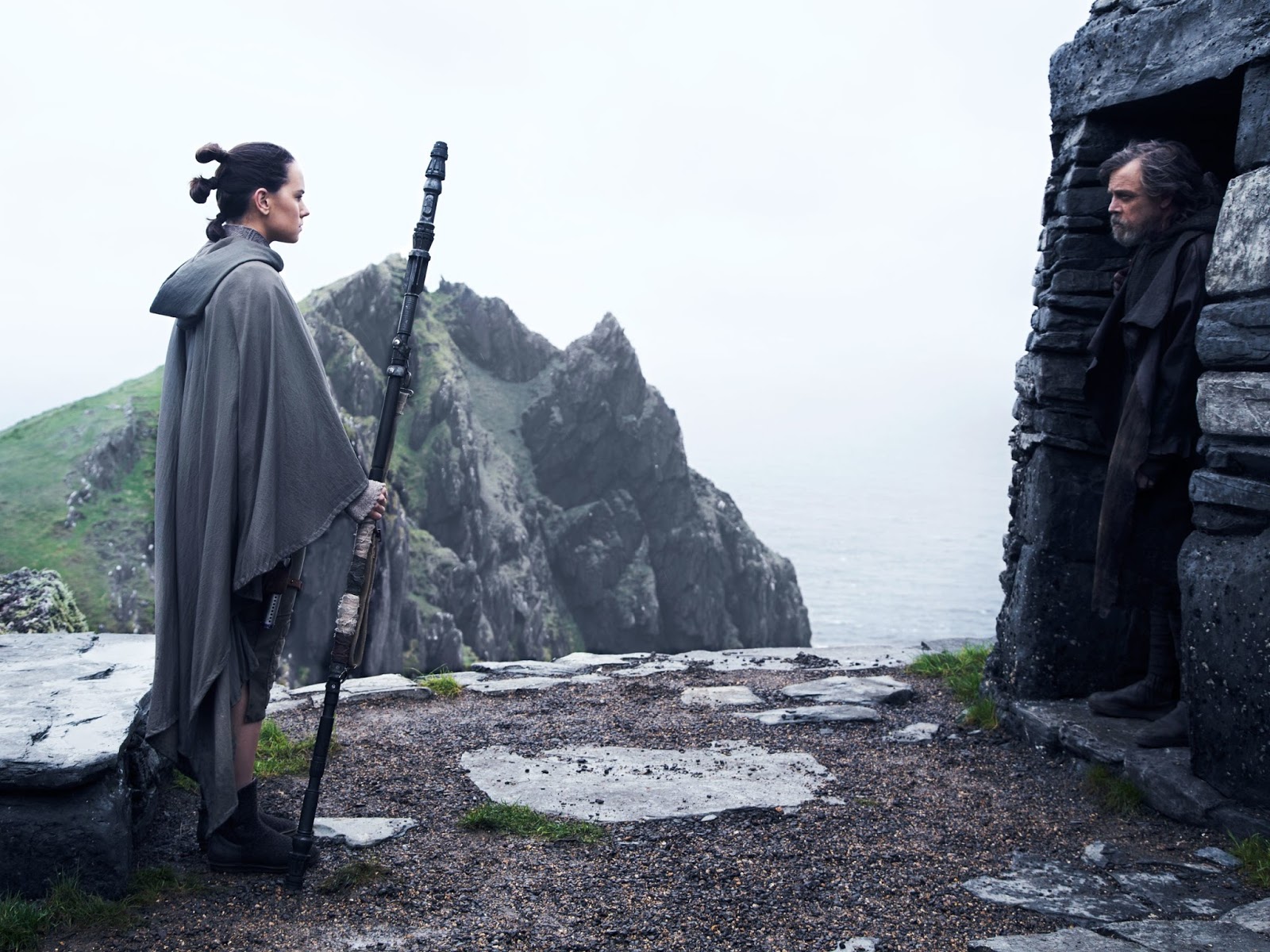

Star Wars: The Last Jedi is in theatres, the second part in the current trilogy pitting the Rebels and the light side of the Force against the darkness of the First Order and the Sith. Picking up where The Force Awakens, the film advances the storyline, weaves in action, humour, and nostalgia, brings back familiar faces, and increases the tensions of a galaxy long ago and far, far away. Setting its characters on different journeys meant to converge together (not unlike the original trilogy’s second act The Empire Strikes Back), the film proves to be entertaining by the time it all ends.


The film follows its characters on different paths when we first catch up with them. Rey (Daisy Ridley) has found the old Jedi master Luke Skywalker (Mark Hamill) in his place of self-exile, trying to bring him back to the cause of the Resistance and learn about the ways of the Force. Leia (Carrie Fisher) is rallying the Resistance, which is under attack from the First Order. Poe Dameron (Oscar Isaac), Finn (John Boyega), the droid BB-8, and a Resistance mechanic, Rose Tico (Kelly Marie Tran) take an unauthorized mission on in the wake of events. And Kylo Ren (Adam Driver) contends with the will of his dark master Snoke (Andy Serkis) and the ambitions of his First Order rival General Hux (Domhnall Gleeson).


Rian Johnson (Looper) came aboard as writer and director for this second chapter in the trilogy, and it turns out to be a wise choice. A fan of the franchise and what’s come before, his story builds on what has already happened and takes it in new directions. The tone of the story mixes together military intrigue, special operations, a spit in the face bravado on the part of some characters and a melancholy despair on the part of others, themes of temptation and the line between light and dark, and strong characterization in its key players, giving them depth as the story goes along, even in surprising directions. Johnson’s story feels firmly grounded in the mythos and philosophies of the Star Wars universe, and it flows well throughout, as we weave in and out of the different plotlines.


Having the same person write and direct turned out to be wise as well. Johnson gets the best out of his actors as he goes along, maintaining the right balance between what the cast has to do and the CGI special effects that form their backdrop in much of the film (something that was problematic for George Lucas in the prequel trilogy at times). The production crew really does well at bringing new worlds and new characters to life, drawing out of an extensive established framework for some of the story, but giving the audience new species and new backdrops that mesh well with the established continuity. 


This shows itself in costume design, set design, equipment and vehicles for both sides… and the unbearably cute Porgs that end up in the film (think along the lines of fluffy pigeons with the biggest eyes imaginable). The already well established CGI of Lucasfilm handles the special effects exceedingly well throughout, and composer John Williams, who’s been doing this for quite awhile now, gives us another score in his repertoire that successfully builds on what has come before in the franchise, while adding on new thematic material as he goes. It’s a score that stands out well on its own, which you expect out of the best composer in the film music industry.


The cast are well chosen in their roles, and some of them are newcomers to the Star Wars world. Benicio Del Toro has made a career out of playing character roles that feature shades of grey morality, and that features into how he plays the codebreaker DJ, a man who plays the knife edge between two factions and is loyal more or less only to himself. Laura Dern appears as a Resistance admiral, Amilyn Holdo, a colleague of Leia whose instincts at a critical time are in want, but who conveys principles in her decisions. Kelly Marie Tran’s role as Rose is a compelling one- we get a character who earlier in the franchise would have just had a five second appearance and instead gets fleshed out as a full character. She’s a mechanic who is drawn into the larger story and comes into her own. The actress makes the most of her, to the point where we want to see more of her as time goes on.


The previously established villains are back. Gwendoline Christie plays the storm trooper commander Captain Phasma again, conveying a ruthless and cranky energy in her performance throughout. She’s suitably irritable (especially about a wayward deserter crossing her path after the events of the first film) and someone not to be trifled with. Domhnall Gleeson returns as the ambitious General Hux, the First Order commander whose priorities waver between loyalties to his leader and his own place in the galaxy. The actor gives him an arrogant, unpleasant quality that fits with his established persona. Andy Serkis, who’s made a career out of body capture performance, returns as the supreme leader Snoke, a repugnantly evil villain with no redeeming qualities. Serkis makes him a worthy counterpart to the late Emperor Palpatine.


Adam Driver returns as Kylo Ren, the son of Leia Organa and the late Han Solo, once a Jedi in training, now consumed by the darkness. He pouts and schemes, proves to be ruthless and relentless in battle, and yet there are moments when we see him in a different light- as someone who might have the chance to pull away from the darkness, when hints of humanity pull at him. And yet he chooses the wrong path time and again. Pouting or not, the actor makes him a compelling villain, one that you can jeer at one moment and feel empathy for the next.


Two faces return, of course, but one of them with a fresh actor in the role. Anthony Daniels has been playing C-3P0 in all of these films from the start, and he returns yet again as the fussy, anxiety prone protocol droid, mostly spending his days in headquarters and fretting endlessly. It’s a character that would drive you nuts to know personally, but Threepio provides some of the humour in the film in how he copes (or doesn’t cope) with rising tensions. Chewbacca returns as well, but now played by a different actor. Joonas Suomato, a basketball player turned actor, did some of the action work for the Wookie in The Force Awakens. The originator of the role, Peter Mayhew, listed in the credits as a consultant for the character, has retired from the role over chronic pains. Suomato is the requisite height, and since the actor gets buried under fur and prosthetic makeup, it doesn’t particularly matter that it’s a new actor. The character is as cranky as ever- but carries the weight of grief over the death of his friend Han in the previous film, something the actor brings across.


John Boyega started out this trilogy as Finn, the deserter storm trooper who finds himself caught up in the battle against that which he was loyal to, struggling to find his path. His take on Finn this time out is one of more certainty and resolve as the character has allowed his conscience to guide his path. He takes the initiative, steps into risks, and finds himself willing to give his life in service of a greater good. It’s a good nod of growth for the character, and the actor makes him interesting to watch. I do like the rapport he particularly has with Rose as the story unfolds.


Oscar Isaac has done a great deal of work in various films in recent years, and I do like his take on Poe Dameron, the ace Resistance pilot. There’s a hint of swagger and cockiness in the character, something you might expect in his profession, but at the same time it’s tempered by resolve and responsibility for those under his command. He’s loyal to a fault, but not blind, willing to do things that bend or break the rules if it helps save the day, and some of the humour of the film comes from Poe- and how he interacts with friend and foe alike.


Watching this film is tinted with sadness, because you’re watching Carrie Fisher’s final role and final take as Leia. She passed away after filming was complete, and that has an impact in the way you see her final performance. There’s a whole lot of sadness in the character, and for good reason: the love of her life has just died, at the hands of their son. And yet Fisher gives the character the strength and willpower one is used to throughout her take on Leia, the determined leader who people naturally look to for guidance. She invests herself in the role, and thus her Leia is the most poignant take of the cast.


Daisy Ridley has taken on the role of the orphan Rey (who happens to be quite strong with the Force) and made it her own. A strong character, Rey is trying to understand her place in the galaxy, even as she has come to accept it without quite understanding it. Ridley gives the character a stubborn, fiercely loyal quality, and an underlying sense of empathy and compassion that makes her compelling to watch. Rey is a wonderful character to watch, the cornerstone of this trilogy, and Ridley keeps her grounded, reminds the viewer of her basic decency, and makes us root for her.


Mark Hamill has an interesting take on his signature role of Luke Skywalker, having had appeared briefly in the last film looking like he’d just woken up from a thirty year nap. He has retreated away from the galaxy and its struggles, a disillusioned Jedi who blames himself for how things have gone wrong and has been punishing himself ever since. He is in many ways a broken man, but not completely; it is the student who draws her teacher out of his despair and reminds him of who he is. It’s a completely different take on Luke, who is the reluctant teacher, reinvesting himself back in the cause.


The Last Jedi takes the mythos that is Star Wars in brand new directions, some of it dark and tense, some of it lighter and hopeful. The cast is splendidly chosen, inhabiting their roles and developing their characters all the more as they go along. There’s a great deal of poignancy in the film too, all while the viewer deals with space dogfights between fighters and strange new creatures. All while blessedly shielding us from ever seeing a trace of Jar Jar Binks again.

Monday, June 8, 2015

This Is What You Get For Trusting Newman

With Jurassic World soon to show up in theatres, I thought I would review the first two films in the franchise here. This is the first, of course, and it's in fact a fresh review (looking at the tags, I've reviewed this movie before!) 


“John, the kind of control you’re attempting simply is... it’s not possible. If there’s anything the history of evolution has taught us it’s that life will not be contained. Life breaks free. It expands to new horizons and crashes through barriers, painfully, maybe even dangerously, but, uh...well, there it is.” ~ Ian Malcolm

“God creates dinosaurs. God destroys dinosaurs. God creates man. Man destroys God. Man creates dinosaurs.” ~ Ian Malcolm 
“Dinosaurs eat man, woman inherits the earth.” ~ Ellie Sattler

“All major theme parks have delays. When they opened Disneyland in 1956, nothing worked.” ~ John Hammond  
“Yeah, but John, if the Pirates of the Caribbean break down, the pirates don’t eat the tourists.” ~ Ian Malcolm

“Well, the question is, how can you know anything about an extinct ecosystem? And therefore, how could you ever assume you can control it? You have plants in this building that are poisonous. You picked them because they look good. But they are aggressive living things that have no idea what century they’re living in, and they’ll defend themselves, violently if necessary.” ~ Ellie Sattler

“The world has just changed so radically, and we’re all running to catch up. I don’t want to jump to any conclusions, but look... dinosaurs and man, two species separated by 65 million years of evolution have just suddenly been thrown back into the mix together. How can we possibly have the slightest idea what to expect?” ~ Alan Grant

In 1993, director Steven Spielberg brought a big screen adaptation of Michael Crichton’s novel Jurassic Park to theatres, a film that got wide critical acclaim and huge box office appeal. The film brings visitors to a theme park island in the making, where cloned dinosaurs are the feature attraction, and of course things go badly wrong. With a wealth of special effects that looked convincingly real- the dinosaurs do in fact look like they’re occupying the same space as the human actors- the film was a landmark adventure tale that still managed to give us strongly written  and acted characters, and a story that grounded itself firmly in questions of ethics and science.

The film opens with a grisly death of a worker, though what it is that kills him is barely glimpsed. The park’s owner must bring in experts to sign off on the facility, and so John Hammond (Richard Attenborough) seeks out a paleontologist, Alan Grant (Sam Neill), and a paleobotonist, Ellie Sattler (Laura Dern). They’re on a dig when we first meet them, and they’re a couple. Hammond persuades them to come to his island for a weekend, holding back what the island contains, but eager to have them see what he has in store. Hammond has to deal with a company attorney, Gennaro (Martin Ferrero), who’s brought in a chaos-theorist mathematician, Ian Malcolm (Jeff Goldblum) as an opposing voice.


The group reach the island, where they see what lives there- and we see as well for the first time. Dinosaurs, alive and thriving, 65 million years after their extinction, live on the island. Hammond reveals his method for their resurrection at the visitor’s centre, which troubles all three academics, each of them bringing up grave concerns about the ethics of cloning dinosaurs. Hammond’s grandchildren Lexie (Ariana Richards) and Tim (Joseph Mazzello) are also present, and the experts and the children end up going out on a tour of the park in full. It doesn’t take long before things start to go wrong.


Crichton and David Koepp adapted the screenplay, which differs significantly from the novel in places, particularly in terms of character personalities and fates, also cutting down on the exposition Crichton was notorious for. The method of explaining the process, for instance, is presented in an animated film, which flows much better than having a scientist lecture at length about genetic cloning. And while the story is very much an adventure with thrills and laughs... it’s also grounded in the question of scientific debate over ethics. Mary Shelley wrote about the ethics of creating life in the wrong way two centuries ago, and the questions she brought up apply today in real life and in science fiction. It’s an examination that looms over this film, and the experts brought in to sign off on the park are the ones raising those concerns most strongly. Malcolm points out that Hammond’s team didn’t do all the work- they co-opted the work of others, stood on the shoulders of others, and ended up going through with this venture more because they were consumed with whether or not they could do it that they never stopped to ask if they should. Asking that kind of hard question ends up making for a compelling story, and the film never backs away from it.


Spielberg has a gift as a director for spectacle (something that’s not that uncommon with the Hammond character, who at heart is something of a showman). His crew in this film worked wonders, and it’s the special effects from that side of things that really stand out. When he made Jaws, he was beset with technical problems with the mechanical shark used for the film, and shot a good part of the film with mere glimpses or from the shark’s point of view to compensate- and thus drove up the tension until at last we saw the shark. Some of the same elements come into play here. We don’t see the raptors at first- they’re mentioned in passing by Grant to scare an obnoxious child at his dig site, and we hear them in a pen when they’re fed, but not seen until it’s the right moment to show them. The same applies to the tyrannosaurus rex, which we don’t see when first expected, and then finally seen in a big way in a rainstorm. It’s one hell of an entrance.


Back in the day, Ray Harryhausen spent most of his time doing stop-motion creature effects in many films, particularly dealing with mythology. He was good at what he did, but when you look at those films, you don’t really believe the hero is in the same space as that gigantic thing. Computerized special effects had advanced in the late 80s to the point where that was about to change. Take a look at James Cameron’s film The Abyss, for instance, and the otherworldly alien beings in that film look completely unlike anything you’d find on Earth- and yet appear to occupy the same space with the actors. The same applied with Cameron’s Terminator 2: Judgment Day, which featured a terminator who could change appearance and whose shape could form liquids and solid weapons- the CGI was so good that the threshold had been crossed; there was no sense of disconnect between actor and special effect. The same qualities came across in Jurassic Park- the dinosaurs look so real, seem to occupy the same space as the actors, and behave and move like living organisms.


Spielberg’s touches as a director are clear throughout the film. He’s gifted in adventure films in particular, and that comes across here, both in how he shoots the film (location shooting was done in Hawaii) and how the story progresses. He’s given to the occasional use of humour- casting Goldblum gives a lot of that, while the fate of the lawyer, while grisly, is rather amusing (particularly if you, like most people, hate lawyers). Another director might well have dropped the kids out of the story, though Spielberg keeps them (and they’re not annoying kids, like you might get if, oh, Haley Joel Osment or Macauley Culkin had been cast) in the story, something we’ve seen in a number of his films. He’s also given to scaring the audience on frequent occasions, the right thing in a movie with out of control dinosaurs. His frequent collaborator John Williams came back to compose the score, a mix of excitement, awe, and terror through the music.


The cast were all well chosen. Martin Ferrero might be a nice guy in person, but here he plays the attorney Gennaro as something of a spineless weasel, a lawyer who gives lawyers a bad name. The character’s not likable at all, only seeing in shades of dollar signs and liabilities.  Samuel L. Jackson wasn’t quite yet known at the time, but on the edge of stardom. He was cast as Ray Arnold, the chief engineer of the park, and he plays the role with cynicism and yet also a professional sensibility. Bob Peck plays the chief warden, Robert Muldoon, something of a precursor to Pete Postlethwaite’s character in the follow up film. Muldoon is a serious hunter with an instinct for the behaviour of the animals in the park, a no-nonsense tough character, and Peck certainly plays him that way. Wayne Knight, who’s known primarily for this role and as Newman on the Seinfeld series, plays computer expert Dennis Nedry as a pure weasel, a sarcastic opportunist out for himself. Nedry is an unpleasant person, and he gets what he deserves- he’s not unlike Knight’s other famous role. It’s a sharp contrast, for instance, to a character he played in Kenneth Branagh’s film noir Dead Again, in which he played a genuinely likable character.


The kids, as mentioned before, are not at all irritating. The script changed things between the two from the novel. Ariana Richards plays Lex as serious minded and interested in computers, the big sister who’s wise beyond her years. Joseph Mazzello gets to be the over talkative Tim, fascinated by dinosaurs (all kids generally are, but this boy seems to know everything about them. He’s curious to the point of obliviousness to risk. The two characters are good foils to Alan, who doesn’t particularly care for children (I can relate to that), and yet finds himself protecting them when things go terribly wrong in the park.


Richard Attenborough hadn’t acted in a film in years before this film came along, having had moved into directing instead. John Hammond is significantly different from the novel, in which he’s a callous businessman, and the film presents him as an amiable billionaire showman of sorts, big on dreams and oblivious to the ethical concerns about his project. He sees himself as a modern day Walt Disney, with ambitions for a theme park that’ll outdo anything before it. He’s so obsessed with the notion of the grand show that he doesn’t heed the warnings coming from others... but at least by film’s end, he’s learned a hard lesson. It’s a compelling character, this kindly old grandfather, and you can’t help but like him, even while shaking your head at his methods.


Jeff Goldblum gets some of the best lines of the film as Ian Malcolm. Hammond refers to him as a rock star instead of a scientist, and there’s something to that. The character’s cocky and has attitude. Ian is eccentric to say the least, a show off and a flirt. And yet beneath all that are solid principles and an ethical core. He voices his objections most strongly of the three experts brought in, and seems resolute in the face of danger. After a narrow escape from a rampaging tyrannosaurus rex, he asks if they might have that on the usual park tour. He delivers the line in a way that gets just the right reaction, something that occurs time and time again with his dialogue.


Laura Dern brings an innate curiousity to her role as Ellie. She’s a bright scientist with strong principles and a sense of humour, and even in the face of a situation going terribly wrong, she doesn’t panic. Ellie is a character who can take care of herself, and Dern plays to that. And her relationship with Alan seems grounded and real. These two love and respect each other (I have no idea why someone decided they should have broken up before the third film), and that shows itself in how they relate. They’re comfortable enough with each other to tease each other- Ellie saddling him with having the kids around when she knows he doesn’t care for kids is a good example.


Sam Neill gets the lead, and Alan’s a compelling character. He’s a bit gruff, doesn’t have much patience where kids are concerned, but also smart and is calm in the face of danger. Grant’s sense of ethics are strong too- like Ian and Ellie, he expresses grave concerns about the island and the notion of tampering with life itself. Put into life threatening peril, he comes into his own, showing how resourceful he is. And while he might have serious ethical concerns about the notion of cloning these animals, there’s also the enthusiastic side of him to actually be around these animals- his astonishment at seeing them for the first time and his reaction to being able to touch a triceratops convey that.

Jurassic Park set a new bar for adventure films when it came out. It’s a rousing adventure that still manages to bring forward questions of ethics when tampering with the building blocks of life. The film remains a pleasure to watch, giving the audience a hint of what it might be like to walk the same ground as a dinosaur.

Plus we get the distinct pleasure of seeing a dirtbag or two meet very bad ends.


Monday, April 8, 2013

Jurassic Park: Or, How Newman Ruined Everything


"See, the movie is about this genius computer programmer. Guy by the name of Dennis. Works for this eccentric businessman who's opening up a theme park on an island. Not a Disney sort of theme park. Well, for one thing, this businessman isn't evil like Walt was. Just misguided. He doesn't really appreciate everything Dennis does for him, and he's a bit sanctimonious about it. For another, the theme park involves cloning dinosaurs. Hey, trust me, we'll make a fortune marketing this one to the kids, right? Kids love dinosaurs. Well, Dennis is our hero, but he's a guy with money problems. So he gets this idea about how to score a big payday, but it's going to take some huge risks. That's just the kind of guy Dennis is. Real stand-up fellow, sort of guy who won't let you down. So what do you think?" ~ early pitch to the studios by Steven Spielberg for Jurassic Park, 1991.


Dennis Nedry, the real hero of Jurassic Park

When I was a child, on occasion I'd go to the Royal Ontario Museum in Toronto. There they had (and still have) a collection of dinosaur fossils and reproductions on display. The sense of awe and wonder I got from seeing that stayed with me, because these days I can still walk into the Museum of Nature in my home town, check out the fossil gallery, and be humbled by the notion of reaching back through time and seeing these creatures that once walked the earth.

Twenty years ago, director Steven Spielberg, who had already long since established a record with action, epic spectacle films, changed the face of moviemaking with Jurassic Park. Based on the novel by Michael Crichton, the film tells the story of a planned theme park on a tropical island where instead of rides... the attractions are dinosaurs. Businessman John Hammond (Sir Richard Attenborough) and his team of scientists have found a way to clone dinosaurs, and he believes the concept will draw visitors from around the world. His investors are nervous, and so he brings in professionals to help him get the project finally approved. Two of them work in the field of paleontology, Doctors Alan Grant and Ellie Sattler (Sam Neill and Laura Dern). Another is a mathematician, a chaos theorist with a flirtatious streak and a tendency to talk a lot, Doctor Ian Malcolm (Jeff Goldblum).


The group arrive on the island, in the company of an overly anxious attorney (Martin Ferrero, soon to meet an untimely demise) and are quickly whisked off into the interior. There the visitors see what Hammond has done for the first time, and we as an audience see it too for the first time: brachiosaur dinosaurs eating. The sheer awe of both Alan and Ellie is something we share: unlike the traditional stop motion tactic of Ray Harryhausen, most of these dinosaurs through the film (with largely the exception of an animatronic or two) are CGI creations, and yet they look so real. We're convinced the actors and the dinosaurs are sharing the same space, though our brains know that's not possible.

CGI had been used in earlier films, like The Abyss and Terminator 2, both films by James Cameron, though in those cases, the effects leaned towards the alien and the robot, concepts that were very much sci-fi in their setting. This time CGI was being used to depict something that had walked the earth once, and the effect of that first moment where we see the dinosaurs is stunning and utterly majestic, even after years of seeing the film, as fresh as the first time.


Hammond explains the technique to Alan, Ellie, and Malcolm, each of them deeply disturbed by the ethical violations and consequences of the science; Malcolm reminds Hammond that nature selected dinosaurs for extinction. They are sent out with Hammond's two grandchildren, Lex and Tim (Arianna Richards and Joseph Mazzello) into the park for a proper tour. Of course this being a movie, things start going very, very wrong. It never seemed to occur to Hammond and his team of scientists that just because they could do something automatically meant they should do that. The film unfolds as disaster strikes, both in the form of nature breaking through the fences of the island and in the form of human sabotage, caused by one Dennis Nedry (Wayne Knight, before he'd go on to annoy Jerry Seinfeld; side note: annoying Jerry Seinfeld is a noble cause).


The visual effects of the film remain as potent today as they were in 1993. The actors definitely seem to share the same space as these ancient creatures. The danger feels much more true than if animatronics or stop motion had been the relied upon special effect. When things go wrong on the island, the production values continue to pay off; an encounter with an angry tyrannosaurus rex and two cars remains a chilling sequence in the film. The raptors, smaller and yet ruthless hunters, are rendered well, stalking in places through the story where they were never meant to walk, and unnerving the audience. The film has been re-released as a 3D film to studios; avoid that if possible; unfortunately all of the theatres in my area were showing it in 3D. It's just a gratuitious thing that isn't needed, and if you're like me, you hate 3D. Hopefully someday the studios get the message and stop releasing in that infernal technology.


Spielberg shoots the film with his usual good standards in cinematography. Out in open plains on the island or in a jungle, we have commanding views and a sense of where we are. Inside dimly lit corridors or rooms as the film moves towards its conclusion and raptors hunt, we're still given enough light to see details, to feel the looming menace. Spielberg tends to be known for spectacle, and that's certainly the case with this film, but there's more. The story itself works better than the novel (it's been a long time since I've read it), and at the heart of it is an underlying debate about ethics, about how terribly a seemingly good idea can go wrong. The story never drags, allowing us to feel a sense of awe one moment, a sense of terror seemingly the next, and leaves us breathlessly entertained. And Spielberg's longtime collaborator John Williams offers up one of his best scores, a mixture of majesty and sweeping epic music that perfectly fits the subject matter.


Regardless of just how well the production values, special effects, and story are, it's really the cast that is the bedrock of the film. It starts with the smaller character roles. Wayne Knight is a weasel as Dennis, and deserves what he gets. Bob Peck plays a game warden in the park who's wary of the animals, knows just how dangerous they can be, how clever they are. Samuel L. Jackson (before he really hit it big) is a systems operator, typically cynical and jaded in his role. The kids, who have since grown up, keep the annoying kid syndrome (yes, it's a term) to a minimum. Arianna Richards, who in recent years has become an artist, is the wiser sister, finding herself in a trauma. Joseph Mazzello, all grown up now and recently co-starring in the miniseries The Pacific, starts off overly chatty, though he seems to quiet down after a couple of near death experiences.

Richard Attenborough has a long record as an actor and director on both sides of the Atlantic, and he inhabits the role of Hammond well. His take on the businessman is that of a showman, a tycoon utterly confident of his own abilities, and who sees all too late the error he's made. Jeff Goldblum as Malcolm steals the entire movie with some of the best lines, a talent he really has as an actor. As insufferably flirtatious and snarky as he can be, we can't help but like the character. And Sam Neill and Laura Dern make such appealing leads. They're grounded and so believeable as a couple, both strongly principled and yet so human at the same time. They're not perfect... but that makes them such good characters. Both of them are characters of personal strength and fortitude, and easy to like.  

Go and have a look at Jurassic Park in the theatres again. You'll enjoy it. Just try to avoid 3D. It's for your own good. Maybe we can train a raptor to attack anyone in the industry who advocates for 3D....


Early studio still for Jurassic Park IV