Faith Can Move Mountains... But Dynamite Works Better
Showing posts with label Steven Spielberg. Show all posts

Monday, August 24, 2015

We Should Feed Bruce Some Marketing Chimps


“I’m not going to waste my time arguing with a man lining up to be a hot lunch.” ~ Matt Hooper

“Y’know, the thing about a shark, he’s got lifeless eyes, black eyes, like a doll’s eyes. When he comes after ya, he doesn’t seem to be livin’ until he bites ya, and those black eyes roll over white... and then, aww, you hear that terrible high pitch screamin’, the ocean turns red, and in spite of all the poundin’ and the hollerin’, they all come in and rip ya to pieces.” ~ Quint

“You’re gonna need a bigger boat.” ~ Martin Brody


It’s been forty years since Jaws first arrived in cinemas, terrifying audiences with the tale of man versus nature and causing public relations nightmares for great white sharks. The adaptation of Peter Benchley’s novel about a small resort town dealing with the havoc caused by a shark has, like the book itself, become a classic, one that still creeps out the viewer on big screens or small screens. An early film by Steven Spielberg, it was the prototype of the summer blockbuster.


The fictional Amity Island in New England is the setting for the tale, a place highly dependent on tourist traffic during the summer so that the locals can get through the rest of the year. It’s an idyllic place when the film opens up, just before the summer season. A young woman is attacked off shore after a late night beach party, and the following day, police chief Martin Brody (Roy Scheider) and his deputy find her remains washed up on the beach. Upon learning the initial cause of death is a shark attack, Brody closes the beaches, but the town mayor, Larry Vaughn (Murray Hamilton), worried about the notion that the summer season could be ruined by news of a shark attack, overrules him, suggesting the death was caused by a boat propeller accident. Brody reluctantly goes along with it.


Another attack soon happens, and the townspeople find themselves stunned. A local grizzled fisherman, Quint (Robert Shaw) offers his services to kill the shark. An oceanographer is called in by Brody, arriving during the efforts by amateurs to collect on a bounty. Matt Hooper (Richard Dreyfuss) quickly confirms that despite the earlier white washing of the initial coroner’s find, the case was indeed a shark attack, and urges Brody and the mayor to take every possible step to close the beaches.


Benchley’s novel dealt with the themes of man versus nature contrasting with the politics and pressures of a small resort town. It did exceedingly well, and producers Richard Zanuck and David Brown snapped up film rights, having had already read the book before publication. Benchley, whose novels often followed stories out on the water, had a hand in adapting the book into a screenplay, along with Carl Gottlieb, who spent time during production on rewrites. Benchley even did a cameo in the film as a news reporter on the beach. There are significant changes from the book, such as some character dynamics, removal of subplots, and the fates of characters. Spielberg was brought in by Zanuck and Brown to direct, an interesting touch since one of his earliest films, Duel, had also touched on the idea of a relentless, unfeeling killer. This would be a different take on that concept, however.


Filming was done mainly around Martha’s Vineyard, and had its own issues- it was over budget and late. The mechanical shark, dubbed Bruce, had numerous issues and required much work. Spielberg compensated by working around it for most of the film, giving the viewer underwater shots from the shark’s point of view or suggesting the shark’s presence by a fin above the water- even the use of barrels to signify the shark’s presence was another such touch. In hindsight, it was the best thing that could have happened for the film, since we don’t even see the shark until late in the film, and when we do, it’s such a terrific shock. No matter how many times you see the film, you still feel a jolt as the beast surfaces behind Scheider while he’s throwing out chum on the water, and you still feel in awe as you see it swim past the boat. In having to deal with mechanical difficulties, the production made Spielberg direct more along the lines of Hitchcock, suggesting the terror than showing it, and drove the suspense up all the better.


Part of that suspense also comes from the film score by the great John Williams, which earned the composer an Oscar. The simple two note alternating pattern main theme comes to play throughout the film, associated with the shark. The theme is relentless and primal, and sends a chill down the spine anytime one listens to it. It’s unsettling- which makes it work so well. If you’re of a devious mindset, play that music out on the beach on a busy day and see how many people rush back onto land.


The cast are all very well chosen. Murray Hamilton as Mayor Vaughn is not a terribly likeable person- though he wants to be. He’s more concerned with the town’s image at first, terrified of the notion of the slightest bad publicity on the tourist business the town depends on. He’s not above arm twisting and doing the underhanded things a politician would do to keep such things out of the light- we can see that in the way the medical examiner quickly changes his judgment on the first attack. Vaughn’s what you would expect out of such a man: fixated on one thing so much that he can’t see the consequences of dealing with the real problem until the damage is done. Hamilton plays to that in his performance, and that gives the character authenticity.


Lorraine Gary is well cast as Brody’s wife Ellen. The two actors make the marriage of their characters feel believable and grounded (a very different take from the novel where the marriage is, in a couple of words, in trouble), and she plays the role of wife and mother as supportive. She’s not above using a sharp word- witness a stern order she gives her son upon looking at photographs of shark victims, for instance, which shifts her from being the mother who indulges a bit of play to the mother who wants her kid away from the water.


Robert Shaw is a marvel as Quint. There’s a lot of real life fishermen in the character that Shaw would have drawn into his performance, men who have lived hard lives out on the water, who have little patience for nonsense. There’s also a streak of Captain Ahab in the character- obsessive about hunting down the shark- and yet late in the film he seems a bit more resigned to the fact that the shark’s more than he can handle. The character is contemptuous of city men like Hooper, and some of that antagonism is mutual, and so it takes time before the two men can come to terms. One of my favourite sequences of the film- no doubt a favourite of many- has Quint, Hooper, and Brody sitting around the table on Quint’s boat. Quint and Hooper compare scars and battle stories, the three men end up singing a marvellously appropriate medley, and in between, Quint tells the real World War Two story of the U.S.S. Indianapolis, a tale which has a chilling, haunting effect, and certainly says a lot about Quint’s hatred of sharks. As coarse and hard as he is, there's humanity in Quint.


Hooper is much more sympathetic and likable in the film than he is in the novel, and part of that comes from the screenplay and the rest comes from the performance by Richard Dreyfuss. There’s a brash curiousity and a good sense of humour in the man. He’s smart, knows he’s smart, but doesn’t brag about it. Hooper has little patience for stupidity (I can relate to that) and is irritated by the short sighted mentality that refuses to close beaches- I like how he notes that when he leaves, Brody will be the only capable guy left on the island. The mutual antagonism between he and Quint plays to a bit of a class difference that is an underlying theme in the film, as well as the notion of outsiders- Hooper’s an outsider to the island, and in many ways, so is Brody. Dreyfuss gives the character a lot of spark and brings him to life in just the right way.


Roy Scheider was well chosen to play Chief Brody, playing the role with a sense of capability and resolve. The character is the moral force of the movie, the symbol of authority who finds himself dealing with a relentless killer unlike the criminals he dealt with in the jungles of the big city. A former city cop, he’s an outsider on this island (and doesn’t  care for water), a job that should be a sleepy, quiet line of work considering he only needs a single deputy most of the year. He’s not quite used to the politics of a small resort town, and so is taken aback when the mayor pulls strings to minimize potential public relations damage. While he initially goes along with that, it doesn’t apply when the next incident happens and Brody ends up taking on the sense of guilt and responsibility thrust upon him by a grieving mother. That reflects on his actions the rest of the movie- he’s not just a lawman, but a father, and it drives him through the rest of the story. Scheider gives the character a bit of a reserved sensibility- he’s most at ease with his wife and children, a stark contrast to his encounters with the water, where through much of the film he’s very much ill at ease.


The film is of course a summer blockbuster classic- despite its many production problems that went into the filming. It did spawn several increasingly ridiculous sequels- Jaws The Revenge seemed to hinge on the notion that a shark would happily swim thousands of miles to chase a grieving mother and widow just to make it all worse- but in and of itself, the film still creeps out the audience, thrills us, and gives us wonderfully complicated characters. And spine tingling music that shouldn’t be played on a  beach.


Monday, June 15, 2015

Beware The Rampaging Critters


It's been twenty two years since Jurassic Park first wowed audiences with visions of dinosaurs on a tropical island, a film that gave us awe before moving right into shock and carnage as the notion of a theme park and the disregard for ethics went completely wrong. Director Steven Spielberg followed that up with The Lost World, and Joe Johnston (Captain America: The First Avenger) came on board to direct Jurassic Park III. Now Jurassic World, the fourth film in the series, has hit theatres, from new director Colin Trevorrow, whose previous work includes a rather quirky film from 2012, Safety Not Guaranteed.


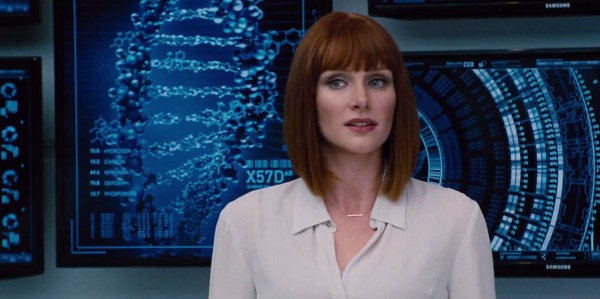
The film picks up on Isla Nublar, the same locale of the first film, where a dinosaur theme park is fully functional and running, attracting thousands of visitors a day. Apparently the lessons of the first film, not to mention the San Diego incident in the second film, have been lost on all concerned. Simon Masrani (Irrfan Khan) is the owner of the island and park, with a staff that includes the park manager, Claire Dearing (Bryce Dallas Howard), animal wrangler Owen Grady (Chris Pratt), tech experts Lowery (Jake Johnson) and Vivian (Lauren Lapkus), and the only character from any of the original films to return, the conscience free geneticist Dr. Wu (B.D. Wong), who got off the island before things started going wrong in the first film.


To bring in the required children in distress element of the film, Claire's nephews Zach (Nick Robinson) and Gray (Ty Simpkins) come to the island to pay their aunt a visit. There's also a wild card in the mix, Vic Hoskins (Vincent D'Onofrio), a security fixer with the InGen corporation of the first two films, who has an agenda of his own. Of course it doesn't take long before things start to go terribly wrong. If only they'd listened to the much missed Ian Malcolm- when things go wrong at Disney World, the Pirates of the Caribbean don't eat the tourist (they just keep making more and more movies).


Trevorrow has a hand in the screenplay, along with three other credited writers- Rick Jaffa, Amanda Silver, and Derek Connolly. The film was in development hell for years on end, usually not a good sign. Still, the story plays around with some of the same ethical questions that come before. I found it interesting, for instance, that the park owner is the one with concerns that the well being of the animals is being put behind the notion of profits- the animals are being referred to as assets, and he finds it troublesome. The story also turns things around by having the heroine initially be oblivious to those ethical concerns- Claire seems more concerned with a park running well than little things like "is this such a good idea?"


The story also comments on the consumer society- it's not enough to see dinosaurs in this theme park setting (again, why was no one listening to John Hammond at the end of The Lost World when he insisted these animals required the absence of humans?). The park's visitors numbers need a boost, and they come in the form of the big new dinosaur draw, a synthetic mix called an Indominus Rex, which is a symbol of consumer excess- bigger, louder, and brasher. There are consequences to messing around with nature, and in creating that particular beast, that's really messing around with nature. And there's an inherent irresponsibility that underlies any corporate ventures in these films, and that factors into the story- as does the notion of irresponsibility when someone stands by and does nothing while these wrongful actions proceed. Trevorrow continues to balance the tension and comic moments of the franchise. He handles action sequences- particularly the climactic confrontation of the film- reasonably well. Trevorrow manages to keep the film moving along, giving us heroism and lots of dinosaur action along the way.


The special effects continue to be effective throughout. It's impossible to top the awe of Jurassic Park, but as before we see dinosaurs looking like living, breathing organisms, with strong detail in their look, a clarity of movement, and as if they're part of the same environment as the actors and setting. The look of the engineered Indominus is particularly effective, a newcomer to these films. And it's a welcome thing to see the T-Rex and raptors again. These beasts and plenty more dinosaurs all feature into the film, and we get to see a lot of them. Michael Giacchino, who seems to be composing every other score out there these days, takes the movie in new directions, while incorporating some of John Williams' classic themes into the mix.


I liked the casting. Vincent D'Onofrio is one of those character actors you've seen in so many things down through the years, often a tough guy or every day man with flaws. He's certainly the antagonist this time out, a scheming, ruthless bastard with his own designs on the animals- he sees them not as animals, but as weapons, and his ambitions run deep. It's a character you quickly dislike, and things don't improve for the odds of the audience sympathizing with him. D'Onofrio makes him fun to watch, though.


Bryce Dallas Howard comes from good acting stock- her father is actor-director Ron Howard, and she's been in a mix of films since M. Night Shymalan cast her in The Village. I've liked her in what I have seen her in, and the same applies here. The character's lucky she's likable- neglectful aunts and park managers who lose control of their parks usually meet bad ends in this sort of film. There's history between Claire and Owen, and Howard plays to that. Despite being a yeasayer as far as the viability of the park is concerned as the story gets underway, Claire's a sympathetic character, and much of that comes from Howard's performance.


Pratt, who made a big impression last year with Guardians Of The Galaxy, is pretty straightforward as the hero of the film Owen (though they couldn't have given him a better first name?). There's something of a swashbuckler in the character, an ex-military type who's capable and resourceful (his method of evading detection by the rampaging Indominus is inspired). The character has some odd ideas about raptors, and is a nature lover with his own hesitations about the park, but he comes into his own in a crisis, as a hero should.

Carrying on the Jurassic Park franchise after several years away works, though it's not quite up to the standards of the first two films. I did find myself missing Sam Neill, Jeff Goldblum, Laura Dern, and Julianne Moore. The lessons of previous films seem to have gone unlearned, and of course there are repercussions to be seen to. Not that the dinosaurs mind... they're too busy snacking on tourists.


Wednesday, June 10, 2015

Dinosaur Hunting And Other Disasters

Some links before getting started today. Norma wrote about the Triple Crown. Parsnip checked in. Eve wrote about naughty or nice. And Maria had tips for writers in regards to disposing of bodies.

Today I have another movie review...


“Oh yeah. Ooohh, aahhh, that’s how it always starts. Then later there’s running, and, ah... screaming.” ~ Ian Malcolm

“Please. Don’t treat me like a grad student. I’ve worked around predators since I was twenty years old. Lions, jackals, hyenas.... you.” ~ Sarah Harding

“Yeah, well, noble was last year. This year I’m getting paid. Hammond’s check cleared, or I wouldn’t be going on this wild goose chase.” ~ Nick Van Owen

“Saddle up! Let’s get this moveable feast underway!” ~ Roland Tembo

“Careful. This suit cost more than your education.” ~Peter Ludlow

 “These creatures require our absence to survive, not our help. And if we could only step aside, and trust in nature, life will find a way.” ~ John Hammond

“Remember that chap about twenty years ago? I forget his name. Climbed Everest without any oxygen, came down nearly dead. When they asked him, they said why did you go up there to die? He said, I didn’t, I went up there to live.” ~ Roland Tembo

“Why don’t people listen to me? I use plain and simple English, I don’t have any accent that I’m aware of...” ~ Ian Malcolm  
“Oh, shut up.” ~ Sarah Harding


After the success of Jurassic Park, it was inevitable that there would be a follow-up. Author Michael Crichton wrote a novel, The Lost World, which would be very loosely adapted in a screenplay by David Koepp, who had co-written the screenplay for the first film. The film follows some of the characters from the original film on a new island where dinosaurs have survived, and features a power struggle between those who wish to protect the animals and those who seek to exploit them.


Four years after the events of the first film, a wealthy family has stopped for a break on the beach on Isla Sorna, off the Costa Rican coast. A young girl wanders off, encountering little dinosaurs that quickly turn on her. The incident allows Peter Ludlow (Arliss Howard), the nephew of John Hammond (Richard Attenborough) to take control of InGen, the company that built the ill fated theme park on the nearby Isla Nublar. Hammond has spent the last few years trying to keep Isla Sorna from being exploited; it’s the site where the dinosaurs were nurtured before being moved to the park, and with the events of the previous film, the animals have been left there to roam wild, and are thriving. Hammond calls in Ian Malcolm (Jeff Goldblum), whose reputation has been wrecked by whistleblowing the events at InGen, and explains his dilemma. He can only safeguard the island by getting public opinion on his side, and that requires sending a team in to document the animals in their natural environment. Hammond wants Ian on that team, given his previous experience.


One of the team members happens to be Ian’s girlfriend, Sarah Harding (Julianne Moore), a behavioural palaeontologist who’s already gone ahead to the island. Ian is annoyed by the fact that Hammond’s already taken liberties, and is determined to go to the island and bring Sarah back. He meets the other two members of the team, a logistics specialist, Eddie Carr (Richard Schiff) and a videographer, Nick Van Owen (Vince Vaughn). Things are also complicated by the arrival of Ian’s daughter Kelly (Vanessa Lee Chester). The team set out for the island and a rendezvous with Sarah, not knowing they have a stowaway, and unaware that there is another team with a different agenda- collecting dinosaurs and taking them- coming to the island as well.


The story is more of an adventure straight off than the first film. The characters and the audience know there is no illusion of control about this island, that the threat is paramount. The ethical question shifts from what we saw in the first film, as the right of people to tamper with life, to what we see here, the struggle of two different agendas. On the right side of that equation is the need to protect the animals and keep them out of harm’s way. The other side is the greedy disregard for what’s right- the desire to exploit and use the animals no matter the consequence. Hammond, who’s learned lessons the hard way, has gone from venture capitalist to environmentalist, lessons that his nephew doesn’t learn. I like that shift in the ethical side of the film. Aside from moving the narrative along, providing thrills, a measure of horror, and humour along the line, the story also grounds itself in relationship dynamics, and they’re best expressed in the relationships between Hammond and Ludlow, Kelly and Ian, and Sarah and Ian. Those are explored as the film goes along, though in the first case, only indirectly.


The special effects once more make dinosaurs come alive. We get the tyrannosaurus rex, the raptors, and a variety of other dinosaurs that seem to be sharing the screen with the actors as opposed to being a special effect. Full use is made of them, in a variety of ways- I love the way Spielberg sets up the scenes of raptors stalking a group of people running through tall grass- we see glimpses of the predators, their paths through the grass, a flash of their tails as they converge on their prey. And he doesn’t shy away from giving us full view of them either. 


The climax of the movie, with a Rex loose in San Diego, brings both terror and a sense of sly humour to it- and that beast certainly looks like it is alive and stomping around city streets late at night. Spielberg also brings back composer John Williams, who makes spare use of his previous themes and instead infuses dangerous, thrilling sounds into the score, with a hint of the jungle in the music.


The cast again is well chosen. Richard Attenborough appears only briefly as Hammond, who’s learned his lessons the hard way after the previous film. He seeks redemption for his earlier mistakes by safeguarding the island, and his intentions are at least better this time out- though he takes liberties in how he carries them out. Still, the character continues to come across as the kindly old grandfather. 


This is not the case for Arliss Howard as his nephew Peter Ludlow. The executive is a sneering, arrogant man, obnoxious and condescending, thoroughly unlikable and not as bright as he thinks he is. There’s a basic antagonism that he brings out in everyone- even the people working for him. Though the two characters never share a scene, there’s a sense that Ludlow holds his uncle Hammond in contempt. And for all his arrogance and bluster, deep down the character is a spineless excuse for a human being.


Vanessa Lee Chester as the stowaway daughter Kelly has the bulk of her interaction with Goldblum and Moore, filling the place of having a kid in the movie that Ariana Richards and Joseph Mazzello had in the first film. The relationship Kelly has with her father is somewhat tense- part of that is normal teenager stuff, the roll the eyes at whatever Dad says routine. Part of it is also the dynamic between them- her parents aren’t together, she feels her father doesn’t particularly want to be a dad. It’s a complicated relationship- she doesn’t understand that what’s driving Ian is keeping both her and Sarah safe; he of course has extensive experience with these animals, and knows how dangerous they can be. Actually Ian and Kelly have more in common than she realizes. Richard Schiff is good as the sardonic but capable logistics man Eddie Carr, who seems to have the right equipment for the right occasion, but isn’t really ready for what’s on the island until he sees dinosaurs with his own eyes. The character has a dry sense of humour, and while things end badly for him, he goes out working to save others, which is a nice touch. After this movie, Schiff went on to be one of the core cast members of The West Wing. Vince Vaughn plays the charming and somewhat idealistic Nick, bringing some of his motor-mouth personality to the role; this was an earlier role for him, and while I don’t mind the motor-mouth act in this film, it’s gotten tiresome in the years since as he’s pretty much kept using it. That said, however, Nick’s an interesting character, sarcastic but principled.


Pete Postlethwaite became better known later in his career to international audiences, particularly because of his outstanding work in the 1993 film In The Name Of The Father (far and away the best film of that year). Here he gets a really good role as Roland Tembo (what a name), a big game hunter who leads Ludlow’s team on the island. The character’s a boisterous, tough, and capable leader, a thoroughly dangerous man (one would not want to get into a fight with him). There’s something of a Captain Ahab to the man- he seeks the challenge of hunting a Tyrannosaurus Rex- and yet he can pull back from that hunt and let it go- a vital difference from Ahab. Where he ends up is a different place, personality wise, than where we first meet him. While he might work for the opposing side, he’s not unsympathetic, and we get to like him more as the film goes along. The character’s a force of nature, and Postlethwaite seems to be having a ball playing him.


Julianne Moore’s one of those actresses who could read the phone book and make it fascinating- she’s just that compelling and interesting in what she does. She’s resourceful, curious, and smart- and perhaps not wary enough of the dangers of the island until things go wrong. We believe her as an expert in the field- she seems entirely comfortable in her surroundings and carries herself with authority as you’d expect out of an experienced palaeontologist. Sarah’s relationship with Ian also feels real. The two have their disagreements, but have a lot of history, too, and for the most part seem to get along. Sarah’s touched that Ian’s come to rescue her, but adds that it would help if he did so on occasions when she could really use the help- such as a dinner with parents he missed. They’re not a perfect couple (who is?), but they seem grounded and real, and Moore plays to that, adding a sense of spirit and strength to her role.


Jeff Goldblum is fun once again as Ian Malcolm. He’s more cynical when we first meet him- having one’s academic career dismantled will do that. Having lived through the experience on the other island, he’s also the one character who understands the dangers the animals present. Try as he might to warn everyone around him, they don’t listen- until it’s too late. His motives are more personal this time out as well. While his ethical world view remains the same, his driving motivation is the safety of the woman he loves, and the daughter who thinks he doesn’t understand her. He might not go about how he deals with both in the right way, saying the wrong things at times, but we get what drives him, because like him, we know where this is going to end up- with lots of bloodshed and dinosaurs ripping people in half.


The Lost World was a fitting follow-up to Jurassic Park. Given that we already had the awe and majesty of the first film (before the chaos started), this film goes pretty much for the chaos, particularly in its second and third acts. It has a terrific cast, a good sense of humour, an adventurous spirit, and a fine way of driving up the tension.


Monday, June 8, 2015

This Is What You Get For Trusting Newman

With Jurassic World soon to show up in theatres, I thought I would review the first two films in the franchise here. This is the first, of course, and it's in fact a fresh review (looking at the tags, I've reviewed this movie before!) 


“John, the kind of control you’re attempting simply is... it’s not possible. If there’s anything the history of evolution has taught us it’s that life will not be contained. Life breaks free. It expands to new horizons and crashes through barriers, painfully, maybe even dangerously, but, uh...well, there it is.” ~ Ian Malcolm

“God creates dinosaurs. God destroys dinosaurs. God creates man. Man destroys God. Man creates dinosaurs.” ~ Ian Malcolm 
“Dinosaurs eat man, woman inherits the earth.” ~ Ellie Sattler

“All major theme parks have delays. When they opened Disneyland in 1956, nothing worked.” ~ John Hammond  
“Yeah, but John, if the Pirates of the Caribbean break down, the pirates don’t eat the tourists.” ~ Ian Malcolm

“Well, the question is, how can you know anything about an extinct ecosystem? And therefore, how could you ever assume you can control it? You have plants in this building that are poisonous. You picked them because they look good. But they are aggressive living things that have no idea what century they’re living in, and they’ll defend themselves, violently if necessary.” ~ Ellie Sattler

“The world has just changed so radically, and we’re all running to catch up. I don’t want to jump to any conclusions, but look... dinosaurs and man, two species separated by 65 million years of evolution have just suddenly been thrown back into the mix together. How can we possibly have the slightest idea what to expect?” ~ Alan Grant

In 1993, director Steven Spielberg brought a big screen adaptation of Michael Crichton’s novel Jurassic Park to theatres, a film that got wide critical acclaim and huge box office appeal. The film brings visitors to a theme park island in the making, where cloned dinosaurs are the feature attraction, and of course things go badly wrong. With a wealth of special effects that looked convincingly real- the dinosaurs do in fact look like they’re occupying the same space as the human actors- the film was a landmark adventure tale that still managed to give us strongly written  and acted characters, and a story that grounded itself firmly in questions of ethics and science.

The film opens with a grisly death of a worker, though what it is that kills him is barely glimpsed. The park’s owner must bring in experts to sign off on the facility, and so John Hammond (Richard Attenborough) seeks out a paleontologist, Alan Grant (Sam Neill), and a paleobotonist, Ellie Sattler (Laura Dern). They’re on a dig when we first meet them, and they’re a couple. Hammond persuades them to come to his island for a weekend, holding back what the island contains, but eager to have them see what he has in store. Hammond has to deal with a company attorney, Gennaro (Martin Ferrero), who’s brought in a chaos-theorist mathematician, Ian Malcolm (Jeff Goldblum) as an opposing voice.


The group reach the island, where they see what lives there- and we see as well for the first time. Dinosaurs, alive and thriving, 65 million years after their extinction, live on the island. Hammond reveals his method for their resurrection at the visitor’s centre, which troubles all three academics, each of them bringing up grave concerns about the ethics of cloning dinosaurs. Hammond’s grandchildren Lexie (Ariana Richards) and Tim (Joseph Mazzello) are also present, and the experts and the children end up going out on a tour of the park in full. It doesn’t take long before things start to go wrong.


Crichton and David Koepp adapted the screenplay, which differs significantly from the novel in places, particularly in terms of character personalities and fates, also cutting down on the exposition Crichton was notorious for. The method of explaining the process, for instance, is presented in an animated film, which flows much better than having a scientist lecture at length about genetic cloning. And while the story is very much an adventure with thrills and laughs... it’s also grounded in the question of scientific debate over ethics. Mary Shelley wrote about the ethics of creating life in the wrong way two centuries ago, and the questions she brought up apply today in real life and in science fiction. It’s an examination that looms over this film, and the experts brought in to sign off on the park are the ones raising those concerns most strongly. Malcolm points out that Hammond’s team didn’t do all the work- they co-opted the work of others, stood on the shoulders of others, and ended up going through with this venture more because they were consumed with whether or not they could do it that they never stopped to ask if they should. Asking that kind of hard question ends up making for a compelling story, and the film never backs away from it.


Spielberg has a gift as a director for spectacle (something that’s not that uncommon with the Hammond character, who at heart is something of a showman). His crew in this film worked wonders, and it’s the special effects from that side of things that really stand out. When he made Jaws, he was beset with technical problems with the mechanical shark used for the film, and shot a good part of the film with mere glimpses or from the shark’s point of view to compensate- and thus drove up the tension until at last we saw the shark. Some of the same elements come into play here. We don’t see the raptors at first- they’re mentioned in passing by Grant to scare an obnoxious child at his dig site, and we hear them in a pen when they’re fed, but not seen until it’s the right moment to show them. The same applies to the tyrannosaurus rex, which we don’t see when first expected, and then finally seen in a big way in a rainstorm. It’s one hell of an entrance.


Back in the day, Ray Harryhausen spent most of his time doing stop-motion creature effects in many films, particularly dealing with mythology. He was good at what he did, but when you look at those films, you don’t really believe the hero is in the same space as that gigantic thing. Computerized special effects had advanced in the late 80s to the point where that was about to change. Take a look at James Cameron’s film The Abyss, for instance, and the otherworldly alien beings in that film look completely unlike anything you’d find on Earth- and yet appear to occupy the same space with the actors. The same applied with Cameron’s Terminator 2: Judgment Day, which featured a terminator who could change appearance and whose shape could form liquids and solid weapons- the CGI was so good that the threshold had been crossed; there was no sense of disconnect between actor and special effect. The same qualities came across in Jurassic Park- the dinosaurs look so real, seem to occupy the same space as the actors, and behave and move like living organisms.


Spielberg’s touches as a director are clear throughout the film. He’s gifted in adventure films in particular, and that comes across here, both in how he shoots the film (location shooting was done in Hawaii) and how the story progresses. He’s given to the occasional use of humour- casting Goldblum gives a lot of that, while the fate of the lawyer, while grisly, is rather amusing (particularly if you, like most people, hate lawyers). Another director might well have dropped the kids out of the story, though Spielberg keeps them (and they’re not annoying kids, like you might get if, oh, Haley Joel Osment or Macauley Culkin had been cast) in the story, something we’ve seen in a number of his films. He’s also given to scaring the audience on frequent occasions, the right thing in a movie with out of control dinosaurs. His frequent collaborator John Williams came back to compose the score, a mix of excitement, awe, and terror through the music.


The cast were all well chosen. Martin Ferrero might be a nice guy in person, but here he plays the attorney Gennaro as something of a spineless weasel, a lawyer who gives lawyers a bad name. The character’s not likable at all, only seeing in shades of dollar signs and liabilities.  Samuel L. Jackson wasn’t quite yet known at the time, but on the edge of stardom. He was cast as Ray Arnold, the chief engineer of the park, and he plays the role with cynicism and yet also a professional sensibility. Bob Peck plays the chief warden, Robert Muldoon, something of a precursor to Pete Postlethwaite’s character in the follow up film. Muldoon is a serious hunter with an instinct for the behaviour of the animals in the park, a no-nonsense tough character, and Peck certainly plays him that way. Wayne Knight, who’s known primarily for this role and as Newman on the Seinfeld series, plays computer expert Dennis Nedry as a pure weasel, a sarcastic opportunist out for himself. Nedry is an unpleasant person, and he gets what he deserves- he’s not unlike Knight’s other famous role. It’s a sharp contrast, for instance, to a character he played in Kenneth Branagh’s film noir Dead Again, in which he played a genuinely likable character.


The kids, as mentioned before, are not at all irritating. The script changed things between the two from the novel. Ariana Richards plays Lex as serious minded and interested in computers, the big sister who’s wise beyond her years. Joseph Mazzello gets to be the over talkative Tim, fascinated by dinosaurs (all kids generally are, but this boy seems to know everything about them. He’s curious to the point of obliviousness to risk. The two characters are good foils to Alan, who doesn’t particularly care for children (I can relate to that), and yet finds himself protecting them when things go terribly wrong in the park.


Richard Attenborough hadn’t acted in a film in years before this film came along, having had moved into directing instead. John Hammond is significantly different from the novel, in which he’s a callous businessman, and the film presents him as an amiable billionaire showman of sorts, big on dreams and oblivious to the ethical concerns about his project. He sees himself as a modern day Walt Disney, with ambitions for a theme park that’ll outdo anything before it. He’s so obsessed with the notion of the grand show that he doesn’t heed the warnings coming from others... but at least by film’s end, he’s learned a hard lesson. It’s a compelling character, this kindly old grandfather, and you can’t help but like him, even while shaking your head at his methods.


Jeff Goldblum gets some of the best lines of the film as Ian Malcolm. Hammond refers to him as a rock star instead of a scientist, and there’s something to that. The character’s cocky and has attitude. Ian is eccentric to say the least, a show off and a flirt. And yet beneath all that are solid principles and an ethical core. He voices his objections most strongly of the three experts brought in, and seems resolute in the face of danger. After a narrow escape from a rampaging tyrannosaurus rex, he asks if they might have that on the usual park tour. He delivers the line in a way that gets just the right reaction, something that occurs time and time again with his dialogue.


Laura Dern brings an innate curiousity to her role as Ellie. She’s a bright scientist with strong principles and a sense of humour, and even in the face of a situation going terribly wrong, she doesn’t panic. Ellie is a character who can take care of herself, and Dern plays to that. And her relationship with Alan seems grounded and real. These two love and respect each other (I have no idea why someone decided they should have broken up before the third film), and that shows itself in how they relate. They’re comfortable enough with each other to tease each other- Ellie saddling him with having the kids around when she knows he doesn’t care for kids is a good example.


Sam Neill gets the lead, and Alan’s a compelling character. He’s a bit gruff, doesn’t have much patience where kids are concerned, but also smart and is calm in the face of danger. Grant’s sense of ethics are strong too- like Ian and Ellie, he expresses grave concerns about the island and the notion of tampering with life itself. Put into life threatening peril, he comes into his own, showing how resourceful he is. And while he might have serious ethical concerns about the notion of cloning these animals, there’s also the enthusiastic side of him to actually be around these animals- his astonishment at seeing them for the first time and his reaction to being able to touch a triceratops convey that.

Jurassic Park set a new bar for adventure films when it came out. It’s a rousing adventure that still manages to bring forward questions of ethics when tampering with the building blocks of life. The film remains a pleasure to watch, giving the audience a hint of what it might be like to walk the same ground as a dinosaur.

Plus we get the distinct pleasure of seeing a dirtbag or two meet very bad ends.