Faith Can Move Mountains... But Dynamite Works Better
Showing posts with label Civil War. Show all posts

Saturday, April 11, 2015

From History To Legend- March To Mortality

Some links before starting today. Norma had a photoblog from Hong Kong.Yesterday having had been a Friday, Parsnip had a Square Dog Friday post. And Eve is taking part in A-Z this April; you can find her posts at her blog.

Now then, here is the second of my two movie reviews for Civil War films....


“Afterwards men in tall hats and gold watch fobs will thump their chests and say what a brave charge it was. Devin, I’ve led a soldier’s life, and I’ve never seen anything as brutally clear as this.” ~ John Buford

“Win was like a brother to me, remember? Towards the end of the evening, things got a little rough. We both began to... well, there were a lot of tears. I went over to Hancock. I took him by the shoulder, I said, Win, so help me, if I ever raise my hand against you, may God strike me dead. Ain’t seen him since. He was at Malverne Hill, White Oak Swamp, Sharpsburg, Fredericksburg... One of these days I will see him, I’m afraid. Across that small, deadly space.”  ~ Lewis Armistead

“Generals can do anything. There’s nothing so much like God on earth as a general on a battlefield.” ~ Joshua Lawrence Chamberlain

“Soldiering has one great trap. To be a good soldier, you must love the army. To be a good commander you must be willing to order the death of the thing you love. We do not fear our own death, you and I. But there comes a time... we are never prepared for so many to die. Oh, we do expect the occasional empty chair, a salute to fallen comrades. But this war goes on and on and the price gets ever higher.” ~ Robert E. Lee

"Lovely ground." ~ John Reynolds
"I thought so, sir." ~ John Buford
"Now, let's go surprise Harry Heth." ~ John Reynolds

"Up, men! And to your posts! And let no man forget today that you are from old Virginia!" ~ George Pickett

“Well, if he’s an angel, all right then, but he damned well must be a killer angel.” ~ Buster Kilrain

“That’s Hancock out there. And he ain’t gonna run. So it’s mathematical after all. If they get to that road, or beyond it, we’ll suffer over fifty percent casualties. But Harrison... I don’t believe my boys will reach that wall.” ~ James Longstreet

“There are times when a corps commander’s life does not count.” ~ Winfield Scott Hancock


Michael Shaara’s classic novel The Killer Angels won the Pulitzer for fiction in 1975. It is my favourite novel, and tells the story of the three-day Battle of Gettysburg through the eyes of some of the commanders, both North and South. The novel was adapted by director and scriptwriter Ronald F. Maxwell and released in 1993 as the film Gettysburg, filmed on and around the battlefield itself, involving a cast of thousands, including many re-enactors who make a life’s hobby out of this sort of thing. The film follows the novel closely, giving us the point of view of commanders on both sides in a balanced way while conveying the ferocity of the greatest battle ever fought in North America.


The film begins with a voiceover, showing the movements of the Union and Confederate armies in late June 1863, as the Army of Northern Virginia under Robert E. Lee (Martin Sheen) moves north into Maryland and Pennsylvania, pursued by the Army of the Potomac, moving more quickly than expected. The Confederate army have been used to victory time and again, while the Union army has suffered losses and the incompetence of commanding generals. This time, however, things are different- the Southern cavalry commander, Jeb Stuart (Joseph Fuqua) is missing, off on one of his grand rides up north with his cavalry, leaving the infantry blind in enemy country. This worries Lee’s senior commander, James Longstreet (Tom Berenger), who has employed the use of a civilian scout to determine the movements of the enemy.


The Union army, meanwhile, is moving quickly; command has been given over to a new commander, George Meade (Richard Anderson). The cavalry commander in the field is a brigadier general by the name of John Buford (Sam Elliott), who brings his troops into Gettysburg the day before the battle. He’s been scouting the movements of the Confederate army, and has learned they’re turning south, perhaps to threaten Washington. Buford understands the value of the ground south of the small town, the best high ground around, and makes the fateful decision to stand his ground, summoning the infantry to come up quickly and take control of the high ground before the rebels can take it. Two senior corps commanders, John Reynolds (John Rothman) and Winfield Scott Hancock (Brian Mallon) know him well enough to take him seriously, and promise to have the army up in the morning.


Coming with that army of Union troops is an unlikely officer, a colonel with his own regiment from Maine. Joshua Lawrence Chamberlain (Jeff Daniels) is a professor who’s joined the war effort, a scholar and a man of principle who happens to be very good at the life of a soldier, an effective commander. His brother Tom (C. Thomas Howell) is a junior officer in the regiment, and tends to call Chamberlain by his first name. One of the senior enlisted men, Buster Kilrain (Kevin Conway) is a wise, gruff Irishman who’s been in the army most of his adult life, something of a father figure to the scholarly colonel. Their regiment is brought up along with the rest of the army, where they will meet destiny on the second day of the battle.


There had been efforts for years to adapt the book for the screen, either television or movies, but it was Maxwell who brought the film to the big screen. He received the backing of Ted Turner, who has a cameo as a Confederate officer during the climactic and ill fated Pickett’s Charge. Turner loved the novel too, and wanted to see it made. The National Parks Service allowed filming and battle re-enactment to be done on the battlefield itself, which gives the film a higher authenticity, particularly since places like Devil’s Den and Little Round Top had never seen this done. It is a long film- over four hours- but the material demanded that length. And the use of re-enactors, who know the story so well, allowed for a smoother filming process. Maxwell wrote the script, which closely adapts the novel, and which in turn paid heed to the history of the battle. Shaara noted at the time that while inner thoughts and some dialogue were his own interpretation, his foundation was on fact, and certainly his interpretation of the people on the page, and how they came to life on screen certainly rings true to who they were.


Maxwell’s direction throughout is sterling. He captures the ferocity of that war perfectly through the battle sequences, particularly the desperate fighting on Little Round Top on the second day, when the entire Union left flank is in danger, but also the cataclysm of the third day’s Pickett’s Charge. We feel the movement of vast forces of soldiers on the battlefield in how Maxwell’s camera team works, but then quickly find ourselves among regiments and get the close-up view in the midst of battle. The story gives balance to both sides- enough time is given to both perspectives, even though we know in our day that one side is wrong. It doesn’t romanticize the Old South in the infuriating way that Gone With The Wind did. And Maxwell even preserves a bit of Shaara’s humour in the story, mostly at the expense of one of Longstreet’s division commanders, George Pickett (Stephen Lang), a not that terribly bright but quite affable officer whose name will forever after be attached to the turning point of the Civil War. His three brigade commanders like to poke fun at his not so stellar academic record or his dim view of science.


Filming on place allowed for great authenticity, and that is much the same for the costuming and prop people. Many of the re-enactors would of course bring their own uniforms and gear for the project, but for those members of the cast who were featured players, their uniforms look very much of the era. This applies to makeup as well- most of the men (with a couple of minor cameos, this is an all male cast) have facial hair, some enough to house bird nests, but fitting for the time, and authentic to the men they are portraying. The music comes from Randy Edelman, and remains one of my favourite scores, emphasizing character moments at quiet interludes in the film, but also ferocious, desperate, and grand when accompanying the fury of battle.


The cast is huge. Many of the roles are cameos; documentary director Ken Burns, for instance, plays a Union staff officer during the cannonade on Cemetery Ridge preceding Pickett’s Charge. George Lazenby, a one-time James Bond, turns up as a Confederate division commander, Johnston Pettigrew, one of the other division commanders involved in Pickett’s Charge. Morgan Sheppard, an ancient looking actor with a huge resume of character roles (you’ve seen this actor in at least something), plays the third division commander of that charge. He’s a gruff staff officer when we first meet him, disgusted by the ineffectiveness of another corps commander, and placed into a vital position by Lee, who needs to fill a hole. Anderson’s appearance as General Meade is a brief one- he only appears once in the film as the commanding general, but that fits the story and the history, since Meade wasn’t that much of a factor in the battle. Donal Logue has more than a cameo, appearing frequently through the first half of the film- though he’s unrecognizable under facial hair- as Major Ellis Spear, Chamberlain’s capable and serious senior subordinate. John Rothman appears briefly as the ill fated General John Reynolds, playing the role as the man must have been: a superb commander, completely calm in the face of battle.


C. Thomas Howell plays the younger Chamberlain with a certain naive quality that works. Tom is the brother who always looked up to his older brother, joined the military because that’s what his brother was doing, and seems oblivious at times to military protocol, particularly his tendency to forget to address his brother by rank. He’s been in the army for awhile, has seen a lot, and yet that boyish naivety is still there. Kevin Conway, a character actor who’s been in multiple roles in the movies and television for years, gets one of the best parts as Kilrain. He’s a career soldier, the sort of senior enlisted man who make up the backbone of military services. And he’s gruff and disgusted by the foolishness of high command, something one might expect out of such a soldier. Yet he also does his duty, and is surprisingly thoughtful and wise. A conversation along the way with Chamberlain shows the father-son relationship between the two, and Kilrain’s principles as a person. He believes that only a fool judges people by the group or race- that you take people one at a time. It’s such a good role, and Conway makes it so memorable.


Brian Mallon gets the most screen time of the senior corps commanders in the Union Army as General Hancock. The real man was one of the finest officers in the army, a tough, tenacious, exceptional officer, and Mallon plays those qualities in his performance. Hancock is a commander who’s a natural leader, an inspiration to those around him, and calm under pressure. Mallon conveys that, but also shows the other side of the man, the humanity of Hancock, and a melancholy over an old friend who’s fighting on the Confederate side.


That friend, as it turns out, is Lewis Armistead (Richard Jordan), a brigade commander under Pickett, who, as fate would have it, is facing Hancock’s lines on the third day of battle. Both men become aware of each other being across the empty space between the lines, and both aware this means these two best friends will be fighting each other. It’s a twist that weighs heavily on them both, and we see that particularly in Jordan’s performance. It is the most poignant role in the film- we like Armistead tremendously; there’s a great warmth in the character. He has a sense of humour, but there’s also tragedy to him; he expresses that to his old friend Longstreet, particularly in a explaining about a vow he made the last time he saw Hancock. And now fate has brought him to fight Hancock head on. The performance is made all the more poignant by the fact that this was Jordan’s final performance; he died soon after filming was wrapped, and the film is dedicated to the memory of Jordan and Shaara.


Stephen Lang has spent years playing various character roles, often villains, but this is my favourite role by the actor. He plays Pickett just as you’d expect the real man to be. Pickett’s not a bright guy- he finished dead last in his class at West Point- but he’s capable and reliable, able to follow through on orders. He also seems to be good company, cheerfully taking jokes at his own expense, even instigating some of them, a boyish sort of fellow engaged to a woman half his age. Pickett is a jovial officer- and so the ill-fated charge that bears his name leaves him utterly shattered. When we last see him, he’s a broken man, and Lang conveys all of those qualities in his performance.


This is one of my favourite roles for Sam Elliott. John Buford was fated to die later in 1863, and for many years was a forgotten figure in the Civil War. It was perhaps the benefit of Shaara’s novel that started to give him serious attention and credit again. A bright man with a gift for topography and the best use of the land for military purposes, it was Buford’s decision to fight at Gettysburg and his stubborn fight on the first day that allowed the Union infantry to come up and occupy the high ground. In doing so, Buford saved the battle and perhaps the war. Elliott conveys the tenacious nature of the man, his frustrations at commanders, and his tough, capable, and steady character. Buford is a man who can see what’s to come; his prediction of the battle to one of his brigade commanders is chillingly accurate, at least for the losing side.


Martin Sheen is given the role of General Lee, and he plays the role well. Looking at history, one is struck with the dignity of Lee, his intelligence, and his skill as an officer. These are qualities that Sheen brings across throughout the film. He’s still a torn man; he remembers that he once took a vow as an officer in the Union army, and that he served with many of the men fighting against him. And yet he believes his duty first and foremost is to his home state. He’s also an officer with great empathy for his men; he says that a good commander must love the army, but also be willing to order the death of that which he loves. It’s a great contradiction, but it fits in perfectly with the character of the man. Another element that resonates is his anger- it’s a quality Lee tries to keep harnessed, but it shows itself in a late night meeting with Stuart, whose absence until the battle has started has leaved the general deeply disappointed. The anger he expresses to Stuart is effective in the moment- a mark of a man who could be very dangerous when riled. Sheen takes all of these into account with his performance, and it rates as one of his finest roles.


Tom Berenger also inhabits the role of Longstreet just as you’d expect the man to be. Longstreet was a military genius, devising systems of trench warfare decades before its time. He was a methodical, defensive commander of great skill, an effective general who’d advanced to his position based on his own talent. He was also a man of gloom and frustration, with a tragic past, suffering multiple personal losses during the War. Berenger plays Longstreet with gravity and force, a man of strength. He knows what’s coming- he tries to argue with Lee about moving the army away from the field and threatening Washington directly- but to no avail. And Berenger’s Longstreet feels the loss of what happens, the responsibility for it all, very heavily.


Jeff Daniels gives his best performance as Chamberlain. The fighting professor from Maine was the sort of person who could master any subject before him, and he certainly excelled at military life, ending up as one of the most extraordinary soldiers of the war. He’s a man of scholarly knowledge and deeply held principles, a man who believes in the cause he is fighting for. Daniels brings those qualities to the role, and also comes across as a highly capable leader, trusted by his men, someone whose ability to speak can be persuasive. He also shows the ingenuity and resourcefulness of Chamberlain, whose last minute use of a textbook tactic saves the second day and the Union army on Little Round Top.

Gettysburg is one of my favourite films, if not my favourite. The tale of the pivotal battle of a terrible war captures the immediacy of battle, the desperate odds on both sides, and the ferocious nature of that war. It also gives the viewer outstanding performances all around, bringing figures from the past back to life in rich and deep ways. It is, quite simply, a magnificent achievement in film.


Thursday, April 9, 2015

Glory Hallelujah: Courage, Spirit, And Honor

Some links before getting started today, and I've been remiss in doing this. Norma had seven revelations and a where are they now post on one of her books. Parsnip had Easter Scotties and views from home.Cheryl had a crime blotter post. And Krisztina had carrot cake.

Now then, today, April 9th, marks the 150th anniversary of Lee's surrender to Grant at Appomattox during the American Civil War, the end of major fighting in the Eastern Theatre of that conflict. I thought I would mark the occasion with two movie reviews of Civil War films that really appeal to me. This is the first of the two.


“Why do you treat the men this way, Robert?” ~ Cabot Forbes 
“How should I treat them?” Robert G. Shaw 
“....Like men?” ~ Cabot Forbes

“And what are you? So full of hate you want to go out and fight everybody! Because you’ve been whipped and chased by hounds. Well that might not be living, but it sure as hell ain’t dying. And dying’s what these white boys have been doing going on for three years now. Dying by the thousands. Dying for you, fool. I know, ‘cause I dug the graves. And all this time I keep asking, when, O Lord, is it gonna be our time? Gonna come a time when we have to ante up. Ante up and kick in like men. Like men!” ~ Rawlins

“See, the way I figure, I figure this war would be over a whole lot sooner if you boys just turned right on around and headed on back down that way, and you let us head on up there where the real fighting is.” ~ Trip

“There’s more to fighting than rest, sir. There’s character. There’s strength of heart. You should have seen us in action two days ago. We were a sight to see. We’ll be ready, sir. When do you want us?” ~ Robert G. Shaw


Glory has been called by some the best war movie ever made, and it is a fair comment. Director Edward Zwick (Legends Of The Fall, Courage Under Fire) brought the Civil War tale of African-American soldiers in the 54th Massachusetts Regiment confronting racism, distrust, and the culture of the time as their commanders strove to give them the chance to get into the fight. It not only tells the story of the regiment, whose extraordinary bravery allowed for far more African-American men to enlist, but the experience of such men throughout that terrible war.


The film opens on the fields of Antietam, one of the bloodiest battles of the war, where we meet a young officer, Robert Gould Shaw (Matthew Broderick), wounded but having had survived the battle. He meets a gravedigger named Rawlins (Morgan Freeman) and returns home to recover in Massachusetts with his parents, prominent abolitionists. There he is offered command of a new regiment to be made up of freemen and escaped slaves. He accepts the command, asking his friend Cabot Forbes (Cary Elwes) to serve as his right hand man, and getting his first enlisted man, a born free well educated friend named Thomas Searles (Andre Braugher) signing up.


The regiment organizes for training. Most of the enlisted men are escaped slaves, with little education but much will to get into the fight. Rawlins is one of them. Another is a man named Trip (Denzel Washington), a bitterly angry man aching to take the fight to the people who held him and his family as slaves. As training gets underway and the men start to come together as a regiment, they find themselves dealing with life in the military, being treated unfairly or neglected because of officers elsewhere along the line, and their own expectations of what is to come. Shaw and his officers must handle their grievances, balancing the needs of the men and realistic expectations of how they’ll be used. As time goes on, the regiment finds themselves finally drawn into battle in the deep South, at a place where they will meet history.


The screenplay comes from Kevin Jarre, based on the letters by Shaw to his family and friends back home, as well as two books on the 54th. It does make use of composite characters- Trip, Rawlins, Forbes, and Searles are all composites, as opposed to historical figures, but these are based in the sort of men who made up these regiments, both enlisted and officers. The story in the film relates to the overall experience of black soldiers in that war just as much as it tells the tale of the regiment- the obstacles they faced, the prejudices, the reasons these men went to war. Jarre wove that all into the screenplay; while the point of view character might be Shaw the historical figure, his story is interwoven so strongly with the men, and the enlisted men are rendered with depth and complexity throughout.


Zwick certainly has a gift for directing films with strong characterization and yet also managing the ferocity of the battlefield, and both elements of that are in play here. Much of the filming was done on location, with strong attention to detail in terms of period uniforms and clothing, equipment, and settings. Zwick hired on the writer and historian Shelby Foote as a consultant, a wise move, as his thorough knowledge of the war and the times comes through in the storytelling. Throughout the film we feel like we’ve stepped back in time and are walking unseen among these people in this time, silent witnesses to a pivotal period in history. That comes down to the sheer amount of attention to detail by Zwick and his crew.


The cinematography is amazing- it won Oscars for that and for sound, scoring nominations in other technical categories and a win for Best Supporting Oscar. The climactic charge at Fort Wagner, a tactical failure that nonetheless had a huge impact on history to follow, is rendered in an apocalyptic, brutal way that leaves one feeling as if you were there. As terrifying as it is- and we can imagine it must have been to the real soldiers- it also leaves one with a respect for the fact that not one of them let the fear control them. Lastly, the score by James Horner- accompanied by choir on frequent occasions- is his very best, a majestic and dignified score that perfectly fits into the movie.


The casting of the film is brilliant. Andre Braugher, who would go on to regular film and television appearances after, and would create one of the best roles in television history in the form of Frank Pembleton on Homicide Life On The Street, gets an outstanding role as Thomas Searles. Thomas is an outsider in the story; when we first meet him, this is a civilian, an articulate, well educated man who’s been friends with Shaw and Forbes for years. He’s been free his entire life, is involved in the abolitionist movement, and is thoughtful and principled. He jumps into military life without really thinking it through, and finds himself isolated. The rules of military structure mean that he can’t freely socialize with the officers he’s known as friends, but his well educated status also isolates him from the other men in the regiment, particularly Trip, who seems to despise him. Braugher has to bring these qualities to the role, and he does so splendidly, the character very gradually coming into his own. It’s a great performance from a great actor.


Cary Elwes gets one of his finest roles as the cynical officer Forbes. He’s not overly ambitious, seems to not take things seriously when we first meet him, including his own abilities as an officer. He’s wary of the notion of accepting the job, and seems to do it more because his friend is asking. And yet as the film goes on, and the stakes get higher, including a Southern proclamation that white officers commanding such a Union regiment will be treated just as harshly as the men, Forbes shows his loyalties to the men and a commitment to the cause, acting much more decisively and with dedication than when we first meet him.


Morgan Freeman had already been acting for many years, but this film, along with Driving Miss Daisy, really started getting him noticed as an actor, and he never looked back afterwards. There is a patient wisdom in his role as Rawlins, a man who yearns for freedom and justice. He has a background as an escaped slave, seeks a world where things can be set right. He’s better tempered than some of the men around him, particularly Trip, but beneath that is a man who sees the horrors of slavery and racism for what they are. Rawlins is one of those men in any army who becomes the backbone of a fighting force, the reliable senior enlisted man who can keep calm under pressure. It is a compelling performance, and a character that is one of the best, if not the best, roles for Freeman through his career.


Denzel Washington won the Oscar for Best Supporting Actor as Trip, and it is well deserved. It is one of his finest roles, a man of fierce defiance and absolute rage at the injustice done to his people. Trip is deeply cynical, with a huge chip on his shoulder, no respect for anyone, and an eagerness to pick a fight. He lashes out, speaks his mind, tends to alienate others, and yet as the story goes along we see his headstrong courage, his dominant will, and determination to make a difference. His lack of respect for others translates to the officers, only gradually fading away as the story goes along and he understands they have as much at stake as he does, and particularly where Thomas is concerned; there comes a moment between the two later in the film where one is convinced the two very different men might well kill each other, a moment defused by Rawlins in a way that gets Trip to reconsider his own worldview. The performance by Washington is a marvel to behold.


Broderick was ideally cast as Shaw, commanding officer of the regiment. He had already been serving in the army for awhile, facing the worst of the fighting when the command came into his orbit, so Shaw was not fresh to war. He’s an idealist, though, a man of strong principles that have been infused into him by his parents and the abolitionist circles he’s travelled in. Shaw is a man who believes in justice, and takes on a difficult assignment, confronting all of the problems that entails. It requires him to do some give and take with the men- subjecting them to the verbal abuse of an Irish drill sergeant who rightfully has to drill them into shape on the one hand, while taking their side and refusing pay when his men are not being paid the same as white men on the other. Over time, Shaw gains their respect by showing his own respect, and Broderick conveys that in how he plays the character. It’s a mature performance, tightly controlled and dignified, and Broderick brings weight and seriousness to the role. We believe him as a capable commanding officer.


Glory is a film masterpiece, both as a powerful storytelling epic and as a strong character study. It weaves between the horrors and heroics of war while telling the story of the experience of that war through the eyes of some of the unlikeliest soldiers of that conflict. What the 54th accomplished at Fort Wagner is a testament to willpower and courage, and while a tactical defeat, it allowed for thousands of more African-American men to join the fight. Lincoln credited these men with turning the tide of the war. Glory does them credit, serving as a magnificent film paying tribute to their extraordinary story.


Monday, August 25, 2014

Four Score And Seven Sequels Ago

Some links before I get myself started today. Yesterday was a Snippet Sunday at our joint blog. Krisztina has a different kind of challenge at her blog. And the Whisk had a Red Shirt Sunday at her page yesterday. 


Director Announces New Film Sequel; Reporters Ponder What He Is Thinking

Los Angeles (AP) Director Roland Emmerich met reporters at the offices of Centropolis Entertainment yesterday, announcing an unlikely film project, something that may or may not be a sequel for an earlier film. Emmerich, who is known for films like Stargate, Independence Day, and The Day After Tomorrow, was introduced by one of his staffers as he arrived on site to speak to reporters. This reporter, having had landed seemingly in the permanent bad books of his editor, was condemned to cover the event. At least Emmerich isn't as self absorbed as Michael Bay.

"Thank you for coming," Emmerich said as he stepped up to the podium. "Today I am announcing a new film, reuniting myself with a number of cast members from a previous film. Is it a sequel? Well, that depends on what you think of as sequels. Yes, this involves some of the same actors, but they are playing different characters. In a manner of speaking. Ladies and gentlemen, my next film is a Civil War drama I'm calling The Patriot Returns."


Reporters were puzzled. The original film, which played fast and loose with history, was set during the American Revolution and featured, among other things, a pack of children who did not age one day in a period of several years. What room was there for a sequel, decades later during the war? Emmerich went on. "My concept is very simple. Benjamin Martin's family has carried on through the generations after the Revolution. The Civil War comes about, and his grandson James Martin is a Pennsylvania farmer and state legislator. I chose to move things up north for the sake of the story, because we can't have a Confederate as a hero, can we? Anyway, he's been an officer, served in the Mexican War, and has something of a reputation from those days as a bit of a lunatic. He's a widower with a bunch of kids, has himself a really hot sister-in-law, and they've got some unresolved sexual tension going on. He gets involved in the war, and what he doesn't know is that there's a British officer out there looking for him." Emmerich smiled, pausing for effect before continuing.


"He's the grandson of Colonel Tavington from the first film. It seems that our Colonel Lucius Tavington grew up pissed off at that colonial who killed his grandfather, and swore he'd get even somehow, some way. And finding out that there's an officer out there who's descended from the colonial is the perfect opportunity for revenge. So, despite the fact that the British are staying outside of the whole thing, Tavington goes to America to join the Confederate army on the infinitely small chance that he might come across that grandson on a battlefield, even if he has no idea what he looks like."


Reporters looked at each other, baffled by the concept. Having had already mucked up the historical timeline of the American Revolution in The Patriot, Emmerich would undoubtedly do the same with the Civil War. This reporter spoke up. "You do realize you're just rehashing a lot of the original film?" 

Emmerich shrugged. "That's a matter of opinion. And hey, since I can't have Heath Ledger come back to play his own grandson and have the same dynamic with Mel- unless I find a way to raise him from the dead... anyone know a voodoo doctor? I decided to change that dynamic to the eldest child being a daughter who's somewhat at odds with her father, deciding to pass herself off as a guy and fight in the war. Wouldn't that be a good idea? Anyway, I'll start announcing the cast, and it occurs to me I've already announced one of them. Playing Colonel James Martin, I give you Mel Gibson!"


Gibson came out and waved to the crowd of reporters. "Hey there! Nice to be back, and working with Roland again. And I get to have yet another chance to act out on my loathing of the English, so that's a great thing!"

"Mel, you're such a kidder," Emmerich told him.

"Who said I was joking?" Gibson countered.

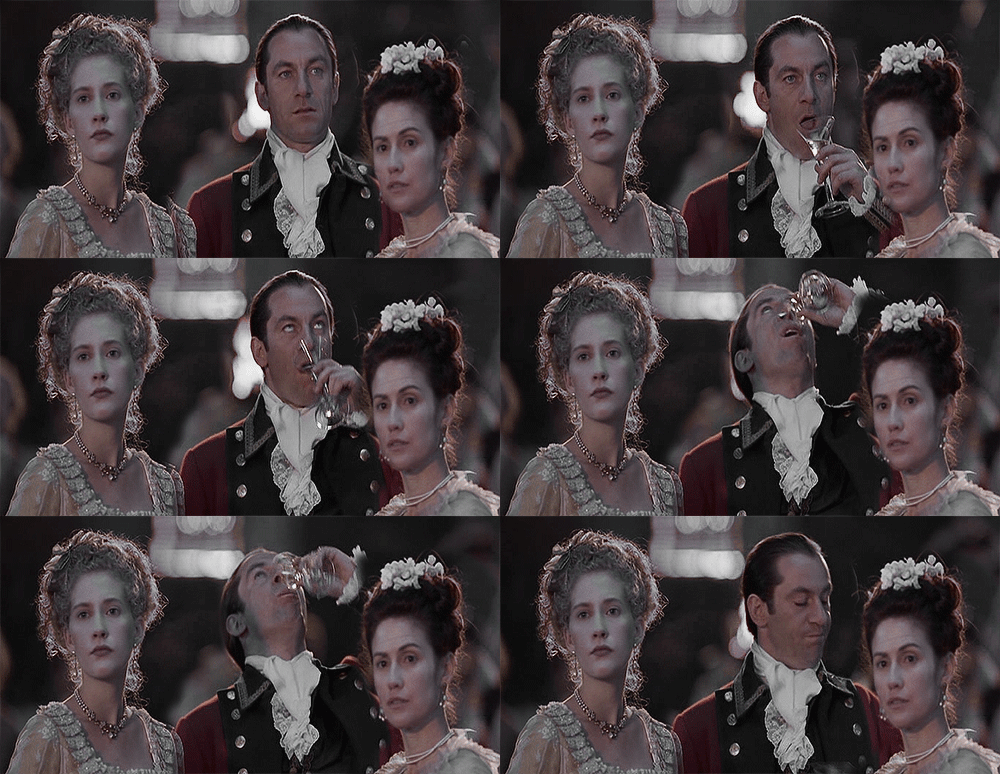
Emmerich shrugged. "Returning again to play the grandson of the original villain, this time as Colonel Lucius Tavington, say hello to Jason Isaacs!"


Isaacs emerged from backstage and waved. "Roland promised my character would get plenty of opportunities to sneer and roll my eyes again, so how could I pass on that?

Emmerich nodded. "You do that so well, too. As well, I've got Joely Richardson returning to the cast, playing the really hot sister-in-law who just happens to look exactly like the second wife of James Martin's grandfather. No, there's no Freudian things going on in this story, so don't read anything into that. Joely, come on out!"

Joely Richardson stepped out on stage, joining her other cast members and the director. "It was either this or a follow up series to Nip Tuck, and frankly I find Julian McMahon to be pretty repulsive."


Emmerich nodded. "Well, we're going to have a lot of fun making this film. We're going to make history with The Patriot Returns, and if that means we have to mess around with history, so be it. I mean, just imagine the operational concept for the Battle Of Gettysburg coming not from the generals on the scene, but from a Pennsylvania ranger."

"Who's carrying the American flag all over the field," Gibson chimed in.

"Can't forget that," Emmerich agreed.  "It's going to be one of my biggest set pieces. I'm even thinking of having him load the flag into a cannon, fire it, and having it impale Jefferson Davis."


Reporters stared at Emmerich for a long silent moment. A Reuters correspondent asked, "You are aware that didn't actually happen?"

Emmerich shrugged. "Like what actually happened matters! I'm making a movie! And if that means having Mel Gibson's character stand in for the President and give the Gettysburg Address with a fake beard, so be it!"

"Yeah!" Gibson said. "Four score and seven years ago, our fathers brought forth on this continent a new nation, conceived in hating the English..." This reporter sighed, and zoned out the rest of the press conference. Rumor has it that Heath Ledger was rolling over in his grave.


Monday, November 18, 2013

The Last Full Measure Of Devotion

Before getting started today, have a peek over at our joint blog for a different kind of review of Thor: The Dark World. And leave us a comment!

Now then, there's an anniversary of sorts to mark for our southern neighbours tomorrow, so that's what I'm doing today....


He arrived at the dedication service for the National Soldier's Cemetery on a November day in 1863, months after the terrible battle that transformed a quiet Pennsylvania crossroads forever. His invitation was almost an afterthought, and he was not the keynote speaker. Yet his short address would come to be thought of as his greatest speech, this from a man who had such an innate skill at speaking.

Abraham Lincoln came to Gettysburg, in the midst of a bloody civil war that set American against American, tore the country apart, with casualty rates that shocked people at home and abroad. At stake was the very meaning of freedom, and the future of the country. From 1861 to 1865, Americans killed each other in large numbers, and the President faced a crisis the country had not seen before or since. The Battle of Gettysburg in July had been the biggest ever fought on the American continent, a bloody victory for the Union, and the battleground would now house a cemetery.

Lincoln sat quietly on the platform among the guests, surrounded by soldiers and civilians. He seemed ill on the trip to and from Gettysburg, and was observed to seem sad and drawn. The keynote speaker that day, November 19th, was a politician and clergyman, Edward Everett. He went on for two hours in an oration, which oddly was a common thing for cemetery dedications at the time. Then it came time for the President to speak.

There are five different copies of his remarks today, with slight differences. The one that we treat as the standard bears his signature, and consists of ten sentences, a brief set of remarks that took him a couple of minutes to recite. The audience response to the remarks was minimal, to say the least. But in those ten sentences, he summed up the entire war.

Four score and seven years ago our fathers brought forth on this continent a new nation, conceived in liberty, and dedicated to the proposition that all men are created equal. Now we are engaged in a great civil war, testing whether that nation, or any nation so conceived and so dedicated, can long endure. 

We are met on a great battlefield of that war. We have come to dedicate a portion of that field, as a final resting place for those who here gave their lives that that nation might live. It is altogether fitting and proper that we should do this.

But, in a larger sense, we cannot dedicate, we cannot consecrate, we cannot hallow this ground. The brave men, living and dead, who struggled here, have consecrated it, far above our poor power to add or detract.  The world will little note, nor long remember what we say here, but it can never forget what they did here. It is for us the living, rather, to be dedicated here to the unfinished work which they who fought here have thus far so nobly advanced. It is rather for us to be here dedicated to the great task remaining before us- that from these honored dead we take increased devotion to that cause for which they gave the last full measure of devotion, that we here highly resolve that these dead shall not have died in vain, that this nation, under God, shall have a new birth of freedom, and that government of the people, by the people, for the people, shall not perish from the earth.

Through sheer force of will, he held the country together through bloody civil war. He stands today as the greatest American President for that achievement. One hundred fifty years ago tomorrow, Abraham Lincoln gave his greatest speech in a career of  great speeches at this quiet cemetery, and his words live on. They are memorized today by schoolchildren. They are carved on his memorial in Washington. They are recited by speakers in his own country and beyond. It is a fitting legacy for the Great Emancipator.


Saturday, August 10, 2013

The Forging Of Two Nations

Some business to see to before I get things started today. We've extended our deadline at the Authors For Oklahoma initiative. Check out our latest update here. All proceeds for the book raffle go to the Red Cross, and help is still needed in Moore, Oklahoma, after the tornado this summer. Head on over to the update for more details, because it's a good cause.

My cover designer Collin Beishir has started up a blog, which you can find here at Wordpress. Check him out and start following him!

Norma's been off for a few days, but yesterday she wrote a new blog about her two birds named Sam at her Wordpress blog. Head on over there, check it out, and comment!

Finally, for those of you who enjoy my Day In The Life blogs, Norma and I worked on a variation over in the joint blog, and with the antics of a certain sleazy mayoral candidate in the news as of late, it's an appropriate and hilarious topic. Go on over and check out A Day In The Life Of A Sex Scandalized Politician. And leave us a comment!

As for today, I've got myself a book review to see to. So without further ado, shall we begin?


The American Civil War tore apart a country. Secession in the South sought to establish a new nation where life could be lived in the fashion people were used to- with the foundation of slavery underpinning everything. Union Northerners refused to allow the country to fall apart, and for more than four years, Americans went to war against each other, killing each other in large numbers over the issues of race, freedom, the nation, and what kind of future they would all have. By war’s end, the country was reunited, slavery was abolished, and state’s rights, one of the underlying issues that had contributed to the war, gave way to a more unified sense of Americans about themselves. Yet two countries did rise out of the aftermath of that war.

Blood And Daring: How Canada Fought The American Civil War And Forged A Nation is a new book by historian John Boyko, weaving the tale of the Civil War and that of the birth of Canada. The war influenced Canada- and Canada influenced the war- in ways that most people overlook, and this book sheds light on a side of the war that needs to be told. I have read earlier books that go through some of this material; Claire Hoy wrote an insightful book several years ago called Canadians In The Civil War. This book delves into the same territory but offers new insights.

The author tells the story of the war and the parallels of what was going on across the border before, during, and after those years. The British North American possessions- Canada East and West, New Brunswick, Nova Scotia, Prince Edward Island, and Newfoundland- had been given chances to form a more cohesive union going back a decade or more before the war; officials in Britain were distracted by events in Europe and wondered if it was worthwhile to hold onto their Canadian possessions. American leaders looked north as well as west, believing in the doctrine of Manifest Destiny, that all of North America should be theirs. Abolitionists brought slaves north into Canada, to safety and freedom, away from the slave hunters, to the far end of the Underground Railroad. Southern aristocratic families vacationed in Canada in the summers, escaping the heat from their home states, forming friendships in towns along the way. And colonial leaders were divided among themselves.


Boyko uses six people from the era as cornerstones to tell his story. John Anderson, a fugitive slave who settled in Canada after his flight to freedom found himself at the core of a court case, pursued by American officials for killing a white man during his escape. The case made headlines around the world; had Canadian courts ruled for deportation, it would bring an end to the safety of the Underground Railroad, potentially allowing any white slave holder to demand the return of a free man from Canadian soil. Through Anderson and people like him, who saw Canada as a place free of bounty hunters, this part of the story, so integral to the war that followed, is told. Boyko stresses the anger felt by many in the South towards Canada for harbouring what they viewed as personal property, and the influence that had in increasing the tensions between North and South.

William Seward


William Seward, the fiery Secretary of State under Lincoln, is a presence through the book. His intention early on to try to provoke a war with Britain, in the expectation that the South would rally around the flag, is explored. Like other politicians in the North, Seward was a fervent believer in Manifest Destiny, seeking ways either through bluffing, intimidation, or negotiation, to take Canada and make it American. This was a belief he held before and after the war, and I can only imagine the personal frustration he must have felt to end up getting so outmanoeuvred, in the end, by a man on the other side of the border.

Sarah Edmonds


Sarah Emma Edmonds is a lesser known figure, and yet it makes her all the more compelling in the narrative. Here we have a young Canadian woman who, through circumstances, began to pass herself off as a man, making a living on both sides of the border. When the Civil War began, she joined the Union Army, serving variously as a nurse, soldier, and spy, seeing action while passing herself off as male. She survived the war, serving both as her male alter ego and as herself later on, one of a number of women doing the same who saw frontline combat. Her story is woven in with that of other soldiers. It’s estimated that anywhere from twenty to fifty thousand Canadians served in the War, the vast majority of them in the Union Army; Boyko settles on a total of forty thousand. This was despite the fact that the British were officially neutral. Some served out of principle, while others were co-opted in by unscrupulous recruiting brokers who got them drunk and ended up putting them in a uniform. Canadian boys served all over; Boyko makes note of their presence in the 20th Maine on Little Round Top during the Battle of Gettysburg. Twenty nine Canadians would win the Congressional Medal of Honour. A Canadian was among the honour guard outside the McLean home when Grant and Lee came to terms at Appomattox. And a Canadian, Lieutenant Edward Doherty, who had moved south in 1860, was the cavalry officer in charge of the troops who ran John Wilkes Booth to ground. Boyko vividly brings the story of the soldier to life in his narrative, exploring how young Canadian men violated the terms of neutrality and served through the Civil War.

Jacob Thompson


During the war, Canada served as a breeding ground of Confederate plots, and into this, Boyko brings us Jacob Thompson. Once a Secretary of the Interior for the US government, he became Jefferson Davis’ point man in establishing a second front, operating from Toronto and Montreal, dispatching spies and irregular operations across the border. Coupled with the fact that arms were shipped to the Confederacy from Canadian sources (including a foundry not far from my childhood home) and that Confederate ships found safe harbour in some Canadian ports, there was some sympathy for Confederates- even while other Canadians were fervent abolitionists. Thompson stepped into all of this, operating a shadowy network of spies and saboteurs, conceiving with his cohorts a series of plots directed at destabilizing the Union, conferring with Copperhead politicians who felt that the war served little purpose. Thompson’s operations were a thorn in the side for the Union at a time when Lincoln was occupied with the war, increasing tensions on both sides of the border. It gave fuel to the annexation agenda, to the idea that Canada was the source of trouble for the Union, particularly given the two faced response from colonial officials and the British.

George Brown


Boyko’s last two keystone figures are tied together, as fathers of Confederation and political rivals who had to work together to forge a country through these years. George Brown looms large in Canadian history. A politician and reporter who founded the Globe (still around today as the Globe and Mail), Brown had already served in a number of capacities in the colonial administration before the War. As a politician and as a journalist, he argued the case that to prevent themselves from being swallowed up by America, Canadians would have to forge an identity, a country, for themselves. And looking at what was happening south of the border, he saw the need for a strong central government clearly from the fact that state’s rights had been such a strong factor in triggering the war.

John A. Macdonald


John A. Macdonald looms over the entire book. From the 1850s on, Macdonald was the strongest voice in colonial politics, in a variety of posts. He was something of a rascal (and a drunkard), but also a fiercely principled man and a masterful politician. As the war came, Macdonald understood that the only way to stand up against a strong Union during and afterwards would be as a united front. Like Lincoln, he concealed his wisdom behind a front of sorts- for Lincoln it was the homespun storytelling, for Macdonald, it was the drinking, which served its own purpose. He was the driving force behind Confederation, negotiating the terms of what would become a country in its own right. And he was a leader who could keep a calm head in a crisis- through the tensions of those four years and the Fenian Raids that followed, the efforts of Irish-American veterans to invade and use Canada to force Britain to let go of Ireland. We see the resourceful and ingenious Macdonald who completely checkmated Seward by purchasing and securing the whole of what is today the Canadian west and north for a pittance, bringing an end to the dream of annexation. And we see the Macdonald who- during the Treaty of Washington negotiations that would wrap up fallout of the war for America, Britain, and Canada- would stand his ground on everything, securing the future of his country.

Boyko ends up giving us an insightful book that explores in depth the complex story of the Civil War on both sides of the border. Canada rose up from that conflict, played a part in many ways. It was a time of deep tension between neighbours, when backstabbing and mutual suspicion seemed to be the order of the day. The Civil War made Confederation a necessity, driving colonial leaders with vastly different concerns to accept that survival meant joining together, and played a big part in shaping the national character. Its aftermath became the foundation for where the country would go, and the way it would relate to America in the years that followed. Blood and Daring is a well written book that offers a fresh look at both countries, and a worthy addition to the story of the Civil War. Readers from both sides of the border will come away enlightened.