Faith Can Move Mountains... But Dynamite Works Better
Showing posts with label Vin Diesel. Show all posts

Tuesday, August 12, 2025

The Fast, Furious, And Frustrating


Latest Script For Overblown Franchise Leaks; Fans Horrified

Los Angeles (AP) Be careful what you wish for. It's an old expression, and a hard lesson learned. Director Louis Leterrier has been busy prepping the eleventh film in the Fast & The Furious franchise (twelfth, if you include the spin off Hobbs and Shaw). Series star Vin Diesel has been vocal about one condition for the next film being that "Brian has to return." This, despite the fact that Paul Walker, who played the character, died during the production of Furious 7, with his role completed with the cooperation of his brothers Cody and Caleb for that film.


The studios have been tight lipped about how to approach that even while assembling the cast. Would the Walker brothers rise to the occasion and play their dead brother's character again, helped with some CGI? Would a dummy be used, a la Weekend At Bernies? Would Walker himself be resurrected from the grave in a voodoo ritual?

Now it appears to be too late to keep the secrets. A copy of the script has leaked online.


The film, slated to have a budget of 150 million dollars, will follow the ragtag team of racers (family, according to Diesel's Dom Toretto) who started out racing cars and ended up in globe trotting adventures with high stakes and no regard for gravity. The leaked script reveals that the film will be a short one, with all of the characters involved in a friendly stakes all out car race in Death Valley- a race that will end with all of them dying in a horrible crash.


And if that isn't bad enough, it gets worse. The entire group will find themselves coming to in hell, and standing there before them will be their old friend Brian O'Conner, former cop turned racer turned criminal turned retired criminal turned... whatever. The point is, all of them will be dead, stuck in hell. And despite the history of the franchise in getting characters out of bad places implausibly, this will be the end of the line. Once they all see Brian, the screen will fade to black, and the franchise will end.


"Look, truth is, we're all tired of this," Michelle Rodriguez said. "We're tired of the franchise, of the nonsense, of the lack of attention to physics... we're just tired. So it's time to move on and do something else. And yes, maybe that script might have gotten leaked by one of us. Or all of us. Or maybe none of us. The point is, this whole thing should have been called to an end seven movies ago."

Jason Statham, playing Deckard Shaw, agrees by concession. "And I didn't get into this until the second half. How long do you keep this up? You can't. So giving it the finality of all of us in hell... well, that's something I can live with."


Dwayne "The Rock" Johnson was in agreement. "There's only so many times you can go flying two hundred feet from one car to another onscreen before your audience starts with the 'yeah, I'm not buying that' logic. And I say that as a guy who used to be a wrestler. Or maybe still am. What day is this?"

The studio is running damage control. "That's not the script!" spokesperson Callie Drake promised. "And the cast are just playing a prank, pretending that they're tired of the franchise! Everyone loves working on Fast & Furious! Look, we'll get to the bottom of whoever released that completely fake script, because it's fake. Fast & Furious is going to go on forever!"


The last word belongs to the franchise lead. Vin Diesel had this to say. "It's about family. And fast cars, and big stunts, and oh my god how did they do that moments. And family. Did I mention family? And everyone loves family. And that's what we are. And that's what we do. So of course we're gonna keep comin' back. And back some more. And back again after that. Because there's no way this franchise will ever run out of gas. Now if you'll excuse me, I've gotta see someone about a voodoo resurrection spell."

Monday, May 8, 2017

Bickering Out In The Cosmos

Today I have a movie review. And for another take on this one, check out Norma and Collin's reviews and Mark's review.


“Just who do you think you are?” ~ Ayesha

“All you do is yell at each other.  You’re not friends.” ~ Nebula

“You need to find a woman who’s pathetic. Like you.” ~ Drax

“The fate of the universe lies on your shoulders. Now whatever you do,  don’t press this button, ‘cause that will set off the bomb immediately and we will all be dead. Now repeat back what I just said.” ~ Rocket 
“I am Groot.” ~ Groot

“Can we put the bickering on hold until after we survive the massive space battle?” ~ Gamora

“Sometimes the thing you’ve been looking for your whole life is right there beside you all along.” ~ Peter Quill


After the success of 2014’s Guardians Of The Galaxy, of course a sequel would be in order. The comic book adaptation of cosmic Marvel characters bickering with each other and dealing with galactic level threats proved to be popular with audiences, opening up new parts of the Marvel cinematic universe. Now the cast and crew have returned for the second film in the series, helmed once again by director James Gunn, in a story that maintains the banter, humour, and cosmic scope of the previous film, while opening up new horizons.


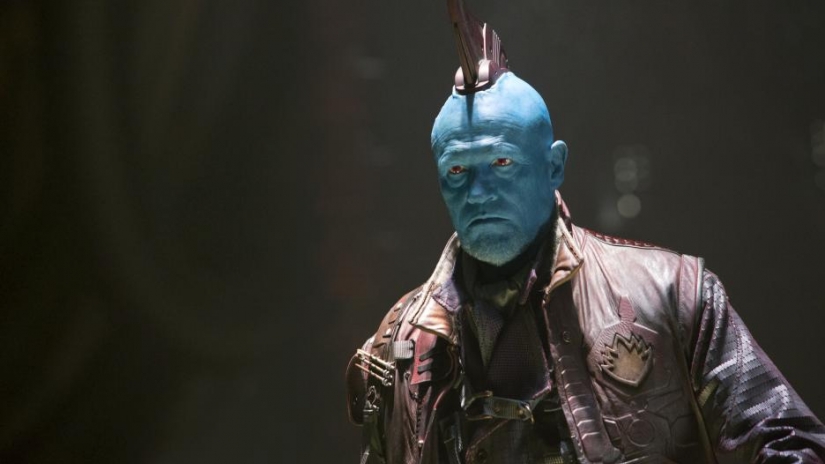
In the wake of the previous film, in which the rag tag band of misfits called the Guardians of the Galaxy brought down the Kree accuser Ronan and his schemes to destroy Xandar, the team find themselves dealing with Ayesha (Elizabeth Debickie), the somewhat cranky leader of the Sovereign, after a job doesn’t go quite according to plan. Peter Quill (Chris Pratt), Gamora (Zoe Saldana), Drax (Dave Bautista), Rocket (Bradley Cooper), and the sapling version of Groot (Vin Diesel) encounter a mystery man called Ego (Kurt Russell), who promptly reveals himself to be Quill’s biological father. Meanwhile, Ayesha hires Yondu (Michael Rooker, returning from the first film) and his rogue crew of Ravagers to track down the Guardians. It doesn’t take long before things get complicated.


Gunn wrote the story, having had co-written the original screenplay. The tale is largely based on the status quo of the team as brought together in the comics by Dan Abnett and Andy Lanning, who assembled a motley assortment of cosmic characters together to face dire threats in the universe. There’s an older version of the Guardians in the comics, from a thousand years in the future, and some of those characters show up here as well as the story goes along, albeit in a different context. Gunn’s story continues the funny, space meets swashbuckling tone of the original, blending in the personal- the search for answers about a person’s heritage and just what family really means- with the large scale in the form of a dire threat to galactic peace.


Along the way there are some character developments woven into the narrative- Nebula’s change of allegiances is a welcome one, while Yondu’s motivations for taking the young Quill from Earth in the first film become clear, and having Groot remain pint sized through the bulk of the film is a creative contrast from the first film, where the three word speaking walking tree was the biggest member of the ungainly team. In fact, the little Groot's status quo provides quite a laugh early on while he dances during the main titles- with a massive battle taking place in the background behind him, establishing the irreverent tone of the film.


The story also presents a new character, Ego, in pretty much the only way he’d work in a live action movie. In the comics, Ego is a living planet- when one approaches him, you see a planet, and facial features on that planet. Trying to transfer that over to live action, you’d wind up with something out of the original Star Trek television series- if all we saw was a floating head in space, it would end up coming across as very cheesy. Instead we have a Celestial being who can present himself as a human being, but is deeply connected to the planet he calls home, and it’s a good work around of where the character came from.


Gunn takes all of these elements and weaves them into the film, which his directing style is well suited for. As previously shown, Gunn has a good touch for the comic book adaptation, particularly the cosmic level of it all. He can give us a scene set in the midst of chaotic battle and ferocious fighting, and keep track of what’s going on. We see fantastic worlds, distant stars, and strange looking alien beings, and while a lot of that comes down to CGI, it all blends well in with what the actors do. This is probably best manifested in Ego’s planetary form, which winds up being perhaps the biggest visual effect in movie history, but it also shows earlier on, giving Russell a younger look in the opening sequences set in 1980.


The cast are all well chosen in their roles. There are a multitude of cameos- Stan Lee gives one of his funniest yet, and actually kind of feels like a connection to all of his other cameos in the Marvel Cinematic Universe. Michelle Yeoh, best known to American audiences for her Chinese spy protagonist in the Bond film Tomorrow Never Dies turns up as Aleta, one of Yondu’s old crew, while Sylvester Stallone joins the MCU as another former friend of Yondu, Stakar, suitably grumpy but principled in the role. There’s a moment between his character and Rooker’s Yondu that’s a good reversal of roles the two actors played in terms of an estranged friendship in Cliffhanger.


This isn’t the first time I’ve seen Elizabeth Debicki in a film- she appeared briefly in the 2015 Everest, but this time she makes more of an impression as Ayesha, a long time presence of the comics. The character is a high priestess and leader of her people, and the actress plays her as someone devoid of humour, pompous, and not to be trifled with. Pom Klementieff appears as Mantis, a character well established in the comics with ties to the Guardians, the Avengers, and others. She’s an empath, with connections to Ego, and her encounters with the Guardians brings out a new aspect to the character. Lacking social interaction throughout her life, she’s something of an oddball, curious about what she encounters, and the way she plays off of Drax, who’s an oddball himself, is particularly fun to watch. Karen Gillan returns from the original film as Nebula, where she was an antagonist. She’s a sister to Gamora, and the film touches on the darkness in their backgrounds. Gillan takes what was an unsympathetic character and makes her someone the audience can empathize with- we see the emotional cracks in her armour as the story goes along.


Kurt Russell turned out to be an inspired choice for Ego. In the comics, Peter Quill’s father is a ruthless bastard and ruler of an alien race called the Spartax. It was clear that the cinematic version would not be that character, but it was hinted in the first film (courtesy of Yondu) that Quill’s father had that same quality. Ego is welcoming and friendly at first, but he’s hiding a whole lot of secrets from everyone, and Russell plays the character in a way that’s close to the vest- we’re not really getting inside his head. He might seem friendly, but there’s more beneath the surface, which is fitting, considering he’s a planetary being.


Michael Rooker returns as Yondu, the hardass alien with a rather handy fighting style from the first film. He was less sympathetic last time out- after all, he came to Earth, kidnapped a child and took that child out into the stars for an unclear reason, and was generally hesitant to get involved and do the right thing at first. The reason he didn’t bring Quill to his father plays out here in this film, and Rooker retains the hardass aspect of the character while becoming the third element of a story of a son and the two father figures in his life. His character rises to the occasion as things go along, and the actor makes it the best performance of the film.


Bradley Cooper does voice duty as Rocket, the genetically engineered cranky alien mercenary who happens to look a lot like a raccoon. He complains, he wonders what his place is among the Guardians, and he takes care of Groot (whose same three words over and over again he understands perfectly well). Rocket’s a formidable character, largely CGI, but Cooper, whose work in live action I generally avoid, gives the voice of the character the right amount of grumpiness (and even poignancy) it requires.


And speaking of vocal roles, the same applies to Vin Diesel, who returns to voice Groot, the walking tree who’s more of a sapling this time out. All we ever hear him say is “I am Groot”, even though in each instance, the meaning of the words are vastly different. The CGI of the sapling Groot (or Baby Groot if you will) renders the character as oddly cute, where the full sized version of the first film was formidable. For Diesel, the challenge would have been in the nuances of a line recorded in post production- what context are those three words used in at any given moment- and in giving Groot a vocal sound that’s quite different from what the actor actually sounds like.


Dave Bautista returns as Drax, and again, proves to be hilarious to watch as he goes along. The character is a warrior sworn to revenge against Thanos (who will eventually turn up big time in the cinematic universe). He’s a formidable looking wall of alien muscle, the sort you wouldn’t want to pick a fight with, which works well for the actor, who comes from that kind of background as a wrestler. Bautista adds into it a certain obliviousness, socially speaking, to personality interaction (Drax can make the whole room feel awkward), and a hint of innocence and heartbreak- there’s a moment when he’s speaking of his late wife that plays to that. He’s also become more invested in the idea of the Guardians as a family.


Zoe Saldana returns as Gamora, the fierce warrior without much of a sense of humour, drawn out of a dark background. She’s resourceful and cunning in a fight, but keeps her guard up, particularly with Nebula (until the walls come down for both of them), but also in a different way with Quill. The actress gives the character a sense of tough fortitude, and a yearning for redemption from her own past. As much of a force of nature as she is in combat, she’s also the voice of reason in this motley team of misfits at times, which is a refreshing touch, and she and Pratt give their characters just the right touch of chemistry.


Chris Pratt reprises the role of Peter Quill, the human who’s spent most of his life out in the stars, abducted in the wake of his mother’s death from cancer, not knowing who his father was, and growing up among inter stellar mercenaries. It’s made him something of a swashbuckler, a dashing charmer who’s trying to be more responsible now. Finding his father- with the mixture of emotions that has to bring- doesn’t quite lead to what he might have expected, which Pratt plays off of. Learning that his half-Celestial side gives him access to great power might seem ideal at first, but ultimately the character’s humanity serves to be his anchor.


Guardians Of The Galaxy Volume 2 serves up more of the irreverent, adventurous tone of the first film, while addressing the idea of what family really means. While its protagonists might bicker endlessly, we can see the informal family they have become, and the story, cosmic in scope but quite personal too, plays to that. It opens new horizons in the Marvel cinematic universe, presents a threat of a formidable scale, and proves to be a thrill ride that mixes together humour and poignancy- sometimes in the same conversation. 

Saturday, August 2, 2014

Never Call The Raccoon A Raccoon

Some links before I get started today on this film review, which Norma has reviewed as well. Shelly has a new grandson to celebrate. Check out this museum at Krisztina's page. Yesterday was a Square Dog Friday at Parsnip's blog. And The Whisk asked a pressing question of the gravest importance. 


"The fate of twelve billion people is in your hands." ~ Nova Prime Rael

"So here we are. A thief, two thugs, an assassin, and a maniac. But we're not going to stand by as evil wipes out the galaxy." ~ Star Lord


Guardians Of The Galaxy is the latest in the series of films from Marvel Studios, a space faring romp through the cosmos with a gleefully anarchic sense of fun. Director James Gunn helms the film, working with fellow screenwriter Nicole Perlman in telling a story of a group of misfits out among the stars confronting threats and learning to work together. The roots in comics reach back decades, when a team by that name was first formed in the pages of Marvel comics, having adventures a thousand years in the future. The configuration of these characters, however, goes to the writers Dan Abnett and Andy Lanning, who several years ago were heavily involved in writing the cosmic side of things at Marvel. Abnett and Lanning took a group of star faring characters who had been around at Marvel for years, joining forces and taking the name of the previous team. The core of that group helm this movie, and the film's story owes much to Abnett and Lanning's work. There is an ongoing series being published at the moment with the team, though I advise you to avoid it entirely- it is being written by the worst writer in the industry, a man who just happens to be the best friend of Marvel's head honcho.


The film opens up in the past, when we meet Peter Quill, a boy whose mother has just died. He is abducted by space pirates, led by the alien Yondu (Michael Rooker), and taken into the stars. Years later as an adult, Quill (Chris Pratt) has taken to calling himself Star-Lord and is in the midst of stealing a mysterious orb when he is intercepted by another alien, Korath (Djimon Hounsou). The orb itself, it turns out, happens to contain an Infinity Stone, something that can tend to be very dangerous in the wrong hands. His theft attracts other attention beyond Korath: Gamora the assassin (Zoe Saldana) is dispatched after him.


Two bounty hunter partners, a genetically altered raccoon called Rocket and a walking tree called Groot get mixed up into the mess. The interstellar peacekeeping Nova Corps arrest the lot and throw them into a cosmic prison, the Kyln, where they encounter another entity, Drax the Destroyer (Dave Bautista). Drax has a grudge or two against Gamora, because of her association with a big bad named Ronan (Lee Pace). Ronan is a particularly nasty fellow (at least in this movie; the comics version has tread the line from acting as an antagonist to an ally). Gamora, however, isn't loyal to Ronan, and the group find themselves banding together, first to escape, and then to deal with the grave threat Ronan and his allies pose against the galaxy as a whole.


Gunn and Perlman's story leans heavily on the influences of Abnett and Lanning, and yet tells a story that stands on its own quite well. It stands apart from the previous Marvel films in that it sets its story out among the stars, and it infuses a sense of humour into the proceedings. This reflects itself in the makeup of the team, who are brought together not particularly in a voluntary way, and bicker with each other all along. It reflects itself in small ways- the incredibly bad taste of music on Quill's Walkman (his mother's musical inclinations, was, in a word, awful), or the way no one takes Quill's personal nickname seriously. Quill himself is written as a rogue, a fish out of water with an influence of Han Solo about him, a snarky and sarcastic character. The snarkiness certainly extends to another member of the team, the cranky Rocket, a motormouth voiced by Bradley Cooper. The story, over all, builds on the classic cinematic notion of a Maguffin (the heretofore mentioned mysterious orb) that everyone wants, and while it has all of the sci-fi action you would expect out of a comic book adaptation, the story has fun with itself, in the way that a good sci-fi film ought to be.


The special effects serve the story well. Having a story set out in the stars offers a variety of realms, and special effects and CGI render these realms in different ways. The world of Xandar, home of the Nova Corps, is an orderly- somewhat too orderly- world, clean and sterile somewhat. Other places are murky, particularly the Kyln or Knowhere, a refuge the team take to. That gloom extends to the lairs of Ronan, or his patron Thanos, who we've seen before. By contrast, the archives of the Collector is a place of the bizarre, and that comes across in the special effects. At times, of course, and that's to be expected in a comic book adaptation, the action can overwhelm the story, with the explosive pyrotechnics you'd expect, but it didn't become tedious at all to me.


Where the CGI and special effects particularly come out so well are in the renderings of two main characters. Groot and Rocket certainly come across as inhabiting the same space as the actors. Part of this might involve motion capture, the techniques being used in The Lord of The Rings and The Hobbit films to such good effect. The snarky raccoon very much feels like he's scurrying about on gangways and in starships, just as much as his lumbering partner Groot comes across as a cohesive, real presence in the shots. Best of all- neither of the pair come across in the same obnoxious way as an infamous certain Star Wars character (Jar-Jar Binks, I'm looking at you). 


The cast make the most of their parts. For some it's taking things more seriously (villains tend to be quite serious, after all). For others, they're having something of a romp playing their roles, even if they can't quite show it. Glenn Close turns up as the head of the Nova Corps, and she plays the role with authority, albeit little tolerance and patience for nonsense and backtalk. She certainly comes across as a believable leader, and it's a pleasure to see her playing a very different part from what you might expect. John C. Reilly is one of her lieutenants in the Corps, and he gives his character something of a more sardonic quality. Michael Rooker, a character actor who's been in movies and television for years, plays Yondu with a slightly shifty moral worldview and a gruffness that you'd expect out of the actor from previous roles- but I liked him regardless. Benicio Del Toro returns as the Collector, after an appearance in Thor The Dark World. He's an eccentric sort of character, an elder being of the universe who seems to have a bit of a Liberace flamboyance about him, and a fondness for odd items. He plays the part as the weirdo a comics fan would imagine the Collector to be.

Djimon Hounsou has been around for years as an actor too, playing in historical dramas, action films, and more, often in memorable character roles. He plays the Kree Korath as the capable subordinate to Ronan, and gives him a rather impatient quality. There's an appearance by Josh Brolin as well, doing the voice of Thanos (a villain we'll see again). The character is as menacing as he'll continue to be down the line, and it was a good touch to give him the role. Karen Gillan plays a particularly unhinged character named Nebula. She and Gamora have connections, but are at each other's throats. I haven't seen her in anything before, but she gives Nebula a formidable, manic quality that I liked. Lee Pace has been appearing in The Hobbit films as the elven king Thranduil, and here he plays Ronan with conviction and weight. Ronan as a character has often been a villain, but sometimes not, and Pace gives him a serious, determined, and ruthless quality that you'd expect in an antagonist. His Ronan feels dangerous indeed.


Vin Diesel voices Groot- which is actually an easy job. Probably because Groot actually only speaks three words (though Rocket understands the differing meaning of those three words). I found myself wondering if Diesel got into a recording booth, did a few takes, and was done with his part for the film, or if there was motion capture involved. Bradley Cooper does the voice for Rocket, who tends to chatter a lot. This is a mixed factor for me. I didn't mind Cooper back when he was a cast member of Alias, but at some point after that, when he became famous, I began feeling a profound dislike of the actor. Fame seemed to get to his head, and frankly, the guy comes across as a complete sleazebag. That said, however, I didn't find myself distracted by that dislike. Perhaps just having the voice was a factor in that; I was listening to the character instead of the actor. Had he actively been appearing on screen, I might have felt different, but he does capture the snarkiness and crankiness of Rocket as I would expect.

Dave Bautista comes from a background in professional wrestling, so we're not talking about a formal actor here, but he actually does well as Drax. The character is a blunt force of nature, a wall of muscle driven by the idea of avenging the death of his family. Bautista really does look the part, and gives the character a  threatening, physical presence. Yet there's also in his role a degree of sympathy that we can relate to. There is much tragedy in the man, and Bautista conveys that. It's actually a surprise, because I wouldn't have expected that of a wrestler.


Zoe Saldana has been doing quite a bit of sci-fi in the last few years. She was in that miserable wretched excuse for a blockbuster otherwise known as Avatar (what can I say? I hate Avatar), and she's been a key player in the two Star Trek reboots under director J.J. Abrams. She plays Gamora as I would expect. The character is a thoroughly dangerous woman, and yet with multiple layers. She keeps much to herself, and yet is driven by a conscience and awareness of the right thing to do. She guards herself closely, but acts with courage and without hesitation when the stakes are high. Gamora finds herself puzzled by her comrades at times, impatient at others, and Saldana conveys these qualities in her performance, grounding the role in the character's need for redemption. She also brings good chemistry to her role with the last of the major players.

This is actually the first time I've seen Chris Pratt in any role. He's been on the series Parks And Recreation for years, and a look at his filmography reveals that he was in the tense Zero Dark Thirty film, but I have never seen his work. He plays the part with sarcastic glee, starting off as a man out of his element, out for himself. Placed into a crisis, however, he seems to come into his own, finding a sense of meaning for himself. He certainly exercises some of the disdain for authority that you would expect in Han Solo, for example, and I liked that, but when push comes to shove, he gives Quill a sense of leadership that feels natural for the progression of the story. Pratt's performance becomes part of the fun of the film, and a nice revelation to the viewer who's first being introduced to him as an actor.

Guardians Of The Galaxy especially cranks up the sense of fun at the box office. It features a motley group of misfits thrown into cosmic stakes danger, moves the story along at a brisk pace, and brings a good sense of humour to the proceedings. I had fun with this film; I think you will too. Even if the post-credits sequence features an extremely unwelcome character that should be cast into a black hole with all possible speed.


Friday, June 6, 2014

Stepping Into The Fields Of Normandy

"Soldiers, sailors, and airmen of the Allied Expeditionary Force. You are about to embark on a great crusade, toward which we have striven these many months. The eyes of the world are upon you. The hopes and prayers of liberty loving people everywhere march with you." ~ General Dwight Eisenhower, 1944

Today is the seventieth anniversary of D-Day, the landing of American, British, and Canadian forces on five beaches in Normandy during World War Two, and the turning of the tide on the Western Front. I thought I would review one film that takes D-Day as part of its subject matter. I would also recommend you find The Longest Day, or Ike: Countdown To D-Day for a more recent examination of the lead up to the invasion from the point of view of the commanding general.


"I don't gripe to you, Reiben. I'm a captain. There's a chain of command. Gripes go up, not down. Always up. You gripe to me, I gripe to my superior officer, so on, so on, and so on. I don't gripe to you, I don't gripe in front of you. You should know that as a Ranger." ~ Captain Miller

"You wanna explain the math of this to me? I mean, where's the sense in risking the eight of us to save one guy?" ~ Private Reiben

"Why do I deserve to go? Why not any of these guys? They all fought just as hard as me." ~ Private Ryan


Saving Private Ryan is the 1998 war epic by director Steven Spielberg, following a squad of soldiers in the wake of the D-Day landings, as they set out on a mission into the French countryside. The film won Spielberg a Best Director Oscar, among several other Oscars and awards, and is a harrowing, graphic exploration of war at its most horrendous. While it tells a fictional story, the story carries an authenticity about the life of the soldier in the Second World War, exploring personalities of different men as they drive deeper into occupied territory.

The film starts and ends in Normandy five decades after the landing, with a veteran and his family walking through the military cemetery at Omaha Beach. We are then drawn into the bloody landing at Omaha Beach, following a number of soldiers off a landing craft as they storm the beach and German defenses. They're led by a captain, John Miller (Tom Hanks), and after men fall around them in the barrage against the landing, the squad breaches German defenses, achieving their objective. The first half hour of the film is a violent, brutally realistic view of the invasion from the boots on the ground viewpoint. That very same viewpoint will carry on through the rest of the film.


While Miller and his surviving Rangers catch their breath, the camera shows us a body on the beach. For the only time in the film, the story takes us across the ocean to the halls of power, where the identity of the body is brought to the attention of General Marshall, who learns three brothers have fallen in the line of duty in various theatres of war, and the fourth, a private who parachuted into Normandy, is unaccounted for. He insists that the private be found and brought back home. The mission is given to Miller, who picks the core of his squad to go with him. His right hand sergeant Horvath (Tom Sizemore), rounds up a sardonic private, Reiben (Edward Burns), a sharpshooter, Private Jackson (Barry Pepper), the medic, Wade (Giovanni Ribisi), and two more riflemen, Carpazo (Vin Diesel) and Mellish (Adam Goldberg). They've all faced battle together, and while they might bicker and annoy each other, they know they can count on each other. Miller also brings in a cartographer from the staff, Upham (Jeremy Davies), because he knows he needs someone who can speak French and German. And so the squad sets out from the beachhead in search of a lone private (Matt Damon), who has no idea his brothers are dead.


The story was written by Robert Rodat, who first drew inspiration for it after seeing a Civil War monument about the deaths of eight siblings in that war. Rodat transplants the essence of that into the Second World War, giving the soldiers a mission, one they question the sense of, but one that we can be sympathetic with. A family shattered by the loss of three sons makes for a compelling reason to go after the last son. And while it's a fictional story, it certainly rings true. The Sullivan brothers, for instance, all died during that war when their cruiser sank during the Battle of Guadalcanal. Rodat's script is intensely character based- as much as the story follows a narrative through the ruins of occupied Normandy, it's grounded in these eight men, all of whom are explored in detail and given depth, and in the young man they're out to find, who doesn't believe he has the right to go home.


Spielberg used the work of cinematographer Janusz Kaminski for this film, giving the tone of the film a gritty, devastated look, which perfectly fits Normandy at that time. They shot much of the film in Ireland and England, standing in for Normandy, but the setting looks like you might expect of France in the Second World War- ruined villages, damaged homes, destroyed countryside. The film has a washed out quality in the images, lending it a sense of time and place. Kaminski worked with Spielberg on Schindler's List, and that same tone of harsh realism permeates the entire film; his work would win the Oscar for Best Cinematography, and rightfully so. Colours feel muted, and the finished film has something of a newsreel sensibility to it, completely desaturated. The camerawork also adds to the sense of authenticity to the film- Spielberg chooses to film close and with tight angles, instead of at a distance. During the opening sequence, for example, it feels like the camera is the point of view of a soldier on the beach, including the carnage of war, the noise, and the bloodshed. It's intensely personal, this camerawork that really gives us that boots on the ground perspective. It was a wise decision. 


The sense of authenticity lends itself as well to the work of the crew. The uniforms take us back in time to the era, as do the weapons and vehicles. The same applies to civilian clothing and ordinary items- everything feels like it's drawn out of the past, as if we're walking through the carnage of Normandy in the days following D-Day. Attention to detail is, in a word, rendered with great care, and it really shows. The uniforms, for instance, feel lived in, and the actors look exhausted and drained, a testament, perhaps, to the fact that many of them were subjected to a rigorous boot camp to prepare for the film. The battle sequences have been acclaimed as realistic, and while violent, the purpose is to demonstrate the brutality and desperation of battle. In all that carnage, there never seems to be a gratuitous moment. As well, Spielberg's regular collaborator John Williams delivers one of his finest scores, one that is a stark contrast to much of his work. The music only shows itself in the quieter moments, rather than the epic sweep of battle. It gives the audience a moment to breath, and the music in and of itself gives a noble, stirring quality to the film.


There are a number of cameos scattered in various places. Dennis Farina turns up early on as Miller's superior, giving him the assignment. He doesn't like handing the mission to Miller, but stresses its importances. Paul Giamatti and Ted Danson turn up along the way as soldiers Miller and his squad meet on their way to finding Ryan. Giamatti's sergeant is a hardened sergeant among the paratroopers, playing the role as cynical. Danson, playing a fellow captain, learns of Miller's mission, urging him to find the private and get him home, and we sense he means it. All three actors play these roles with a sense of authority as they go along. Another cameo features an early performance by Nathan Fillion (Castle; if you haven't seen the series, you're missing a lot). He turns out to be the wrong Private Ryan, and serves as a brief red herring- the news that his brothers are dead is wrong, but you can understand his reaction. Harrison Young plays Ryan as an old man. When we first see him at the beginning, we don't know who he is, but he conveys the essence of a man who survived the war, and yet feels the sorrow and pain of knowing so many young men died and he got to live. When we catch up to him again at the end, Young's performance rings true to the performance of Damon, and comes across as one of the more poignant performances in the film.


Jeremy Davies occupies the role of Upham, playing him as an outsider. The character is perfectly happy as a staffer, and gets drawn into hazardous duty without really having a choice. He wasn't part of the invasion in the first place, and so hasn't seen battle. He finds himself trying to figure out how to fit in with the rest of the squad, all of whom have seen battle. He's an intellectual, and at one moment, a moral center for the story. At another moment, late in the film, he has an all too human reaction, freezing up in the midst of battle. It's a complicated character, which must make him compelling to play. Vin Diesel as Carpazo is perhaps the least developed of the core squad. Part of that has to do with his fate, and part of it has to do with the fact that Diesel's not that good an actor. He plays the part though as someone who can stay calm in the heat of battle, and yet wears his heart on his sleeve. Giovanni Ribisi plays the medic Wade, and we get to see more of him. He's ferociously angry at moments during the beach landing as his work gets undermined by hellishly accurate German riflefire. He's a young guy who, like so many other soldiers, misses being home. Adam Goldberg gives the character of Mellish a somewhat cynical air. Mellish talks a lot, is something of a wiseguy, and yet is very much aware of the German attitude towards his people. He taunts prisoners of war with the fact that he's Jewish. For him, the personal nature of the war has an added dimension.


Barry Pepper is one of those actors who, for the most part, tends to be interesting in whatever he's in (there are a couple of exceptions, but he's not to blame for disasters like Battlefield Earth and The Lone Ranger). He plays an exceptional marksman who quotes scripture while killing enemy targets, finds himself calm during battle, and suggests the war might end sooner if he was assigned to go after Hitler personally. It's not arrogance- the character simply knows how good he is with a rifle. Edward Burns is the sarcastic and cynical Reiben, plays him as a wiseguy who tends to talk back. Reiben is suspicious of the notion of wasting time going after one man, to the point of disgust when two of their own die, and yet acts protectively during the climactic battle for a private whose life he has held in disdain. Tom Sizemore embodies the sergeant Horvath just as you'd expect. He's a tough guy, feels like he's been in the army for most of his life, and carries himself like a soldier. He keeps the others in line, makes himself indispensible for Miller, and despite the tough exterior, can see the value of the mission.


Matt Damon hit it big before this movie was released with Good Will Hunting, but there's still a freshness in the performance despite being well known at that point. He plays the role as someone who's torn between his duty and the grief he feels for his brothers. He doesn't believe he deserves the right to go home, despite the fact that the order is coming down all the way from the top. He's quite defiant on the point that he must stay where he is until reinforcements can come up to the ruined town where he's posted. And at the same time, we see the agony of his grief moments later as he silently sits among his fellow paratroopers. And in the calm before the storm, we learn more about him, both in a story he tells that proves to be a darkly hilarious tale and in how Miller says that Ryan reminds him of so many students he taught down through the years. And the added touch, in that conversation, in which Ryan admits he can't visualize his brother's faces, rings true to anyone who's suffered a recent grave loss- the shock of the grief does that.

Hanks gives the central role of Miller the gravity and weight that it deserves. He leads his men forward into battle as a natural leader- despite the trembles he does his best to conceal. He manages the personalities of the men under his command. There is a weariness in the character that Hanks brings across, along with a quiet wisdom and an inner resourcefulness. There are moments of gallows humour in the character, but also the behaviour of a commander who knows he must show concern for his men. He feels the losses of fallen men intensely, though he can't show that to the men. And at a pivotal point when the mission seems to be at a  crisis, he is completely honest with his men, giving them insight into himself, and the audience a glimpse at the man inside. In doing that, he defuses the tension in the scene, and it's one of the most powerful scenes in the film.

Saving Private Ryan has established itself as a classic in the war genre, and a truly great film. It is both an epic and an intensely personal, character driven film that deals with the themes of the brotherhood of war, the meaning of courage, and the brutality of battle. It is harrowing and graphic, but it needs to be. It is a gritty, realistic look at the Second World War from the perspective of men on the ground, and is a masterpiece from the director.