Faith Can Move Mountains... But Dynamite Works Better
Showing posts with label Richard E. Grant. Show all posts

Wednesday, March 8, 2017

A Drunken Hobbit Walks Into A Bar


“Nature made me a freak. Man made me a weapon. And God made it last too long.” ~ Logan

“Charles Xavier, the world famous mutant octagenarian.” ~ Donald Pierce 
“Actually, I’m a nonagenarian.” ~ Charles Xavier

 “She is not my daughter, but I love her. You may not love her, but she is your daughter. Please, help her.” ~ Gabriela

“I have nightmares. People hurt me.” ~ Laura

“Beware of the light.” ~ Caliban

“See, you know who I am.” ~ Logan 
“I always know who you are, I just sometimes don’t recognize you.” ~ Charles Xavier
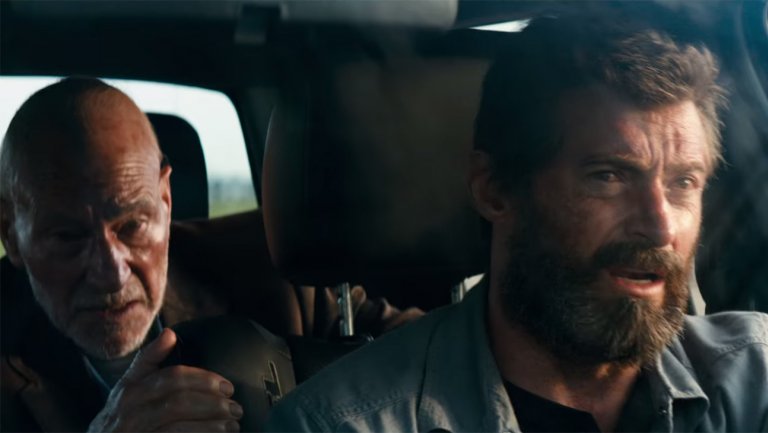

The simply titled Logan brings things full circle for two longtime members of the X-Men franchise. Hugh Jackman and Patrick Stewart, who have played the characters Wolverine and Charles Xavier off and on since the first Bryan Singer adaptation in 2000, give their final performances in those roles in this film, which mixes together comic book sources with dystopian elements and what ends up feeling very much like a Western. The result is a violent, stark, but tremendously effective film, one that brings out the best in both actors.


It’s the year 2029. We meet the former X-Man Logan (Jackman), who’s scratching out a living driving a limo in Texas. He’s looking older, with grey in his hair and beard, and his healing factor seems to be failing him. Logan is busy drinking himself into oblivion when he’s not driving people around. Every few days he heads south of the border into Mexico, where his mentor Charles Xavier (Stewart) is isolated at a wreck of a place in the middle of nowhere. Professor X is in the care of one of the last mutants, Caliban (Stephen Merchant), an albino with tracking abilities and a profound aversion to sunlight. Xavier’s ninety now, long past his days of teaching mutants how to use their powers. He’s ravaged by dementia that’s barely controlled by medication, and his occasional seizures can wreck havoc on those around him- a drawback of the world’s most powerful telepathic mind under the effects of age.


A woman, Gabriela (Elizabeth Rodriguez), approaches Logan for help for the girl (Dafne Keen) in her custody. She wants him to take them to a place in North Dakota.  He also meets Donald Pierce (Boyd Holbrook), an enforcer and cybernetically enhanced field leader for a research facility called Transigen. Pierce leads a group of black ops men called Reavers, and answers to the project head, Zander Rice (Richard E. Grant). He’s looking for Gabriela and the girl, Laura, asking Logan for help, but Logan refuses. Soon, the fate of the girl becomes critical for Logan, Xavier, and Pierce and his associates.


The narrative has several sources. James Mangold, the director, devised the story, collaborating with Scott Frank and Michael Green on the screenplay. Their story weaves together elements of the X-Men comic history while carving its own distinct path. A storyline called Old Man Logan is one element- an arc about an alternate reality future Logan whose healing factor has depleted, and who finds himself undertaking a hazardous journey in a dark future. While the sense of a journey and an older broken down Logan has common traits with that storyline, the film’s narrative is better written (the writer of that particular arc in the comics tends to be rather mediocre), and the future is not so far flung in the movie as it is in the source story. Another element from the X-mythos is Pierce himself, a member of the Hellfire Club in the comics, but inhabiting a different place in the film world. He is, however, partially cybernetic, which fits with his comics counterpart.


There are other nods towards the comics throughout, in contrasting ways. The way Caliban is presented, for instance, has similarities and differences- he looks more, well, disfigured in the comics, but the albino aspect of the character is retained, and in the film, he’s more thoughtful and articulate than the comics version. We also get hints of what might come to be called the New Mutants as the story goes along.

And the story also brings across a vital character, introducing Laura into the mix. Known to the project that created her as X-23, the character has been in the comics for years now, initially as a feral gender reversed clone of Logan. These days she’s taken up the mantle of Wolverine himself, as Logan’s dead (the comics version is the version I tend to refer to as the Drunken Hobbit). The parallels between comics and film in terms of her character tend to run close- we first see her as a sullen, quiet girl with a thousand yard stare who proves to be ferocious in battle.


Mangold already has credentials in the X-Men franchise, having had directed the previous solo film, The Wolverine, which featured Logan in Japan. His director’s style works very well here, as he tells a story that feels very much grounded in reality, one that takes on the tone of a Western. There are the other influences visible here and there- we get the sense of a near future in which things have gone wrong, something that’s common to dystopian themes. And we get some nods towards such a sci- fi future in terms of the technology we see- driverless trucks, vastly oversized farm equipment that seem to drive themselves, a limo that seems a few years ahead of our time, or airborne drones.


And yet Mangold’s film plays very much more like a Western, with clear differences between good and evil, the notion of a broken down former hero rising to the occasion for a good cause, and the interplay of humanity and the land. We get landscapes through the film that wouldn’t be out of place in a John Ford film. The production was done on location around Lousiana, Mississippi, and New Mexico (elements of which fill in for the wild reaches of North Dakota, while also doubling for Texas and Mexico). Mangold makes use of the landscape as the film goes along- particularly in the latter half- but his filming style lends itself well to the physical action. Fights are tightly focused, and yet allow you to keep track of things as a viewer. They’re also violent- this film has earned its R rating, and yet the story requires it. The same applies to chases, in cars or on foot, as the film goes along. The director tightly focuses things, and yet it doesn’t feel claustrophobic or shaky as some action directors would be inclined to try.


The cast are all well chosen in their roles. Richard E. Grant is one of those marvellous character actors you’ve seen in many a film or television project. The British actor sometimes might go for eccentricity in a character, but this time he plays his role as cool and calculating. Rice is amoral but brilliant, a man who has a previous connection to the X-Men films (we learn that Logan killed his father during his cameo in X-Men Apocalypse, which Doctor Rice doesn’t seem that broken up about). He’s in charge of what is basically the near future version of the Weapon X program, cares more for the notion of controlling and making use of a mutant as a weapon than any ethical concern. Rice is a cold blooded character, and Grant gives him a calm, steady presence.


Boyd Holbrook is well cast as Pierce, a long time nemesis to the X-Men in the comics as a member of the Hellfire Club, but making his first appearance in the film world. The actor played Cap Hatfield, one of the Hatfield sons, in the Hatfields & McCoys miniseries from a few years back, which I didn’t know until after I’d seen the movie. His Pierce is different from the comics version, working instead as a chief of security for a rather nefarious organization, though his cybernetic prosthetic arm is a good nod to his comics roots. Pierce is arrogant but capable as a leader of men, a dirtbag from the moment we first meet him (generally speaking, when you meet someone who likes wearing colour tinted sunglasses, odds are he will end up being a complete bloody prick of the first order- I say that with the benefit of personal experience). Holbrook gives the character a relentless and calculating energy that combines to make him a formidable adversary.


Stephen Merchant is very well cast as Caliban, a character I’ve never particularly liked in the comics. We saw the character briefly in X-Men Apocalypse, played by another actor, but this is a fresh take on the character. Caliban has an odd look to him, being an albino, one forced to seriously cover up if he wants to step out during the day. And yet Merchant gives the character a thoughtful, sympathetic quality, giving him heart. We empathize with him, and he can stand up to Logan in early conversations. Where Logan seems content to drink himself into a grave, Caliban is mindful of responsibilities, and Merchant brings that across in his performance.


Dafne Keen is a revelation as Laura, aka X-23, a product of a program meant to weaponize mutant power. Through the first half of the film, she’s largely mute as the eleven year old bundle of ferocious power (with adamantium claws to match). Yet as mute as she is, the character’s expressiveness really works well- that  thousand yard stare brings an intimidating quality to it, and Laura seems very aware of the world around her. Keen brings across the sense of a girl who’s not socialized that well, who’s feral at times, through that first half of the film. When she finally starts speaking, a mix of English and Spanish, it almost seems like she won’t shut up. She also plays the character with a sense of curiosity, loyalty... and outright stubbornness (which she comes by honestly). Watching Laura emerge from her proverbial shell, and seeing her change through the narrative of the film, is a great treat, and the actress conveys that. There’s a moment late in the film, in her performance, that will break your heart.


This is the last take for Patrick Stewart in a role he’s become quite well known for (though we might not be done with the younger version of the character as played by James McAvoy). His Charles Xavier is a broken man when we first find him here, his mind under the ravages of age, his telepathic abilities proving to be dangerous under the effects of a seizure. He speaks of voices and we wonder along with Logan if it’s nothing more than the dementia we find him in. When he’s himself, thanks to the medication Logan brings him, he’s filled with regret over an incident hinted at in the film. His X-Men are lost, and Xavier seems to be the reason for it. Stewart gives the role a fragility, looking older than his years, but also gives the character a sense of purpose. Hope has always been a driving force for Charles, and he finds it in a mute girl who’s quite like one of his X-Men. Stewart’s performance is powerful and poignant, a fitting send off for the actor to finish with.


Jackman has also said this would be his final time playing Logan. This is his ninth appearance as the character, counting his cameo appearances in X-Men First Class and X-Men Apocalypse. In one way or another, Jackman has always brought out the best in the character. I can’t stand the comics version of Logan, a short of stature ugly drunkard, but Jackman’s interpretation renders him well. Yes, he’s the best he is at what he does (which is pretty ugly, killing people with reckless abandon), but Jackman has tended to portray him as a broken man in many ways, always bringing new elements to that in different ways as the films have gone along. This has Logan as broken down beyond the emotional- his healing factor is failing him, so wounds don’t heal in the same way they had before. The character’s nearly two hundred years old when you factor in his origins from X-Men Origins: Wolverine, some of which got retconned by the events of X-Men Days Of Future Past, and time is starting to catch up with him. He’s not the fresh faced cranky mutant we met in X-Men back in 2000, but instead looks to be in his late fifties, worn down by life, limping and drinking his way into the grave.


The actor actually gets double duty in the film, playing X-24, a clone of himself, with none of the conscience and all of the viciousness, a stark contrast to the man Logan has become over time, which adds another interesting element to where the actor takes things. Logan is reluctant to put himself back out there on the line in this story, prodded more or less by his former mentor, and his own sense of guilt more or less gets the better of him. Jackman has mixed together a sense of ferociousness throughout his history with the character, combining it with a basic sense of responsibility and empathy- he does have a conscience, even if he spends a considerable amount of his time slashing and impaling gun toting henchmen. Things like that have always made his take on Logan a compelling one, and this final spin at the character is the actor’s best interpretation of the iconic role. Logan is haunted, grouchy, emotionally shattered, wants to withdraw from the world, and yet still rises to do the right thing.


Logan mixes together the world of the comic book adaptation with science fiction dystopia before weaving strong influences of the film western into its narrative. It’s ferocious at times, thoughtful and eloquent at other times, and violent. It gives us formidable villains, calculating and treacherous in their ways, all the more so perhaps because they don’t have powers such as those wielded by Magneto. The film introduces a young actress who makes a pivotal role her own, impressing the audience all the way and ultimately moving us deeply. And it gives two actors one last go at two iconic roles they’ve gotten to know very well indeed, and both actors make the most of it, giving poignant and powerful performances as they go along.

Saturday, November 22, 2014

Once Upon Twelfth Night, Or What You Will

Some links before I get started today. Norma wrote about medical issues and a new idea.  Yesterday having had been a Friday, Parsnip had a Square Dog Friday post. Krisztina had Thanksgiving ideas. Shelly related some family history. The Whisk posted about meatloaf.

Today I have a movie review....


“Make no compare between that love a woman can bear me and that I owe Olivia.” ~ Orsino

“The more fool, Madonna, to mourn for your brother’s soul being in heaven.” ~ Feste

“I’ll be revenged on the whole pack of you.” ~ Malvolio

“Why this is very midsummer’s madness.” ~ Olivia

“I left no ring with her! What means this lady? Fortune forbid my outside have not charmed her.” ~ Viola


Aside from a place of prominence on stage for centuries, the works of the Bard have often been adapted for the big screen by a wealth of creative talent. Laurence Olivier was a master in the genre in the classic era, and Kenneth Branagh has returned to Shakespeare’s works many times in our era. One of his best comedies, Twelfth Night, has often been staged around the world, but not so often brought into the cinema. The story that plays around with gender bending humour and upstairs-downstairs dynamics in a wealthy household appeals to audiences after all this time, and the roles are particularly sought after by actors. British stage director Trevor Nunn adapted the story for the silver screen in 1996, setting it in the 19th Century with a mixture of Victorian and Central European influences.


We first meet a pair of twins, Viola (Imogen Stubbs) and Sebastian (Steven Mackintosh) aboard a ship bound for home in Messaline. A storm wrecks their ship, and the twins are separated, each believing the other is dead. Viola washes up on the shore of Illyria with most of the survivors. Devastated by her grief, uncertain of where to go, and in a country in a state of perpetual tension with her own, she asks the captain to help her disguise herself as a man.


Viola takes on the name Cesario, coming into the employment of the Duke Orsino (Toby Stephens). He’s infatuated with the Countess Olivia (Helena Bonham Carter), who will see no suitors after the recent death of her brother. He sends Cesario with messages of his love for Olivia in the hopes that a new face might be admitted, and off she goes. Things get considerably complicated when Olivia finds Cesario much more interesting than the pleadings of the Duke. While all of this is going on, Sebastian is still out there, in the company of a sailor, Antonio (Nicholas Farrell). And there’s household politics going on in the home of Olivia. Her pompous steward Malvolio (Nigel Hawthorne) is at odds with her drunken uncle Sir Toby Belch (Mel Smith) and his friend Sir Andrew Aguecheek (Richard E. Grant). Maria (Imelda Staunton), Fabian (Peter Gunn), and the fool Feste (Ben Kingsley) are all caught up in Sir Toby’s plot to bring about the downfall of the prudish steward.


Nunn as a director has done a tremendous mixture of work, mostly on stage, but also on television and film, and he goes back and forth between Shakespeare and contemporary work. He adapted Shakespeare’s play for the big screen, condensing where needed for a movie running time, and wisely chose to set it in a mid-19th Century setting. The clothing varies between a mixture of Victorian styles, particularly for the women, and north Central European, in terms of uniforms for Orsino and his men. The props, things like muskets, for instance, or horse drawn wagons, feel very much of that era. This is a good decision, since Shakespeare seems to work particularly well in that era (Elizabethan era fashions, sufficed to say, look abysmal). He shot the film on location in the Cornwall area of England, particularly at two country houses, Padstow and Lanhydrock House, and the locations are beautiful, both a contrast from each other, both feeling very much like the domains of their residents. Nunn’s style of telling the story moves things along nicely, and respects the dialogue, which is an essential requirement in Shakespeare.


The crew makes full use of the locations to their advantage, and it leaves the audience wishing to walk through those halls, stroll through those gardens, and spend time in a place that feels familiar all while passing itself off as a fictional country. I enjoyed the way Nunn filmed the work as a whole- it doesn’t feel like theatrical staging, and yet respects its origins and its humour. He opens up with the shipwreck, for instance, an event alluded to in the play, but not seen, and he does well with it. Compare this opening sequence, for instance, with the closing sequence two years later in Shakespeare In Love, where Gwyneth Paltrow’s Viola, the inspiration for the character in that particular film, survives a shipwreck. A long interlude in a garden maze, for instance, where Malvolio is being lured into a trap by his antagonist through a letter, is filmed in a way that allows the audience to keep track of where everyone is. And a duel between Cesario and Sir Andrew has a brisk, chaotic, and very funny manner in the way Nunn films it.


When we first meet Olivia, she’s in mourning clothes, all black, including a veil, and the costuming department wisely change that as the story goes along. She’s charmed by Cesario, and that reflects itself in the lighter, more colourful clothing she wears. The costuming department also came up with just the right look for the uniforms of Orsino and his court. The soldiers all look very much like military officers, and rather like the sort of people you don’t want to start a fight with, all while still looking like they’re out of the 19th Century. One other aspect from the crew’s side of things that I enjoyed is the work of composer Shaun Davey. He’s an Irish composer who works mostly in classical composition, but has occasionally turned to film scores, in projects like Waking Ned Devine and The Tailor Of Panama. Davey weaves together romantic and comedic themes, and uses a mixture of symphonic orchestra and solo instruments in this score. He also adapts Shakespeare’s lyrics for the occasional song by Feste (Ben Kingsley really does have a good singing voice).


The cast are all marvelous in their roles, drawn from British acting circles, mostly from stage backgrounds. Nicholas Farrell has that background, has been on the big screen in Othello, Branagh’s film adaptation of Hamlet, as well as Amazing Grace. His Antonio is something of a fugitive, a man with reason to avoid the court of Orsino, having had once been in conflict with them. Nonetheless, he is a loyal friend to Sebastian after saving his life, putting himself in peril by staying with him. And at a critical moment late in the play, he shares in the confusion many other characters have about the twins- and has an angry reaction that works perfectly, hinting at the gravity of the actor. 


Steven Mackintosh gets the part of Sebastian, which can be something of a thankless role. The audience is much more invested in his twin sister, so he gets the short end of things. Mackintosh bears enough of a resemblance to Stubbs that the audience can buy the twins angle of it all, even while we must suspend disbelief that no one is really noticing slight differences in their appearances. He gets more to do as things move towards the end of the film, particularly in getting confused by the lady Olivia and getting caught up in a fight with people he’s never met, and yet who think he’s someone else.


The late Nigel Hawthorne (Yes Minister, Richard III, Demolition Man, Amistad) gets a great role as Malvolio- as much of a pompous ass as the character is, actors love to play him. He’s full of himself as the story begins, a man who sees himself as the model of good behaviour, and who frowns on misbehaviour such as that coming from Toby and Andrew. He’s a sanctimonious man, sneering at anyone who he dislikes, and feeling very much in charge of the household. He’s devoted to Olivia, even harbouring feelings for her. And while he certainly deserves his comeuppance- and it gives the actor some wonderful comedic opportunities- we can’t help but feel for the man by the time it’s all done. It’s a performance that brings out laughter and yet works in a poignant way as well.


Imelda Staunton would, years later, go on to play the seemingly polite but really malicious Dolores Umbridge in a couple of the Harry Potter films. This was the first time I ever saw her in a film, and I like her as Maria, Olivia’s closest servant, the senior maid in the house. She scolds Feste, who has a habit of wandering off whenever he pleases, and scolds Sir Toby for his drunkenness, but at the same time, there’s a fondness in the character for both, and Staunton particularly has good chemistry with both Smith and Kingsley.


The late Mel Smith, who was so delightful as the Albino in The Princess Bride, has a comic touch in most of his previous work in Britain. He plays the debauched, drunken foolish uncle Toby in just the right way. He’s a man who likes his drink, who’s rather crude and can be occasionally even unpleasant. He dislikes with intensity the tut-tut attitude of Malvolio- there’s a moment or two that we can imagine Toby hitting Malvolio just on principle. There’s also something of a devious, opportunistic side to the character, perfectly willing to benefit from his friend’s untimely death if it comes to that, or finding himself entertained by manipulating his friend into a duel. If we knew this guy in real life, we’d avoid him, and yet as a character he’s amusing.


Richard E. Grant gets another good role as Sir Andrew, a man who loves to drink, thinks of himself as a bright and eligible fellow, and yet is really, really stupid. He has designs of his own on Olivia, and yet is oblivious to her dislike of him. He fails to pick up on social cues from other characters, things that most people would grasp immediately. He doesn’t seem to understand that his friend is playing him for a fool. And when it comes down to it, Sir Andrew is something of a coward. Grant gets to play all of these qualities, and does so in a way that tickles the funnybone.


Ben Kingsley might be playing the fool in all of this, but his Feste is the wisest character in the whole story. He moves back and forth between the two households, playing whatever musical instrument he might have at hand, offering up wisecracking commentary on all that’s going on. Beneath his foolery and irreverence, however, there is a wise man, and one of empathy. There’s a great fondness between he and Olivia, who is unhappy at his absence when things start out, and yet completely lets her guard down with him and lets herself grieve in a way she won’t with anyone else. He sees Viola for who she is, even under the guise of a page, and banters with her from time to time in a way that clearly shows how smart he is. And yet even he is confused at one point. It’s a great performance from one of the best actors around, and Kingsley’s Feste is such an enjoyable character.


Toby Stephens comes from good English acting stock; his father was Sir Robert Stephens, a highly regarded Shakespearean actor, and his mother is the incomparable Maggie Smith. Stephens has done much of his work on stage, but has also appeared in movies like Die Another Day and Possession. His Orsino is a love-sick nobleman, very much in charge of his land. Stephens gives him the gravity the role requires- we can certainly believe him as a man respected by those who serve him. He gives the role the quality of a natural leader. At the same time, he plays the man as possessed by a love he cannot have, a brooding sort you might expect to meet in a Jane Austen novel (one wonders what he could do as Mr. Darcy), and totally oblivious to the affections of the young woman who’s passing herself off as a man in his employ. Viola as Cesario might allude to things in conversation, but she can’t say it, and part of the charm of the film is in how Orsino and Viola deal with each other. The dynamic between them plays off the way men and women look at the same aspects of life, particularly love.


Helena Bonham Carter is one of my favourite actresses, and rarely does she falter in a role (when it does happen, it’s generally the fault of someone else, such as in The Lone Ranger). She has to run the gauntlet of emotions as Olivia, starting out in a state of deep grief, withdrawing from the world, devastated by death in her family. Out of that though, and because of the influence of an impertinent page sent by Orsino, she comes back to life, and Carter plays that aspect in just the right way. She’s charmed by Cesario, finds herself drawn to ‘his’ irreverence, and is pretty much seduced in their first meeting without even realizing it. It draws her out of her grief, cheering her up, and she finds herself hopelessly attracted to Cesario, having no idea that Cesario is a fiction and the object of her affections is a woman. She sparkles in the role.


Imogen Stubbs also comes from a largely theatrical background in Britain, though she’s done some international work on film as well. She was the romantic rival of Emma Thompson in Sense & Sensibility, for instance. She was married to Nunn at the time this film was made, and it’s a great part for her to play. Viola is a comedic role, both poignant and funny, and as an audience, we root for her. She gains our sympathy early on in her mistaken belief that her brother is dead, and shifts into a more comic side of things as she learns how to walk, talk, and act like a man. She’s caught up in romantic misunderstanding, and yet the way she reacts amuses us, and shows us a woman who improvises and adapts as the situation requires it. Stubbs makes us empathize with Viola, charms us with her personality, and delights us with her response to the state of affairs she finds herself caught up in. And she has great chemistry with both Carter and Stephens in a rather unlikely love triangle that only gets more complicated as things go along.


Shakespeare gained immortality through his work, still performed today, and in fact best seen in performance, where the words come to life. It’s impossible for anyone to agree on what they might think of as his best work, but among his comedies, Twelfth Night is my personal favourite. I’ve seen it staged several times, as well as a couple of television versions. This cinematic adaptation is a favourite for me; it modernizes the setting, but holds onto the meaning of the play and respects Shakespeare's dialogue. It has a wonderful cast with extensive stage experience in Shakespeare, all well suited for their roles. And it maintains the great sense of humour and the romantic misadventures of Shakespeare’s play, all while giving the story the poignancy and tenderness it deserves.


Wednesday, October 29, 2014

No Trace Of Sparkly Vampires Here

Some links before I get started today. Parsnip has company. Eve took a drive and posted pics. Shelly has computer issues. And Maria had a recipe. 

Today I have a movie review for this time of year....


"Do you believe in destiny? That even the powers of time can be altered for a single purpose? That the luckiest man who walks on this earth is the one who finds true love?" ~ Dracula

"My friends, we fight not one beast but legions that go on age after age after age, feeding on the blood of the living." ~ Van Helsing

"When my time comes, will you do the same to me? Will you?" ~ Mina


Director Francis Ford Coppola, whose body of work includes The Godfather trilogy, Apocalypse Now, and The Outsiders, turned in 1992 to a different genre, that of literary horror with an adaptation of the classic novel in the acclaimed Bram Stoker’s Dracula. The film is a mix of horror, fantasy, erotica, and epic history, with a cast that mostly serves the story, a protagonist that is simultaneously the villain, and a rich vampire story that gets under the skin, all while reminding us in the post-Twilight era that proper vampires do not sparkle.


The film opens centuries in the past, in 1462, where a Transylvanian knight, Vlad Dracula (Gary Oldman) leads his forces to victory against Turkish invaders. His wife, however, believing him dead, has taken her life, and enraged by the priest’s remarks that she’s damned, he renounces God, vowing to avenge her from beyond the grave, and gives himself to darkness. This could have all been avoided if the priest was just a bit less rigorous in doctrine and a lot more compassionate, but that’s beside the point, and there wouldn’t be a story, would there?


In 1897, Jonathan Harker (Keanu Reeves), a solicitor in London, is being sent to Transylvania to make arrangements for a certain Count Dracula after the last solicitor, Renfield, lost his mind during a trip to Eastern Europe. Conveniently he happens to be residing in a nearby asylum, and is being played by the eccentric rocker Tom Waits. You would think that might be his first warning that a trip into Transylvania might be a bad idea, but no. He bids farewell to his fiancée Mina (Winona Ryder), who’s staying on with her friend Lucy (Sadie Frost). Jonathan sets out on his journey to meet his client, who appears in the form of an old man (with really weird hair and interesting shadows that seem to have a life of their own). The Count sees Mina’s portrait, which is a ringer for the long lost wife of his earlier years. Harker, meanwhile, remains largely oblivious of the odd shadow tricks, the mysteries involving mirrors, the way animals behave, the general creepiness of the castle, and lots of other things that would send most people running for their lives. At least he remains oblivious until it’s too late. By then the Count is on his merry path of destruction which will lead him into a bond with Mina and a vendetta with a group led by an unusual professor (Anthony Hopkins).


The screenplay by James Hart frames the story through the use of letters and journal entries, reflecting the fashion that Stoker himself used in writing the novel. This is a wise course, as it makes the film feel very much of its time. It emphasizes both the sensual and the horrific of the story as it goes along, giving us a monster that remains sympathetic. There’s even a dash of dark humour here and there, such as when Coppola cuts abruptly from the severing of a head to the next scene with a roast being cut. Coppola’s style renders the story in an over the top, operatic quality, but in a good way, giving the characters complexity and shades of gray. Where Dracula himself might be a monster, there remains some spark of nobility in him. And the vampire hunters themselves must admit they are not completely noble in the end; Professor Van Helsing remarks that they have become God’s madmen.


Coppola, who had a reputation at the time for going over time and over budget, wanted to keep to a schedule and a budget this time, and it started with extensive preparation in pre-production that paid off as he went along. His crew designed storyboards for the filming in a way that would have made filming proceed more smoothly. He chose to build sets for much of the film instead of relying on location shooting and the problems that might bring. And he had costume and set designers go to work, giving them the instructions to come up with something weird. And weird is in abundance. From the armour we first see Vlad wear into battle to the appearance (or appearances) of the Count to the garb of a Transylvanian carriage driver, weird is all over the place, and it’s not merely confined to Eastern Europe. We see it in the asylum, where the design of the place looks like the work of a lunatic. The work of the crew throughout has a nightmarish quality to the finer details, which fits perfectly with the story matter.


Coppola also refrained from using computer generated effects, going for more traditional techniques in conveying the special effects needed here and there in the film. It’s another wise choice, a nod to the tradition of horror in the past and the timeframe of the story itself. Dracula’s appearances and abilities are rendered in those traditional techniques, and each time, the effects work. Combined with his choice of camera angles and the overall look of the film, there’s a very artistic quality to the film, and it feels just right for the story. The production design overall in the film really shines, and the film won Oscars for makeup, Sound Editing, and Costume Design. Coppola’s choice of composer for the score was also ideal; Wojciech Kilar, a Polish composer, gave the score an Eastern European feel, with brooding themes and the sound of a dark chorus. The music perfectly complemented the story.


With one exception, the cast was very well chosen. Tom Waits as the mentally addled Renfield gives the role a complete eccentricity. He’s totally out of his mind, a servant to the dark count who’s given to chewing the scenery (and some insects) while confined in the local asylum. His performance is a very unsettling one, a surprise given Waits’ usual job. Sadie Frost plays Lucy as the naughty and not quite proper young woman of society, Mina’s best friend. She’s daring and bold, something that startles Mina, and as the story goes along and things become, well, complicated, that boldness continues to assert itself.


Cary Elwes (Glory, The Princess Bride) plays Lucy’s fiancé, Sir Arthur Holmwood. He gives the character an aristocratic and dignified touch; we first meet him as a man vying for the hand of the flirtatious Lucy, and we know he’s deeply attached to her, which makes it all the more troubling for him when things go terribly wrong. Elwes gets all the reactions right as the story moves along, and his transition from nobleman to vampire hunter feels appropriate. Bill Campbell (The Rocketeer) plays one of Lucy’s other suitors, the American cowboy Quincey Morris. He gives the role a brash, loud talking and thoroughly American sensibility, a man who says what he thinks and is handy in a fight. The third member of the group of suitors turned vampire hunters is played by Richard E. Grant (Twelfth Night). Jack Seward is a doctor who studied with Van Helsing, and is puzzled by the change in behaviour of Lucy over time. Grant, who’s one of those character actors so often interesting in whatever he does, plays him as a smart man, but also one who feels, as he says, like a blundering novice when confronted by something he doesn’t understand. Regardless, however, he’s loyal to his old mentor, and rises to the occasion when called for.


Keanu Reeves, however, is the exception to the casting that proves the rule. While he’s perfectly acceptable in films like Speed or The Matrix trilogy, he’s completely miscast here as Harker. He is totally unable to hold an English accent, and comes across as out of his depth. This particularly shows itself around actors like Oldman and Hopkins, who are such skilled actors, and his lack of range is clear. We just don’t believe him with Ryder; the chemistry isn’t there, and the problem is all on Reeves. He’s just dreary in the role.


Contrast that, then, with Anthony Hopkins, who seems to be having the most fun of the entire cast as Professor Van Helsing. He plays the part as an unusual scientist who accepts that there are things science cannot explain, who wages his own fight against evil, while still respecting his adversary- at least the man he once was. And he gives the role a natural authority as well. We accept him as the leader of this group because Hopkins brings the gravity and decisiveness to the role. It doesn’t hurt that humour in the film tends to originate from his performance, and he provides a great counterbalance to the restlessness of Oldman.


Winona Ryder does well as Mina (with a cameo early on as Dracula’s wife). She holds a better English accent than Reeves, certainly, though it’s not quite perfect. However, she inhabits the role in a natural way, starting out as unsure of herself, timid and less daring than her friend, and by the end of the film finds herself in an assertive and decisive role, her character having had gone through much along the way. She has good chemistry with Oldman, which is pivotal for their relationship, as she goes from feeling friendship for a man who happens to not be her fiancé (and who occasionally shapeshifts into other things and has a habit of drinking blood) to feeling much more.


It is Gary Oldman whose performance is the bedrock of the film. As an actor he’s a chameleon, given to taking on new looks in a movie, as we’ve seen elsewhere in Immortal Beloved, JFK, and The Fifth Element. He gives the Count, who’s been portrayed in too many films as a ghoul, a streak of humanity and heart. Yes, Dracula is a monster, but there’s a man in there too, and Oldman’s performance finds that balance in just the right way. He plays the Count as restless, driven by revenge and lost love, but still noble in the midst of his monstrous curse. It’s a towering performance by one of the best actors working today.

Bram Stoker’s Dracula is the way a vampire movie should be made, a Gothic thriller with a sensual romantic streak, a lavish and artistic production, and a story of a monster grown weary of immortality. It features a cast that is mostly chosen well, with two great actors in the form of Hopkins and Oldman as opponents in in a struggle of good and evil. It’s an ideal Hallowe’en movie.