Faith Can Move Mountains... But Dynamite Works Better
Showing posts with label Alexander's Empire. Show all posts

Friday, September 28, 2012

From Marketing Chimps To Creative Freedom


It's a busy day in these parts. Today you can find me guest posting at Lyn Fuchs' blog Sacred Ground, where I wrote about the Gatineau Hills here in the Ottawa Valley. As well, my dear friend, partner in crime, and fellow mischief maker Norma Beishir and I are trading blogs. You can find my guest post at one of her three blogs, Beishir Books.  Norma is the author of Alexander's Empire, Chasing The Wind, Angels At Midnight, The Unicorn's Daughter, and more, both in the traditional publishing industry and now as an independent. She's taking the reins here to talk about her experiences in the industry, her transition to indie writer, and the sort of material she wants to write these days. Norma is known for her fondness for Dove chocolate (it seems that she'll take bribes in that) and for the odd movie superheroes (it must be Chris Hemsworth without a shirt)...

Take it away, Norma!


I've been singing the praises of self-publishing for so long, people are probably wishing I'd learn a new song. But I am a wholehearted advocate of authors taking full control of their careers. These days, conventional publishing has little to offer authors who aren't occupying the top spots on their lists. Rarely do they get advances anymore. Or anything resembling promotion. The new or midlist author is left to do their own marketing, publicity and promotion, while getting far less in royalties than their self-published counterparts.

What does the new or midlist author get from conventional publishing? Prestige, to a degree. I'd rather have creative control!


I was a lead title author at Berkley. I got five and six-figure advances. I got advertising in major publications like Redbook and Good Housekeeping...but the Berkley marketing chimps didn't really know what to do with me or my books. Why? My novels don't tend to fit into specific genres. Berkley marketed them as women's fiction. To be honest, I've never really been clear on what "women's fiction" is. Is it romance? Glitz? Chick lit? All of the above?

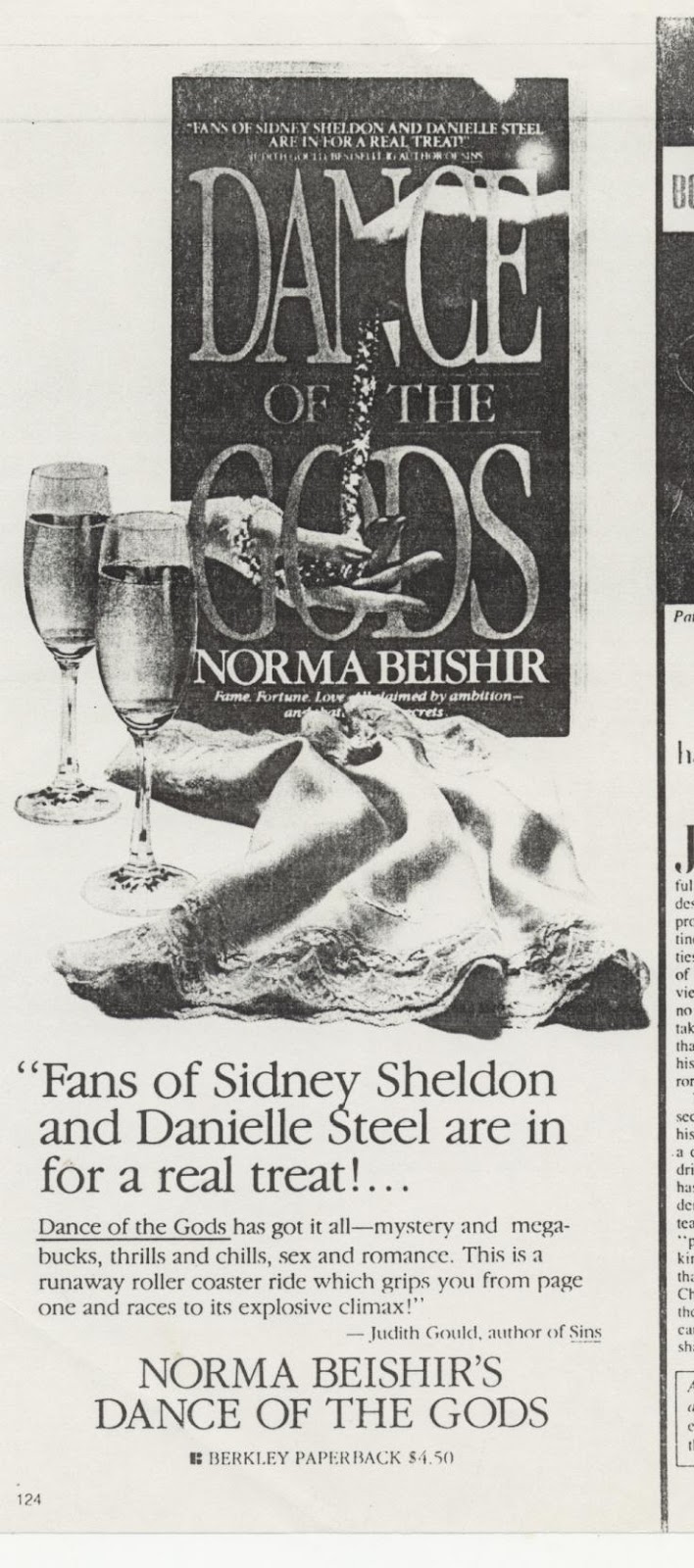
Marketing chimps have limited vision. Just ask William. Give them a genre-specific project and they'll run with it. But my novels are hybrids. For example: Alexander's Empire (which they published as Dance of the Gods) was a romance...and a mystery...and a family saga. Angels at Midnight--romantic suspense/glitz/adventure; The Unicorn's Daughter (originally published as A Time for Legends)--international intrigue/espionage/thriller/romance.

The marketing chimps were clueless.


Then there were the projects I really wanted to do, the ones Berkley rejected: a romantic adventure set in Kenya...a disaster tale involving seismologists in Asia...projects Berkley rejected because they weren't "glamorous."

Long, ugly story short: with Chasing the Wind, I eventually realized things had not changed. They still didn't know what to do with my books. It's a supernatural thriller. It's also a love story. The male protagonist is a modern prophet...yet the first thing I was told to do was to drop that element from the story. That would have meant a whole new plot. No way!


I finally realized I didn't belong in the world of conventional publishing. It wasn't an easy reality to face. Pride is the deadly sin I have the most trouble with, and I knew how that was going to look to the people I'd known coming up in the business. But then, pride had never gained me anything. It had only cost me in the end.

Now...I wouldn't go back for any amount of money. I write in any genre I choose. I'm re-releasing my backlist with new packaging and in some cases, different titles. I'm marketing them under the genres they best fit.  I'm crossing over characters--those I wrote about twenty years ago are connecting with characters from Chasing the Wind. Secondary characters from An Army of Angels have found their way into a planned series of romantic comedies. And the projects that were rejected for their lack of glamour may yet see the light of day. The marketing chimps would never have allowed me such creative freedom.

Think about that when choosing which publishing route you want to take.


Saturday, September 15, 2012

An Empire Of Secrets

Today I'm reviewing Alexander's Empire, by my good friend and partner in crime, Norma Beishir. The novel was originally published as Dance of the Gods during her days writing for Berkley. Norma is re-releasing the book on her own as an ebook, with a paperback to follow; the book is set to go active at Amazon this weekend, so keep an eye on her Amazon page. It'll turn up there, and it's well worth getting hold of... 


"There had been no letter, nothing to identify its sender—just a photocopy of a legal document that needed no explanation. Its message had been only too clear. Not knowing who sent it bothered Meredith most. It meant that someone knew the truth, someone who could turn it into a dangerous weapon... That single piece of paper, in the wrong hands, could destroy them." ~ Alexander’s Empire

The novel Alexander’s Empire is a tale of love, family, tragedy, secrets, power, and ambition. It brings together two leading characters, Alexander Kirakis and Meredith Courtney, from different backgrounds, and weaves an exceptional character story in the process, across the world and over a number of years from the late Seventies and into the late Eighties.
After a short prelude in the latter time frame of the book, we’re drawn back to 1979, meeting the two characters. Alexander Kirakis is the only son of Constantine and Melina Kirakis. He’s the heir to the family empire, a financial conglomerate that ranks as one of the premier companies in the world. Alexander heads the company’s North American operations, while his parents live in Greece, moulding him to eventually take the full reins of the company. Alexander is a troubled man, whose sleep tends to be disturbed by dreams he can’t understand, and whose personal life consists of bedding any woman who catches his eye; yet he seems unable to have a lasting relationship.
Meredith is an ambitious reporter in California, working her way up through television news. She has cut ties with her family, determined to make her reputation based on her own talents and merit.  She first meets Alexander in her capacity as a reporter, and there is a spark there between them, but she’d prefer to keep him at arm’s length, to get an interview with the young executive who has a reputation for avoiding the media at all costs. Alexander, in turn, sees her at first as someone he’d like to bed down with, the latest in a line of such women.
Their paths cross occasionally in the years that follow. Meredith gets involved in a relationship with a film director, which leads her to the story of another film director, a reclusive man with tragedy and secrets in his past. Alexander involves himself with a string of women, making mistakes in judgment along the way, which cause some friction between he and his parents at times. They in turn have secrets of their own hidden away from Alexander, things they don’t know how to reveal. Ultimately, Meredith and Alexander find their way to each other, set out on a new life together, and find themselves confronting hidden truths and secrets of the past, welling back up to the surface, posing a threat to them both.
The story is an intensely personal one, based deeply in characterization, and Norma Beishir gets us well inside the heads of these people. There are a number of supporting players I’ll first note. A man who must go unnamed appears relatively later on in the book, as an antagonist of sorts. His motivations for his actions are entirely understandable, his obsessive hatred coming from a place of anger. He is a ruthless, vindictive man, and drawn out well in that context, pulling strings and manipulating events in his favour. Tom Ryan, the reclusive director whose story intrigues Meredith, is a broken man, worn down by the heartbreaking tragedies of his past, and the reader empathizes with him as he drinks himself into oblivion. An Interpol inspector, Adrian Dessain, appears relatively late in the book, probing irregularities that raise his suspicions and send him along a path to determine the truth. Dessain reminded me of Columbo, methodically and doggedly searching for answers. And Constantine and Melina are very true to life. Constantine is at times hard and demanding, but that hides the softer side of the man, and ultimately we see him as a man who loves his son and his wife very much. Melina is very sympathetic, a warm and loving wife and mother who wants what is best for her son, and remains troubled by her conscience. These two characters particularly feel very grounded and real.
Meredith herself is a strongly written character. She brings a natural curiousity to the table, an essential quality in a reporter. Her personal drive to succeed comes out of her difficult background; it seems entirely appropriate that she wishes to get ahead on her own abilities. She keeps Alexander at bay for a long while, which feels just right; their relationship develops at its own pace, and how she comes to feel about him comes across as genuine and realistic. This gives the character much depth.
Alexander is a bit of a contradiction. It’s hard- at first- to find him likeable. He comes across as selfish, as a user. He’s a ruthless businessman, the sort who attracts enemies.  He has his way with any woman he wishes, disregards their feelings, seems to have no respect at all for boundaries. So for awhile, I found him hard to like, as compelling as he was. That changes during the course of the novel, first in terms of his reactions to the fallout of a mistake he makes, then in regards to events surrounding his parents, and finally in how he softens in the face of a slowly developing relationship with Meredith. As the reader slowly begins to see the reasons for his nightmares, and the answers to questions he has, Alexander becomes much more sympathetic. The events of the book change him for the better, making him a decent man.
Alexander’s Empire takes place across the world, from Greece and Switzerland to New York and Los Angeles, among other locales, and the pacing of the storytelling works just right. Attention to detail is meticulous throughout the novel. Events that take place during the course of the storyline feel very true to life, very set in the world as we know it- albeit one of the relatively recent past when the World Trade Center still stood. The book grounds itself in a very believable and tender relationship between two different people that we come to like. It has a bedrock foundation in strong characterization that serves to make the novel an outstanding achievement.  It’s a tremendously effective and poignant character study, all the more so for its humanity and depth.

The original cover to Dance Of The Gods