Some links before I get started today. Yesterday having had been a Sunday, we had a Snippet Sunday at our joint blog. Lena writes about change. The Whisk had this much too cute lab result. Lorelei wrote about the fiftieth anniversary of Bewitched. And Mark had some crossover fanfiction going on.
Today I have a movie review...

"The time to make your mind up about people is never." ~ Tracy Lord
"We all go haywire at times, and if we don't, we ought to." ~ Liz Imrie
"I'm sorry, but I thought I'd better hit you before he did. He's in better shape than I am." ~ C.K. Dexter Haven
"Well you'll do!" ~ MacCauley Connor

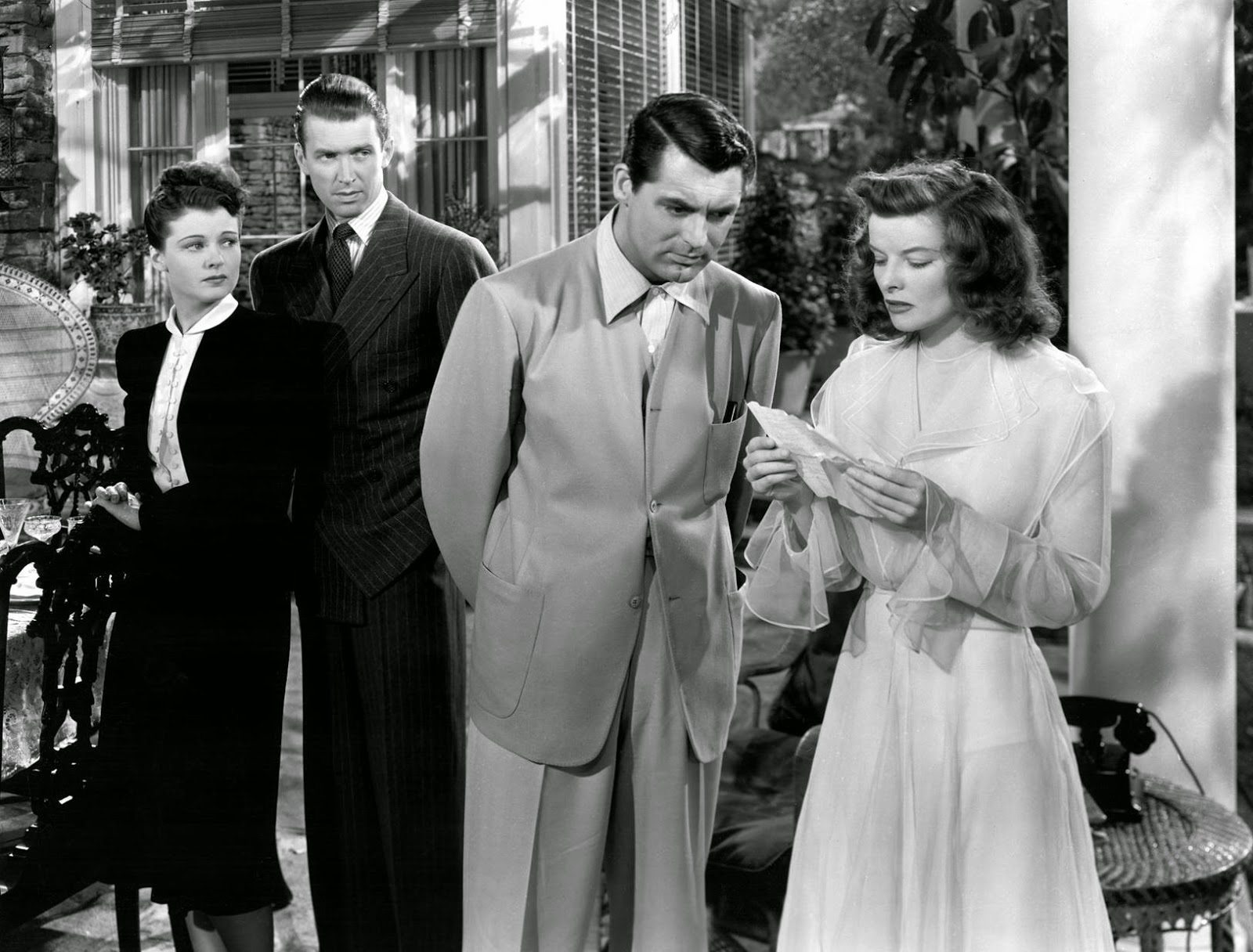
The Philadelphia Story is the 1940 film adaptation of the Broadway play by Philip Barry, telling the story of a socialite getting married and the complications presented by her ex-husband and two reporters turning up for the occasion. Starring Katharine Hepburn, Cary Grant, James Stewart, and Ruth Hussey, the film deals with family dynamics, class differences, and strong characterization, all while bringing a good sense of humour and splendid chemistry between its actors to the equation. Hepburn acquired rights to the play at a time when she was considered box office poison. The movie would be nominated for Oscars, winning two, and stands up well decades later as a true classic.

A prelude scene some years earlier sets up the end of the marriage of Tracy Lord (Hepburn) and C.K. Dexter Haven (Grant) as he walks out on her. In the present, she's about to marry George Kittredge (John Howard, a fellow who's worked his way up and thinks of himself as a man of the people. Tabloid publisher Sidney Kidd (Henry Daniell) wants the wedding covered, assigning writer MacCauley "Mike" Connor (Stewart) and photographer Liz Imrie (Hussey) to crash the wedding. He sets them up with Dexter, one of his former employees, to get them access to the family, using scandalous material he has on Tracy's philandering father to be the leverage to get the Lords to play along. Tracy doesn't like the intrusions of her ex and these strangers, but placed into a dilemma because of potential scandal, she welcomes the reporters into her home, trying to present herself and her family as joyously looking forward to the society wedding. Along the way she finds herself drawn back to Dexter while intrigued by the cynical reporter who would rather be anywhere else.

Barry wrote the play in the first place with Hepburn in mind, and she played the role on Broadway. She deftly arranged rights to the director and cast, asking George Cukor, with whom she'd worked before, to helm the film as director. Grant and Stewart came on board after the original choices, Clark Gable and Spencer Tracy, were unavailable; Grant had starred with Hepburn before, particularly in Bringing Up Baby. Ruth Hussey (The Uninvited) was cast in the fourth major role as Liz. The writing is clever and doesn't mind reminding the audience that it's smart. At the same time, there's such a rich, dry sense of humour to the film as a whole. The film spoke to audiences at the time, becoming a box office success and winning the Oscars for James Stewart and for the adapted screenplay by Donald Ogden Stewart.

The production was done on studio sets, with the right amount of attention to detail to suggest the high society that the Lords travel in, contrasting that with Mike and Liz, who actually have to work for a living. We see this in things like the clothing for the cast, the props on set, the lavish wedding arrangements. We can agree with Mike when he finds himself perplexed with the extensions of a house phone- even one out to the stables. He's out of his usual element, and that kind of detail is a nice touch underscoring the difference in classes that plays out through the film. There are aspects of the story that are very much of its time, but the story as a whole stands the test of time.
Even while that class difference is emphasized, it's also undermined in the way characters relate to each other as the story goes along. George, who's come up from the working class, nonetheless feels uncomfortable with his rising status, and comes across as a man with a chip on his shoulders towards the rich. Dexter, who's comfortably wealthy and doesn't need to work, can cross boundaries and respects and gets along with simple workers like the night watchman for the Lord family. Mike has something of a similar chip on his shoulder about the rich, but as things move along and he gets a look at how the rich live and the problems they must deal with, his point of view must change. Tracy, for her part, is preoccupied with the reputation of her well to do family, and finds herself surprised by the thoughtfulness of a reporter who isn't quite what she expected.

The cast is spot on in their performances. Mary Nash plays Tracy's mother Margaret as the social matron who's trying to manage her daughters and deal with the open secret that her husband is a rake. She's sympathetic, though she doesn't care for the intrusion of reporters in her home. John Halliday plays her wandering husband Seth Lord, finally turning up midway. He has a more difficult role to play; it's hard to be sympathetic to a guy who's fundamentally selfish. It's much easier to like his brother William, aka Uncle Willie, played by Roland Young (even if Uncle Willie is a complete scoundrel). William is a flirt and a rascal, perhaps with too much of a fondness for drink, but we like him anyway. Virginia Weidler plays the other daughter in the Lord marriage, the teenaged Dinah. She's a smart aleck as a character, curious about the goings-on of her sister and not happy at all at how her mother and sister try to shield her from potential scandals in the family. John Howard also gets to play a less than sympathetic role as George, resentful and insecure as a person, but Howard takes that aspect of the role and runs with it.

Ruth Hussey has a wry sense about her role as Liz. Her character has worked with Mike for years, and she's fond of him, but doesn't want to tie him down. You get the sense with the way Hussey plays her that Liz is the one character who sees things very clearly. She has great chemistry with Stewart, and the same applies to the way she relates to Grant. And we even see a friendship form between her character and Tracy.
James Stewart gets to have fun playing Mike. He's a writer who doesn't like working for the tabloids, but he needs to make a living, so he gets on with it. There's a personal pride in the character- he wants to make his own way in the world instead of rely on a benefactor. Mike is a cynic when we first meet him, and a funny one- his phone exchange with Margaret before they even meet is a great laugh, and it's such a contrast from the usual inherently decent nice guy we tend to think of when we think of James Stewart. He has fine chemistry with both Hepburn and Hussey, and his character comes to get along well with Dexter.

Grant is another marvel in his role. There's a laid back sensibility to his role, an amused outlook. And yet he's acting to try to protect his former wife and her family from scandal. He sees his ex for the person she is, and can be blunt about her impossibly high standards, but he still loves her regardless. Grant brings his considerable charm to the role, and it certainly does come across throughout the film.
Hepburn initially starts out as a bit of an ice queen- she holds herself up as above it all, concerns herself with her family's reputation, and seems unforgiving at first. But she loosens up as things go along, finding herself rethinking her engagement, her ex-husband, and the reporter. It's a natural, organic process for the character as she changes, and for the audience as we go along, we like her more. By the time she's had too much to drink and greets Dexter and Mike in friendly ways and her fiance with a frown, we've completely warmed up to her.
The Philadelphia Story remains a classic today, an elegant comedy with a romantic sensibility that gives us likable, human characters with depth. The characters come to like each other, relate well to each other, and we get to like them too. It has a splendid cast inhabiting their roles, and has earned its reputation as one of the great films of the era. Have you seen it?