Faith Can Move Mountains... But Dynamite Works Better
Showing posts with label A Cold Day In Hell. Show all posts

Saturday, August 25, 2012

All My Sins Remembered

Awhile back I wrote something set in my proverbial backyard, in the Gatineau Hills. It was a sequence involving a murder, late at night, on the grounds of the Mackenzie King estate, a place that's open to the public. If you haven't seen it, the original sequence ended up in a blog, which is right here. The sequence will feature early on in A Cold Day In Hell, which will be the third book down the line. The primary antagonist of that book, a terrorist named Cain Reilly, has been introduced in Heaven & Hell (it's really useful writing a series, you can lay the groundwork for future works). The passage I'd originally posted would be the beginning of the present day action, I think, and represents the settling of a score.

Some weeks ago for a writer's meeting, I stepped further back in time and wrote the reason why Cain and his sister would want to settle a score in the first place. That passage will, in time, be the very beginning of A Cold Day In Hell. And so without ado, I present it to you below. Give it a read, and let me know what you think.

Just a word of advice: probably best not to read this one with a weak stomach....

Belfast, Northern Ireland


              He saw the hot steel come closer, and tried to brace himself for the pain. A moment later, it was pressed against his right side, and Peter Reilly screamed in pain, clamping his eyes shut. The heat finally faded away, and he realized the steel had been withdrawn. He opened his eyes, looked at the men before him, saw the contempt, the cold, hostile expressions. He wanted to kill all of them, but he knew that wasn’t to be. Reilly understood he was the only one who would meet a bad end tonight.
            The bastard who had applied the heat to him stood closest; he was a bear of a man, brown hair, blue eyes. Like the others, he was dressed casually, jeans and light shirts, their jackets somewhere else. It was much too hot here to be overdressed, and the man was sweating. He wore a thick utility glove over his left hand, and clutched a steel bar, its tip slowly fading from the glow of heat. Where did he heat it up? Reilly had to ask himself. All around them were large furnaces, vats of molten steel that lit up the large space in a reddish glow, a foundry setting. Reilly wondered if this was one of the foundries in Belfast... he remembered being knocked out while walking in the early evening, on his way to confer with some of his colleagues at a pub on the Falls Road. He tried to jog his memory, to figure out if he had ever been here before.
            There were five other men. Four of them were like the first; the enforcers, the muscle. They were the sort of men who took orders, broke legs, and shot anyone else their boss told them to shoot. Reilly recognized them, though from the heat and the pain in his side, he couldn’t draw their names out of his memory. Not quite yet, he thought to himself. The last man, however, he knew very well. Jamie O’Shea was the furthest away, but he was the man in charge. A cell leader in the Provisional Irish Republican Army, he was a handsome man, late thirties, with curly brown hair and hard blue eyes. Reilly considered him to be the enemy, a vicious, sadistic bastard if ever there was one.
            He felt chains at his wrists, suspended above him, his bare feet barely touching the floor of the factory, his lean, muscular torso aching from the strain and the lingering pain of the wound. They had stripped his shirt away, leaving his pants when they had chained him up. Glancing above, he saw the chains at his wrists, suspended five feet from an overhead mechanical claw, lowered from the ceiling. Reilly felt the sweat at his brow, his unruly red hair wet with perspiration. He was in his late thirties, like O’Shea, and had blue eyes- very Irish, he would have thought. And he shared a profession in common with his enemy, but that was all. Reilly was a feared cell leader in the Ulster Volunteers, had long since established a reputation as a ruthless enforcer, fighting a guerrilla war with the IRA and any Republican activist he deemed a target.
            Reilly looked around, saw a vat of molten steel off to the right, and could feel the heat even from here. The claw ran on a cable line going directly over it, and he realized what they intended to do. Bloody cowards, he thought, glaring at their faces. You’ll remember me, you bastards. And you’ll pay for this. He tightened his face, swore to himself not to let them see any sign of weakness. It was one thing to yell in pain when they inflicted it; it was another to beg for mercy. They wouldn’t give him any.
            He thought, just for a moment, of his children. He had three of them- that he knew of- from different mothers. His sons were older, enough that he thought of them as men. His daughter was just a child. Her mother kept her away from him, had wanted no part of his world for their child. Was she right? He shook his head. Don’t, Peter. What’s done is done. Regretting it now... it’ll make you weak. These bastards will use it against you. Don’t give them that.
            “And so here we are, Peter,” O’Shea said with a smirk, his accent very much the southern Irish variety, unlike Reilly’s hard Ulster accent. “The end of the line, at least for you.” Reilly stared at the man, seeing the amused expression in his eyes.
You bastard, he thought. Do you really think you’ve won? You think it ends with me? That brought out a smile. My sons will learn what you’ve done, Jamie. And one day, you’ll meet the bad end that you’ve got coming. Reilly laughed, despite the pain in his side. “I’ll meet you in Hell, you Fenian bastard.”
“Finn, get him up,” O’Shea ordered. The man who’d driven the hot steel into his side set that down on a table, and picked up a bulky box, linked to a wire, with some buttons on it. He pressed one button, and Reilly felt himself being lifted from the floor, up towards the roof of the foundry. The chains stopped moving up, and Finn pressed another button. The mechanical claw started moving Reilly off to the right, towards the vat of molten steel. He saw the hellish mix of yellow-orange light, the liquid steel that would spell his end. Damn it, there won’t even be anything of me to bury, he thought, feeling the horrendous heat as he moved closer, hanging overhead. “You lost, Peter. And I won,” O’Shea called out, laughing. “Give my regards to your Prod friends in Hell.”
Reilly looked back towards him, feeling the machinery come to a stop overhead. He was directly above the molten vat, the heat overwhelming. He wondered if he’d be dead before dropping into the steel. “You’ll pay for this,” he shouted. “Every one of you!”
“Drop him,” O’Shea said, still smirking, as if he found it funny. Finn pressed one last button. Reilly glanced up above, and saw the claw opening up, the chains coming loose from their grip, and felt himself starting to fall towards the steel below. He couldn’t even manage a scream.

                                                ***
O’Shea smiled to himself, watching Reilly plunge downward. He thought Reilly might have caught fire in mid air, but wasn’t sure. The body dropped into the vat, there was a bit of splatter of molten steel on the floor around it, and then stillness. And that’s that, he thought to himself. Good riddance to the bastard. Who knows, Peter? Whatever traces of your body are left might make part of a good bridge sometime.
He glanced around at his men, all of them with hard faces. There were others outside, keeping any workers who might be about this time of night away. O’Shea knew the owner and the manager of the place- both solid supporters of the Cause- but there was no accounting for a stray worker at one of the other foundries on the property who might wander in. It was just as well to post men to watch for anyone approaching. Not that he thought he would have needed it. And the job was done. Peter Reilly’s roasting in Hell right about now, he told himself, a satisfied smile on his face.
“Come on, lads,” he told the others. “Time to celebrate.”

Tuesday, January 10, 2012

An Island Castle, An Italian Harbour... Oh, Yes, That's Really Roughing It


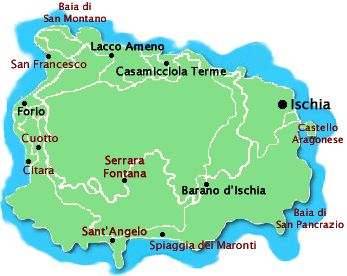
This place turned up in the travel section of one of the newspapers I read during the holidays. I was, of course, intrigued and fascinated. It's a beautiful spot, after all. The location is Ischia, a volcanic island paradise near Naples. The castle above on the small island (with a causeway) is Castello Aragonese, which first has its roots in the fifth century BC. Today it's become a destination for tourists and religious pilgrims alike.


The island itself is quite mountainous, and makes its living from tourism, who come for the thermal hot springs, the beaches, the history, and the scenery. The volcano itself hasn't erupted for the last seven hundred years (cross your fingers, in geological time, that's a millisecond). It struck me as an astonishingly beautiful spot. Just the sort of place one could write into a novel.


In Heaven & Hell, location has often come across as a character in and of itself. I've paid close attention to- and made use of- the places my characters have passed through. The history and scenery of places throughout Israel- Jerusalem, the Masada, Tel Aviv, the Golan Heights- and beyond into Syria have been very much on my mind throughout the book. And in the final phase of the book, on the island of Andros in Greece, the topography of the island and the achingly beautiful location (I could spend months in the Aegean, just saying... and I'm not even Greek) have certainly been influences on me. And down the line, in future books like Sword of the Faith and A Cold Day In Hell, location will continue to have an influence on my writing, to the point where the land takes on a character of its own.


Ischia and particularly that castle fortress are certainly inspiring for a location. As a writer in the spy genre, I could see using it for a meeting between adversaries. Yet it lends itself well to so many other possibilities. The romance genre would practically salivate at such a location. And I imagine at night, the grounds of that island castle would be just the perfect place for a murder in a mystery novel. And just think... wouldn't it be the perfect setting for a ghost story?

What would you do if you had the chance to use this place in your own writing?


Thursday, November 3, 2011

In Character: Michael Campbell

It's been awhile since I've done one of these, and so I thought I'd do two character blogs. The first is from the point of view of an MI5 agent. Michael Campbell is a character who's appeared throughout Heaven & Hell, and will continue to appear in future works. I've gotten to like writing him. This interlude is set late in the book, after a sit down meeting in Belfast with a former IRA gunman....


And I could see Idris Elba (Thor, The Wire) playing the character.....

I had tea with a murderer today.

Oh, we can't prove it, but he's the sort with a lot of blood on his hands. Kevin Conlon runs his own security firm in Belfast these days, but back in the bad old days, he was an cell leader and gunman for the IRA. Granted, he didn't move off to one of the splinter groups when peace broke out, but every assessment we've ever made of the man suggests he's just biding his time, that he doesn't really believe peace will last. Not with the other side, and not with the British. That's his way of thinking.


The Prime Minister and my boss at Five sent me to Belfast today. They wanted to get a sense of the man. The events of the last two days overseas have had a connection that led straight back to Conlon. He had a business link with a member of the Covenant. The information our people in the field gathered has it that he provided them with support in an assassination here several weeks ago.

And so I went. I met with a police inspector we've coordinated with before. We found the bastard at the Europa. During the Troubles it was said that was the most bombed hotel in Europe. Today you wouldn't know it to look at it. And sure enough, there he was, having tea. He even invited us to join him. From an outsider's point of view, it probably seemed like a friendly chat. It was anything but that. It's what's in the eyes that's important. Inspector Grady did most of the talking. I just watched Conlon. He spoke very pleasantly, as if without a care in the world. Underneath all of that, though, I was looking at a man who's killed people before. A man who sees nothing wrong with the taking of innocent lives if it achieves his objectives. A cold blooded bastard, that's Kevin.

He wouldn't crack, not under a more serious questioning. And that's not even what this was. All this was about was getting a measure of the man. And he got a measure of me, for that matter. I'm certain he knows full well I'm a Five man. I'd imagine he'd love the chance to set a bomb in the boot of my car and send me off to an early grave.

I live in a world of shadows, where I don't talk about my work, not with friends, family, or women. That can raise hell with a social life, believe me. I do it for Queen and country. Where my colleagues at Six spend their time abroad, I spend my time defusing the threats that turn up here at home. I've met some nasty, dangerous people in my time. Conlon certainly qualifies as such. And someday, when the peace breaks... he'll be right back in the thick of the fighting.

When that happens.... we'll be ready for him.

Friday, October 22, 2010

Death Among The Ruins

Awhile back, inspired by a murder in a public place in Boston in the writings of Carla Neggers, I thought of a murder in a similar sort of place in the Ottawa valley. I decided on the Mackenzie King estate in the Gatineau Hills. This is the result, and it's jumping ahead of things, an early passage in the eventual third book of my series. Give it a look:


He came awake in pitch darkness, lying on his side in a cramped space, curled up. His hands were tied behind his back, his mouth gagged, and a slight headache and dazed feeling plagued him. Where am I? He shifted, his knee hitting something hard above, and he groaned beneath the gag. The man paused, took stock. The floor beneath him was hard, cold... and he felt as if he was moving. He realized: the trunk of a car...? He had been in this sort of position once before, years ago.
            The man tried to remember, tried to sort out in his head how this had happened. He had been on a short vacation, a few days at a rented cottage in the Gatineau valley, a long way from his home in Ireland. There had been a woman, half his age, blonde and gorgeous in a little black dress. She had bewitched him at a bar in Gatineau, flirted and teased. Then she had invited him to her hotel. He remembered being in the elevator with her, kissing her... and then what? Nothing. A blank.
            Jamie O’Shea was a member of the Irish Parliament for Sinn Fein, and had once been a feared leader in the Irish Republican Army. Back in the day, he had been known for his ruthlessness, a hard man if ever there was one. Yet those days were more than a decade in the past, and he had let himself go soft. Peace had changed things, and if he hadn’t quite disavowed the old ways, he at least understood that most people in Ireland wanted peace. He was in his mid fifties, still a charming rogue, some grey in his thick brown curly hair, and hard blue eyes that still caught the attention of the ladies. A widower for five years, he had become accustomed to the life of the politician, had thought his days of the gun were behind him.
            What is this? The question vexed O’Shea. Unlike colleagues like Gerry Adams, he had blood on his hands. A lot of it, he thought. He had been at war with the Prods and the British since the age of seventeen, nearly thirty years before peace had broken out. He had ordered the deaths of men, had personally killed many times. It was war, he justified. The bastards were doing the same to us.
            The car slowed, making a turn to the right. Where am I being taken? The car moved on, and he could feel it moving slower. Another turn, within two minutes, to the left, and the questions persisted. The car slowed, coming to a stop. He could hear the engine turn off, and heard two doors open. After a moment, he heard the doors softly close. There were footsteps outside, on both sides of the car, but they were otherwise quiet. A key sounded in the trunk lock, turning, and the trunk lid opened. A soft light came on, and it hurt his eyes for a moment.
He gazed up, and saw a dark shape of a man, dressed in black, gloves and a ski mask completing the ensemble. He appeared to be around six feet tall, two inches taller than O’Shea.  A woman – at least the shape of one- stood behind, small in build, no more than five foot five. The man reached down, pulling O’Shea roughly up by the arm, out of the trunk. O’Shea groaned, his legs cramped from the confinement, and felt the cold of the night air. The full moon and the stars shone overhead, and he smelled the faint scent of coniferous trees.
The man closed the trunk as O’Shea steadied himself, and took a glance around. They were on a dark driveway, gravel, from the feel of it. The shape of a house was nearby among the trees, no light to suggest the presence of anyone home. The woman had a gun aimed at him, a small shape in the darkness. He couldn’t tell what calibre. What do they want? He felt no fear, and remembered being in trouble like this before, and the fact that he was still alive reassured him.  That was twenty five years ago, and I didn’t have twenty excess pounds on me back then.
The woman waved her hand, motioning him to walk, and the man was behind him, the feeling of a gun poking at his spine. The woman took the lead, walking along the driveway, a flashlight coming on in her hand. O’Shea walked between them, following her, felt the tightness of the ropes binding his wrists. Is it rope? He shivered, the coolness of the August night a surprise. He was wearing trousers and a grey dress shirt, and the cold bothered him. 
She led the way, down a trail past the house, to a small wooden dock. A rowboat was tied alongside, and she turned, stepping down into it. The man poked at O’Shea’s back with the gun, silently directing him. O’Shea glanced around, saw no other light visible on the lakeshore. Think. Don’t panic. Look for a way out, he told himself. He stepped down into the rowboat, sitting in the middle, and the woman bound his ankles tightly, with what appeared to be climber’s rope. He winced at how tightly she secured him. Making sure I don’t do something stupid, he thought with a grimace.
The man stepped down into the boat behind O’Shea, releasing the lines on the dock, and took the oars, beginning to row out into the lake. It wasn’t an overly large lake, but dark in the night, the moonlight offering little illumination. O’Shea thought briefly of throwing himself overboard, but with his limbs tied so tightly... Suicide, lad, it would be suicide. The boat moved on through the water, the man rowing well on his own, the woman keeping O’Shea carefully covered with her gun. There was silence between them, no need for words.
They reached the opposite shore. There was what appeared to be a boathouse in the darkness, but the rowboat moved towards the right side, directly into shore. The woman untied the cord around his ankles, and then stepped out into the water, splashing, and moved quickly on shore. The man poked O’Shea in the back again with the gun, a hard threat in the gesture. O’Shea struggled up to his feet, and stepped over the side, his shoes getting soaked in the water, feeling the coldness of the lake against his lower legs. He stumbled up onto the shore. The woman had moved slightly up hill, keeping him covered, and he heard the splash of the man stepping out behind him. O’Shea glanced back, saw his captor walk up onto the shore, pulling the rowboat slightly up onto the shore, just enough for it to stay in place.
The woman waved the gun, and O’Shea moved up the slope, saw the dark shapes of small buildings, reminding him of a cottage, and outbuildings. There was a path, faintly visible in the light coming from the flashlight, and he started walking. The footsteps behind him told him that his captors were close behind, not about to let him take a chance to flee. They walked along, through the woods, and he noticed a clearing ahead to the left, the moonlight giving enough illumination to suggest a parking lot. The path forked ahead, one going towards the lot, the other to the right. He felt a hand at his shoulder, the man squeezing hard, directing him to the right.
O’Shea walked, a growing anxiety filling him. They moved up the path, coming to another clear area a short distance up from the lot. An expansive stretch of grass opened up before them in the moonlight, the shape of flowerbeds present. A two-story house stood in the darkness to the left, sizeable porches visible in the moonlight. O’Shea saw no trace of light inside. A tall flagpole dominated the lawn, and he saw the distinctive Canadian flag fluttering at the top. At the treeline, he could make out a columned arch, standing by itself. Where are we?
They pushed him on, a gun at his back, off to the left, past the house, through the trees. Glancing to the right, he noticed a large dark shape low to the ground, peculiar… Stone? The light suggested stonework. On the ground? They didn’t let him linger. His captors pushed him on. Up ahead, there was another clearing. The moonlight shone on a small group of what appeared to be ruins. Arched windows, stone columns,  an arched door, and four sides… as if a building of old had stood here, and was on its way into magnificent decay. What is this place? The question persisted as he walked into the midst of the ruin. He felt a chill. Something about the place, being here this late at night, with two armed people… it filled him with a growing dread.
“Stop.” It was the woman, and even the one word was enough for him to recall the sound of her voice. It was the woman from earlier in the night, but rather then the pleasant French-Canadian accent, the tone was hard, and cold.
“Down on your knees,” the man ordered, his accent hard, cold, and distinctive. It was the Ulster Irish of his enemies, of the Prods. And so, with the sound of that accent, the dread that had been growing inside him became fear. O’Shea paused, didn’t know what to do, and the voice was sharper. “I said, down on your knees.” O’Shea dropped, his knees feeling the dampness of dew on the ground. The woman circled around him, her gun aimed at his head. The man spoke again. “Do you remember Peter Reilly?”
O’Shea froze. Of course he remembered the man. Ulster Volunteers, a nasty piece of work. He had overseen the murder sixteen years before. Killing him in the foundry had been a pleasure. He murmured, but the gag muffled his words. The woman reached down, pulled the gag out of his mouth. “What… what is this…?”
“Don’t play stupid, O’Shea,” she said, her voice containing the same harsh Ulster accent as the man. “You bloody well know who he is.” The man circled around, facing O’Shea, his gun extended. Both of them glanced at each other, and with their free hands, pulled away their masks. Both had the same blue eyes, the same red hair. Hers was longer then his, and he realized she’d been wearing a wig earlier. Yet it was her, the same woman who’d caught his eye in the bar.
It was the man who spoke now. “Peter Reilly was our father.” His voice was filled with hate, his eyes flashing with rage. The same rage was in his sister’s eyes. “And you and your boys dropped him into molten steel. You butchered him.”
O’Shea gasped, realized who he was. Cain Reilly, once a member of the UVF, now his own man, with his own inner circle of Prod terrorists who didn’t give a damn about the peace process. “We’ve settled the score with the rest of them,” the woman said. “Now there’s just you. The one who called the shots.”
They took close aim at him, and he knew fear. They would never let him walk away. Not after what he had done. “Wait,” he muttered, the nervousness in his voice obvious. “Just wait a minute…”
“We’ve been waiting sixteen years, you fucking bastard,” Cain spat. Both of them levelled their guns, ready to fire. “Cecilia…” he called out softly, looking over at his sister. She nodded without taking her eyes off O’Shea. “On three.”
“No, wait!” O’Shea cried out.
“One,” Cecilia replied quietly.
“Just wait!” O’Shea begged.
Cain sneered at him. “Two.”
“Three,” Cecilia whispered. Both pulled their triggers. The last thing O’Shea saw was the flash of both guns, followed by the blackness of oblivion.