Faith Can Move Mountains... But Dynamite Works Better
Showing posts with label Derek Jacobi. Show all posts

Monday, March 19, 2018

The Preposterous Unsurvivable Apocalypse


“All myths are foundations of reality.” ~ Richard Croft

“Lara, your father’s gone. You can pick up where he left off.” ~ Ana

“Seven years, I’ve been on this island. Your father, he put me here. Now I see the likeness, intelligence, the recklessness.” ~ Mathias Vogel

“Some men like dangerous women.” ~ Lu Ren 
“Some men are foolish.” ~ Lara Croft


It’s been years since we last saw Lara Croft on the big screen, in Angelina Jolie’s pair of Tomb Raider adaptations. Based on a video game (not a good source material, but then I’m biased against video games) following a cold as ice British archaeologist-adventurer (pretty much a female Indiana Jones), the two previous films followed Jolie’s character as she confronted family issues, ancient secrets and grandiose treasures, deathtraps, megalomaniacs, and betrayals. A new take on the character takes to the screen in the simply titled Tomb Raider.


We meet Lara Croft (Alicia Vikander), at twenty one living a reckless, carefree sort of life. She’s going through school, working as a bike courier to pay the rent (this despite coming from wealth). And she’s avoiding the inheritance of her father Richard (Dominic West), a wealthy adventurer who vanished without a trace years earlier and is considered dead. His business partner Ana (Kristin Scott Thomas) coaxes her into taking responsibility for her inheritance, and thus Lara comes across a message from her father meant for her, the one of the 'if you're seeing this I'm dead' variety- one that will lead her to a dark legend of the past, a scenery chewing villain, a tomb filled with complicated dangers, and situations that nobody should logically be able to survive.


The last of these films was back in 2003, when Cradle Of Life wasn’t quite the success that the first film had been, and Angelina Jolie decided not to reprise the part. Her take on the character was of a woman already established in her profession on the one hand, and enjoying the wealth of inheritance on the other (all while having daddy issues herself). The story here takes the character and has us see her as a novice, not yet finished her education and living away from the family mantle of responsibility when we first meet her. The script, by Geneva Robertson-Dworet and Alistair Siddons, follows a story the former did with Evan Daugherty, and follows the formula of the franchise- both film and video game. The cool and steady heroine, the ancient secret of incredible power, the ethically challenged villains with visions of profits in their heads, the action set pieces of near death escapes- they’re all present and accounted for.


Given the fantastic elements of the story, the strongest touch of the script is the dynamic of daughter and father- the absence of the two, the mourning of a bond that’s been lost and yet found. As preposterous as the ancient secret turned incredible power aspect of the story might be, that dynamic between the two Crofts is the highlight in a script that otherwise tends to relies heavily on cliches, plot holes, and the avoidance of logic. I mean seriously, how on earth does someone survive all that, let alone seem to heal so quickly and be back in action?


The director is Norwegian- Roar Uthaug. His work has been based out of his home country, though looking at his resume, his last film makes for good qualifications for taking on the job here. The Wave was a 2015 disaster film that was strongly grounded in character, and that reflects itself here. He’s able to handle the CGI that the story presents on the one hand, the grand set pieces and fierce action, all while working reasonably well with the actors themselves. Uthaug as a director deserves better than the script gives him. Have I mentioned I'm not impressed with the screenwriters?


Some of the supporting characters tend to be more sketchy in their development, and that’s more a case of the problems with the writing, where emphasis is placed elsewhere. Daniel Wu plays Lu Ren, a ship captain who assists Lara (and somehow manages to survive things that he shouldn’t survive), but is generally not developed beyond that. The same applies to Hannah John-Kamen (who will soon be appearing as a Marvel villain) playing Sophie, Lara’s loyal friend- the script doesn’t really develop her beyond that point. Kristin Scott Thomas and the veteran actor Derek Jacobi find themselves in the same dilemma, with character roles that aren’t as developed as they could be, for a couple of reasons- the story needs their cards played close to the vest and the story puts its emphasis on the leading character.


Walton Goggins plays the villain, Matthias Vogel. He’s made his name in the television show Justified, but has worked as a character actor in film and television for years on end. Possessed of a strange name and the sort of beady eyed looks that will never make him a leading man, Goggins instead gets to play character roles and oddities. Vogel spends a lot of time chewing the scenery on behalf of a shadowy organization (there’s always a shadowy organization in a film like this). A rival archaeologist to Lara’s father, the man is a greedy bastard, totally without scruples of any kind, seeking power for his own ends and that of those he answers to. The actor seems to be having fun playing the role, but then playing the villain usually is more fun.


The bulk of character development in the film is left to two characters. Dominic West, the British actor, has done a lot of film and television work on both sides of the Atlantic for more than a quarter century, and here he plays Lord Richard Croft, the nobleman turned archaeologist and adventurer who at the beginning of the story has been presumed dead for some time. Unlike Vogel, he is a man of scruples, sympathetic, devoted to the daughter who he’s missed terribly, and the actor plays to that, creating a believable relationship with Vikander in how the two relate to each other- even when they’re not in the same space.


Alicia Vikander gets the rest of the character development as Lara, and she occupies the role well, ending up being the best part of the film. She’s done quite a bit as an actress since her career started, most recently as a primary role in Jason Bourne. Her take on the character starts off as carefree and cool (while avoiding the unresolved issues of her father’s disappearance), something of a novice starting out into a world of adventure. As the story goes along, she invests the character with strength, physicality, sympathy, and a smooth, sly sense of humour. Cool as ice as she may be, her take on Lara is human, and is what makes the film work, and gives the audience someone to connect with. She may be able to survive and heal faster than anyone should be able to (is she related to Wolverine?), but Vikander’s performance gives the character more depth than a video game could have.


All in all, the film manages to entertain despite a weak script that leans too much into spectacle and into cliche at times. Yes, some characters tend to be more one dimensional than others. Yes, there are plot holes and preposterous moments. Yes, there are one too many booby traps that play to the video game origins. But the leading character is compelling to watch, and the actress makes her that way. There will no doubt be more of Tomb Raider to come, and I’d like to see what Vikander does with Lara Croft. As long as they hire different writers.

Monday, November 13, 2017

Murder And The Belgian Detective


“Would you mind if I join you? You’re the world famous detective, Hercule Poirot. Avenger of the innocent. Is that what they call you in the papers?” ~ Edward Ratchett 
“And are you innocent?” ~ Hercule Poirot

“Some men have a good look. All they have to do is keep their mouth shut and they can take home any prize they want. Still the mouth opens.” ~ Mrs. Hubbard

“I’m sleeping here, where everyone can see me, and where I can see everyone.” ~ Mary Debenham

“We’re surrounded by lies!” ~ Edward Masterman

“And who are you?” ~ Gerhard Hardman 
“I am Hercule Poirot, and I am probably the greatest detective in the world.” ~ Poirot


Agatha Christie remains one of the literature world’s leading lights in mystery fiction, with her works frequently adapted for stage and screen. Her creations include the iconic Belgian detective Hercule Poirot, who appeared in a wealth of stories that have provided readers- and viewers- with suspenseful entertainment in a variety of ways. One of her most acclaimed tales, Murder On The Orient Express, has been previously adapted in film and on television, pitting the detective into a case of a murder on the lavish title train. It has now been adapted into a new film version by the actor and director Kenneth Branagh, with an outstanding cast.


Poirot (Branagh), the esteemed and eccentric detective, is looking to unwind and relax after a case in 1930s Europe. This being a murder mystery story, unwinding and relaxing are not going to happen, and he is summoned back to Europe on a case, boarding the Orient Express to swiftly return. He meets a number of other passengers on board, each with their own secrets and reasons for being on board. Some are wealthy and well known, others are of more common stock. One of them, Edward Ratchett (Johnny Depp), asks for his assistance, fearing for his own safety. Murder ensues, and the detective finds himself caught up in the task of narrowing down suspects and identifying the killer.


The screenplay comes from Michael Green, adapting the original story by Christie. Green has been behind films like Logan, Blade Runner 2049, and Alien Covenant, and his screenplay tweaks the story with some details- nationalities of certain characters, for instance. But the screenplay follows the story’s methodical sifting through secrets, the detective’s relentless pursuit of the truth, and the tension of a situation where a murderer lingers among passengers on a train, marooned in winter. I like that the story plays those secrets close to the vest, giving the audience a chance to get used to the characters at a distance before murder and mayhem bring everything in a different direction.


Branagh comes from a background in Shakespeare on the stage, and he’s adapted several of the Bard’s works for film (he’s just about the right age now for a cinematic Macbeth). That theatricality shows itself in this film, with how he works with actors, how he stages the action, and how he performs in the lead role himself. He has a great eye for detail, which shows itself through the film- the luxury of the train is well rendered, with its furnishings providing a lavish setting for those with money to spare and a wish to be seen on one of the great symbols of class. Branagh’s crew keeps that attention to detail in other ways, evoking the period through costume and prop details; we feel like we’ve just stepped back in time and are unseen passengers on board. And Branagh’s style as a director works well with the material, slowly driving up the tension as things go along, with this machine of luxury stranded in the wilderness- while a murderer lingers among its passengers.


With a cast like this, part of the draw of the movie is just watching them at play, and Branagh goes with a diverse selection of fine actors, some of whom he has worked with before, others who are new collaborators. Depp himself has spent the last few years known for bad behavior and playing eccentrics to no end; here he plays the ill-fated Ratchett in an understated way (understated for the actor, anyway). He’s anxious, but tries to hide that behind a smarmy kind of charm, and his character is an unpleasant man whose past carries many secrets and acts of criminality. The actor plays off that well, and needs to play more subtle characters like this for awhile rather than return to over the top mischief.


Derek Jacobi has been a frequent collaborator with Branagh over the years, and this time plays a butler, Edward Masterman, whose ties to others play out through the film. Judi Dench, another occasional collaborator with Branagh, plays Princess Dragomiroff with an occasionally arrogant quality that you might expect of royalty. Josh Gad turns up as Ratchett’s assistant Hector MacQueen, turning out to be as corrupt as his boss. Willem Dafoe, Penelope Cruz, Daisy Ridley, and Leslie Odom Jr. all turn up as passengers- the professor, the missionary, the governess, and the doctor in that order- and suspects in ways that require them to play their emotions and agendas hidden. This is true of the rest of the suspects. Michelle Pfeiffer gets a lot to do as Mrs. Hubbard, the widow with her own reasons for being aboard the train, a forceful personality as the story unfolds. She brings a sultry, cynical air to her performance.


Part of the fun of a murder mystery is watching the detective prove how brilliant he is by unravelling the secrets and circumstances of the murder, and Branagh has a lot of fun playing Poirot. The character has been played before in film and television by actors like Albert Finney, Alfred Molina, and David Suchet, and Branagh slips into the eccentric, salty-mustached Belgian detective effortlessly. When we meet him, he’s eager only for rest, but a man of his skills is never allowed to relax, and Branagh plays off that sense of irritation early. He’s also a man of principle, finding it distasteful to work in a bodyguard capacity for a career criminal, and yet obliged to investigate the murder that ensues. Branagh’s take on the character is a good one, a doggedly determined and brilliant mind that works to seek out a solution, unearthing secrets as he goes along.


Murder On The Orient Express turns out to be a good deal of fun, watching an outstanding cast in a period film deal with a murder mystery. One could watch a cast like this reading the phone book and still enjoy it. It brings to life one of the genre’s great figures, as Poirot confronts an enigmatic puzzle of a mystery, and sifts through its intricate connections. Adding in a dash more action than the prim and proper Agatha might have expected, the film is a fine lark built around blood and death- and proper manners along the way.

Wednesday, May 24, 2017

Murder Among Two Lifetimes


“The man I bought it from explained to me that when a man gives it to his wife, they become two halves of the same person. Nothing can separate them... not even death.” ~ Roman Strauss

“Well, I’m not going into hiding, Mr. Baker. I’m just getting married.” ~ Margaret Strauss

“Aren’t you afraid of dying?” ~ Gray Baker

 “Karmically, self-defense is quite cool.” ~ Cozy Carlisle

“Oh, and you don’t have to worry about forgetting her name. She’s already forgotten it for you.” ~ Pete

“This is fate we’re talking about, and if fate works at all, it works because people think that this time, it isn’t going to happen.” ~ Madson

“Grace? That’s what the teabag says? That my name is Grace?” ~ Grace

“I’m not looking for Miss Right. I’m looking for Miss Right Now.” ~ Mike Church


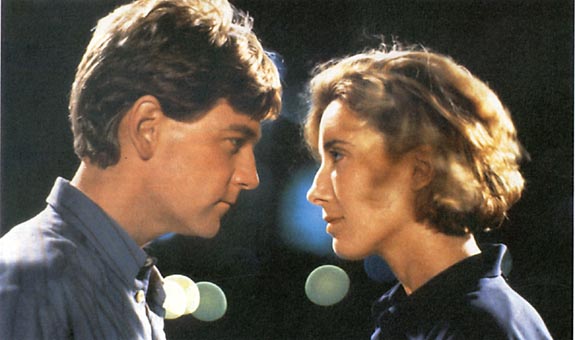
Dead Again is an unlikely mix of genres, bringing together elements of romantic fantasy and the supernatural with a good deal of film noir influences in this 1991 film from director Kenneth Branagh. The director stars in dual roles opposite his then wife Emma Thompson, who was also playing a dual role in a story that combines the mystery of an amnesiac woman with the notion of connections to past lives. With a good supporting cast, the film is quite entertaining, romantic, thrilling at times, stylish, and clever.


The film opens with newspaper headlines through the opening titles, detailing the 1949 murder of Margaret Strauss (Thompson), a classical musician stabbed during a robbery at her home. Her composer and conductor husband Roman (Branagh) is arrested and put on trial in the months that follow. Found guilty, he is sentenced to be executed. Before his execution, he is visited by a reporter, Gray Baker (Andy Garcia), who was acquainted with the couple.


Forty years later, an amnesiac woman (Thompson) has turned up at an orphanage, unable to speak, and plagued by nightmares. The priest who runs the place calls in a private detective who grew up in the orphanage, Mike Church (Branagh) to determine who she is. Church asks his friend Pete (Wayne Knight) to publish her photo in the newspaper to see if her family is looking for her. An antique dealer, Madson, with a sideline in hypnosis, approaches Church with an offer to help, and the first session determines that she can in fact speak- and is able to relive in third person the story of Roman and Margaret. It seems the tragedies of the past are coming back into the present through past lives.


The story is by Scott Frank, whose other work includes Get Shorty, Out Of Sight, Heaven’s Prisoners, The Wolverine, and Logan. The story weaves back and forth between past and present, primarily acting as a mystery, with elements of the familiar private eye genre as a strong influence. The cynical detective, the mysterious woman, the oddball characters, these are all aspects that nod back to the Forties era of hard boiled private eyes in cinema, as does the somewhat dark sense of humour throughout the film. And the narrative weaves in a love story (two, actually) and more to the point the unusual premise of past lives influences the current day, particularly in the sense of the inevitability of fate.


Branagh was already well established as a Shakespearean actor and director on stage and screen at this point- his masterpiece adaptation of Henry V was two years behind him when he directed this film. It has a theatrical quality in its pacing, fitting Roman’s character, since the man is a composer of dramatic opera. The theatrical quality carries over in the rest of the film, as the mystery unfolds, and particularly in the climactic aspects of the film, and Branagh’s directing style plays to that. I particularly like the use of black and white for those scenes set in the past (which mostly unfold in flashback through hypnosis) and colour for the present day sequences, as well as how he uses several scenes that are extended single take scenes. 


The production values are particularly effective in the past sequences, with a palatial residence well outfitted to look like a place out of the 1940s, or a masquerade party at the time looking quite at home in the past. And one of the prevailing visual themes- scissors- are carried over into the present in a creative way. Branagh uses some actors to play smaller parts in both past and present, including his frequent music collaborator Patrick Doyle, whose score for this film mixes together romantic, mysterious, and highly theatrical themes along the way.


The cast are exceptional in their roles. Hanna Schygulla appears mostly in flashbacks as the Strauss housekeeper Inga, who escaped from Germany with Roman and her son during the darkest days of the Second World War and has been loyal ever since. She has to play the character with a certain degree of distance as the film goes along- the audience isn't meant to get inside her head.


Another character who spans both past and present is Gray Baker, played by Andy Garcia. When we first meet him, he’s a young reporter with a cynical world view, fondness for smoking, and a womanizing attitude. This carries over into his interactions with Margaret and Roman, as he doesn’t show much respect at all for boundaries. Garcia makes him thoroughly jaded in his performance, and when we see him in the present day, he’s a wreck of a man, ruined by smoking, but still as jaded as ever. His present day appearance could be said to be the best cinematic argument against smoking.


Robin Williams gets a cameo appearance as Cozy Carlisle. Where Baker is jaded, Carlisle is bitter and acerbic in a way that makes the reporter seem happy. A disgraced therapist who comes into the plot as the subject of a routine search by Church early on, he’s a man with little in the way of scruples, no ethics, unconventional ideas, and the source of much of the dark humour of the film’s present day sequences. Williams gives the character a bleak, serious air in the way he plays it- Carlisle’s not a pleasant person, nor does he pretend to be.


Wayne Knight is best known for a couple of roles, the opportunistic hacker Dennis in Jurassic Park and as the perpetual irritant Newman in the Seinfeld series. Here he plays a very different character as Pete Dugan, the newspaper staffer who’s best friends with Church. He’s loyal and friendly, a genuinely likable guy, with an ironic sense of humour and something of a speech impediment. Knight gives the character a lot of levity as he goes along.


Derek Jacobi is a frequent collaborator with Branagh, having had co-starred with him in films like Henry V and Hamlet, as well as being in the cast for Branagh’s directed Cinderella. He gives the role of the antique dealer Madson a dry air. When we first meet him, he’s hypnotizing a woman at his shop for one reason, while gathering information on potential jackpots for himself. It’s a bit underhanded but amusing, the act of a grifter, but a good way to introduce a character. Madson explains his interest in past lives and how they can influence present day actions. Past life regression through hypnosis is key to unlocking the secrets of the story, and the actor plays the character with dignity but secrecy, playing things close to the vest.


Emma Thompson gets the challenge of two roles- Margaret Strauss in the past and the woman known as Grace in the present. Her Margaret is playful but professional, quickly falling for the conductor Roman, and the bond between them becomes believable as their story unfolds. Grace is a different story- she starts out as plagued by nightmares, in a vulnerable state, not knowing who she is or what’s happening to her. And yet under that, as the story goes along, the actress gives Grace a different kind of playfulness, mixed with uncertainty as she falls for the private detective who’s trying to determine what’s happened to her. The chemistry between the actors, in both eras, works very well indeed.


Branagh also gets to play two roles, giving Roman a certain amount of distance when we first meet him- we’re meant to wonder at his guilt. The character has his stormy, frustrated side that seems to fit in with his composer profession. Mike Church is a different character altogether, a private eye who tends to see the worst in people. He’s a cynic, but not above taking in a stray- a true cynic might be inclined to leave the amnesiac in a mental hospital, but he doesn’t, so this cynic has principles. Branagh plays the two characters in different ways, and Church, who finds the supernatural idea of past lives to be laughable at first, must come to terms with the idea of it as it becomes less implausible and fate closes in on him.


Dead Again got mostly positive reviews and box office at the time, and the film itself is stylish, moody, smart, entertaining, and dramatic, fitting the acting credentials of its leads. It’s a well paced film that skilfully goes back and forth between past and present, giving two lead actors the chance to play two roles across two lifetimes. It’s a hidden treat you might not know of personally, but it’s well worth seeing.

Wednesday, June 3, 2015

Four Scammers Of The Apocalypse

"Is it wrong to suggest a spammer should die a horribly painful death?  That depends on what a spammer is. We're in the glory days of the Roman empire here, people, and spam hasn't been invented yet." ~ Marcus Aurelius, AD 166, Rome

"Gustavo's, for all your going to the Colisseum needs! We've got comfortable cushions, fans for keeping cool on hot Rome days, the right way to dress if you want to catch the eye of the Emperor, and clothing that doesn't stain if some stray blood happens to spurt out into the audience from a dying gladiator. Remember, if it's not Gustavo's brand goods, you must be shopping in Pompeii, and that place has never been the same since Vesuvius blew its top." ~ Roman spam, AD 168


They are a foul pestilence on the globe. They are literally unable to take a hint and kindly drop dead (or not so kindly: drop dead whilst in a whole lot of horrendous pain). They are of course the spammers who keep trying to infest our blogs with endless crap they're trying to sell. Or their counterparts in the industry known in the trade as the internet scammer. Both are obnoxious on a level that makes the flesh eating disease look welcome (note to the flesh eating disease: infect a few thousand spammers and scammers). The following message turned up in my email not too long ago. My junk folders claimed it.


Dear Beneficiary,

Good day and may the peace of the most Gracious God be with you, please I have a problem and needs your help, I have decided that it's good a thing to write you for help.

 I am Emmanuel Yao, 19 years old, the only son of my late parents Mr. and Mrs. Edward Yao.  My father was a highly reputable business magnet (cocoa and gold merchant) who operated in the capital of Ivory Coast and Ghana during his days. It is sad to say that he passed away mysteriously in France during one of his business trip on 12th.September 2009. Though his sudden death was linked or rather suspected to have been masterminded by one his brother who traveled with him. But only God knows the truth!

My mother died when I was just 4 years old, I went to my grand mother's house recently and I storm into a deposit certificate he used to deposited the sum of Twelve Million, Seven Hundred Thousand United State Dollars. (USD$12.700,000) and 3 boxes contained personal effects in one of the leading security company in Ghana.

I am just 19 years old and a University Undergraduate and really don't know what to do. This is because I have suffered a lot of set backs as a result of the death of my late parents. The death of my father actually brought sorrow to my life. I don't want any of my family member to know this and I want you to take this inheritance and help me travel to meet you in your country to continue my education.

I am in a sincere desire of your humble assistance in this regards. Your suggestions and ideas will be highly regarded. Now permit me to ask these few questions:-

1. Can you honestly help me as your Son?
2. Can I completely trust you?
3. Can you contact the security company if I give you the certificate I have and transfer the fund to your country so that the gold boxes will remain for my future?
4. What percentage of the total amount in question will be good for you after the money is in your country.

Please, consider this and get back to me as soon as possible so that I can send you a scan copy of the certificate.

Thank you so much.

My Regards to your family,

Emmanuel Yao


Okay, let's go through our scamming scammer's message in turn. Our boy Emmanuel Yao (nice name to use as a fake cover) has his credentials in the Ivory Coast and Ghana (prime African scammer territory) and uses many of the same tell-tale signs of all African scammers. Bad grammar, punctuation, the sob story, the invocation of God to pass himself off as someone of virtue. Emmanuel (or whatever the hell his real name is) must be hoping I'm dumb enough to fall for the usual invoking God scammer trick. Note to Emmanuel: I'm not. I'd suggest sending this email to my idiot ex-brother-in-law, who really is stupid, but then again, all of his disposable money goes on booze and cigarettes, so you're not going to get far.

  He claims his father was a "highly reputable business magnet." While that might come in handy when dealing with steel and metal, Emmanuel, magnets aren't that handy in business. Come on, scamming scammer, try to keep up with the class, you're falling behind. You were obviously trying to pass off your totally non-existent daddy as a magnate. Which, for the record, I don't believe for a minute.

He then goes on to claim that his father bought the farm back in 2009 and hints that his uncle might have been behind it. Come on, are we talking about Hamlet here, or are you just putting a new spin on the African scammer trick?


"But only God knows the truth!" he exclaims! Well, no, if your non-existent evil uncle Claudius actually had offed your old man like you said, then Uncle Claudius would know too. Unless you're mistaking him for God. Wait a minute, we've already agreed this whole story is fake (well, you haven't, but you already know it is) and I'm now treading pretty close to blasphemy by comparing God to Hamlet's uncle. Though I'm sure Derek Jacobi wouldn't mind the comparison.

Still with me? I'm not talking to you, Emmanuel, I'm talking to my readers, who might be wondering if I'm galloping off madly in all directions.


Our scamming scammer mentions "storm into a deposit certificate" and the grand sum of 12.7 million United State dollars (seriously, dummies, is it that hard for you to spell it United States? It's only the most powerful country on the planet, you dimwits) resting in a security company in Ghana. He laments that he doesn't know what to do and mentions his setbacks. To which I say it's such a shame he didn't have more setbacks. Enough setbacks that he wouldn't be trying to scam half the planet with the same message. And then he asks several questions. Here are my answers.


1. No, I can not honestly help you as my son. Why? Because I don't have sons, particularly scamming scammers like yourself who do nothing in this world but waste oxygen. There's a special circle of hell reserved for scammers like you. I suggest you go find it post haste.

2. You certainly can't trust me anymore than I would ever trust you. If this scheme was real (which it's not), I'd gladly throw you to the dogs, fit you for cement shoes, or hire someone to send you for a long walk off a short dock, and keep every bit of the twelve million for myself (compensation for having to put up with scammers and spammers endlessly). Of course, since that money doesn't actually exist, this is a hypothetical question.

3. I will contact no such security company, because, well, see my answer to #2, and we already have established that there is no fortune waiting.

4.  What part of we already know there's no fortune do you not understand? Were you dropped on your head a lot as a child?


Sigh. Is there no end of them? Are they like the Hydra monster of Greek myth? Cut off one head and two more will rise up to replace it? Can they ever take a hint and just go away? Unlikely, given that this very post will draw in spam. They are entrenched in their positions, always on the lookout for that one person in ten thousand sent emails dumb enough to actually believe them. And if that happens to net them a few thousand in easy money before a banker advises the mark that they've been had, well... that's part of doing business.

For those of us who have to put up with them, though... they are a plague beyond plagues. Moses couldn't have dreamed up a plague this irritating. If this had been the first plague of ancient Egypt, the Pharoah would have begged Moses to take his people out of bondage straight off. "Anything but that!" he would have said. "I am not interested in silver futures hidden away by a non-existent general in Nubia!"