Faith Can Move Mountains... But Dynamite Works Better
Showing posts with label book reviews. Show all posts

Monday, July 13, 2015

The Skeletons In The Family Closet


What would you do if you suddenly learned your biological grandfather was the very essence of evil?

Jennifer Teege knows this from personal experience. She's from an unlikely background- her biological mother was a German, her father from Africa. Her mother gave her up for adoption when she was a child, and for years before that she had been in an orphanage and then foster care to the family she was adopted into. She had memories of her mother and her grandmother- but no answers on other elements of her family.

And so it was that one day in a library in Hamburg, her eyes came across a book... one that changed her life and pulled the rug out from under her. It was a book featuring photographs of her biological mother and her grandmother, tying them to a man made infamous by history: Amon Goeth, the Nazi commandant of the  Plaszow concentration camp in Poland during the war. The same man played by Ralph Fiennes in Schindler's List.

Her grandmother was Goeth's mistress. Her mother was the result of their liason. Which made her the granddaughter of a monster.

My Grandfather Would Have Shot Me is the collaborative book by Jennifer Teege and journalist Nikola Sellmair, telling her story of discovery and coming to terms with the facts against the backdrop of history. Teege writes in the first person, recounting her history with her adoptive family, none of whom knew the history of her biological family, and her struggles in dealing with the revelations. Sellmair writes in the third person, the two trading off each other; Sellmair fills in some of the gaps and provides context where needed, but the book is Teege's story.

And what a compelling story it is. She spent university years in Israel, where among her activities was reading German newspapers to elderly Holocaust survivors- she wonders how any of them would feel to know about her family connections, as well as friends she's made there. She writes about the memories she had of her mother and grandmother, and the contrast particularly between the loving grandmother she remembered and the reality that this was the mistress of a Nazi- the question is asked, how could a woman who once chose to ignore the Holocaust as it was happening right outside her window be such a loving grandmother to a mixed race child who would have been shot by the man she loved?

Teege also writes about her mother, who seemed in her memories to be distant and deeply troubled, carrying the weight of her father's sins without explaining why. The two writers go into detail in different ways about the notion of history passing down through generations- Holocaust survivors on the one hand pass along a legacy of trauma that differs from the second to third generation, while the descendants of perpetrators inherit a legacy of guilt that is not their own, reacting to it in different ways- some children steadfastly defended their Nazi fathers, while others deeply rejected their family past. Teege speaks of her mother, who seems to have been profoundly damaged by that legacy, perhaps to the point where she realized she couldn't be a fit mother. 

The book is in effect a journey by the author, both in terms of making peace with her family past and a physical journey. That includes journeys to Poland, to the home her grandmother shared with her grandfather, where he would shoot inmates from his balcony; today the camp is gone but a memorial remains. It is a journey of healing; she struggles with depression, and refers to it as being in a deep hole, something I can relate to, as much as she struggles with the guilt and the questions of the past. 

I found the writing deeply affecting. It is not possible to feel empathy for Amon Goeth- the man was pure evil, and whatever answers might be out there about what made him that way remain unknown. One does feels a tremendous sense of empathy for others, for the author, her family as it is today, for her friends, and even for the mother and grandmother she remembered. Teege's grandmother, though she chose to ignore evil happening outside her door, was nonetheless marked by it, taking her own life. Teege's biological mother has spent a lifetime weighed down by guilt and shame because of her father. When I finished reading the book, as difficult as it was to read, given the subject matter, it was also compelling, very human, and ultimately uplifting.

Monday, October 7, 2013

Secondhand Shoes And Killer Stilettos

Two items of note to take care of before we do anything else today. First, check out our joint blog for a look at football. Then go on over to Kittie Howard's page for her look at the air operations on D-Day and pics from her recent trip to Normandy.

Now then, today I thought I might go back and reprint a review. It's been awhile since I wrote it, and this is for Shelly Arkon's book Secondhand Shoes. Shelly is a friend of mine, a great supporter of fellow indie writers, and in short good people. She's been dealing with a lot of chaos in her life as of late, so it's time to put some attention her way. This was a fun book to read, a real page turner that kept me entertained. Check it out, and I'll leave links at the bottom.


Secondhand Shoes opens in an uneasy place, with the main character, Lila, an eighteen year old woman on her wedding day. Her bridal nerves are more than what might be expected; she's marrying a man she barely knows and doesn't particularly like, thanks to the pressure of her overbearing mother Babs. Lila has little say in the direction of her life, no respect at all from a mother who thinks that she's crazy, a father living far away in exile, and a step-father who bows to his wife's every demand and seems to have lost his spine. The only living person who seems to be on her side is her best friend Cynthia, and we can see this in her advice to run while she can. 

Then there are the ghosts. Just like a long out of work former child actor who shall remain unnamed, Lila sees dead people. One of the ghosts in her life happens to be her paternal grandmother, who has little patience for her former daughter-in-law's overbearing ways, and is at Lila's side through much of the story. Gram is a force to be reckoned with, a mixture of common sense and great wariness about the threats that exist in the world, particularly where her granddaughter is concerned.

Lila's ability isn't appreciated by most people around her, let alone her mother, who won't abide such nonsense. Instead Babs, who we learn has coerced her daughter into breaking off with a young man she did like, simply because of her own prejudice, has orchestrated a relationship with Max Butz (yes, that's his name), a dirtbag of the first order who thinks that turning up in a orange polyester suit for his own wedding is perfectly acceptable. Max runs with a similar pack of criminal degenerates, has a father with anger management issues, and a religious zealot for a mother (with a few hidden secrets of her own). It doesn't take long before the reader confirms that first impression: Max is a vicious bully with no respect at all for Lila, and nothing at all resembling scruples.

The story hinges on a decision Lila makes to take her life into her own hands, and it leads her into danger, both physical and supernatural. She has to confront her own fears and anxieties (fear of germs, insects, and other creepy crawlies plays big for this protagonist). She gets help along the way, from the living, the dead, and those who are, well, in between.

Shelly Arkon has done well with her first novel. She has a strong style, giving characters a voice that are distinctly their own, even minor characters who might only appear for a scene or two. And she pays attention to detail: scenes in a Southern swamp make the reader feel like they're right there; the same applies to sequences in a truck, a roadside dive, or even in an afterlife of sorts. The style draws the reader right in, and gives the narrative a touch of authenticity. The same applies for when the story is set. This is firmly set in the Eighties, and cultural references of the time abound, small touches that firmly ground the story.

As mentioned, there's a liberal dose of humour spread throughout the book. Some of it comes from the living characters, such as Lila herself (especially her paranoid germ phobias), Cynthia, or B.J., a trucker who turns up along the way. Much of it comes from the ghosts, particularly Gram, who is a wise sage capable of interacting with the world in a number of different ways; she can wreck havoc with electricity or make use of nature, and does so with regularity.

Characterization itself is the bedrock of the book, and this is the strength of the novel. I felt a particular dislike- and this shows the strength of the writing- for Babs, who comes across as a bully (including at times even physically) and a terrible mother. She's overbearing, difficult, temperamental, and bigoted. She might be Lila's mother, but at the same time, there's a toxic quality to her that was close to home for me. I've known a couple of Babs, and these are the unpleasant sort of people you wish you'd never known

Max and his cronies and relatives are memorable, if unlikeable. In different ways, their personalities come across as real, and sleazy. At least in some ways, I expect real people have inspired them. 

Cynthia is a strongly written character. She's absolutely supportive of her friend, fierce and courageous when she needs to be, and willing to prod Lila along when she needs it.

Gram is the scene stealer of the book, a wise woman with heart. For a ghost, she's more than lively, won't take nonsense from people she doesn't care for, and is protective of her granddaughter. She's aware of the world in a way that those who are living can't be aware of, including a lingering threat that might well be left for another novel.

The book is really about Lila's journey. It takes her from being meek and submissive to making choices for herself, to finding her own strength and resolve. It's understandable, given the way her mother is, that the character starts out as not wanting to rock the boat and refuse her mother's wishes. Over time she's gotten used to surviving what basically amounts to emotional abuse by just going along with everything her mother says. During the events of the book, Lila comes to terms with what it means to be an adult, to have to be responsible for her own decisions. It's character growth, and it helps that we're sympathetic towards her from the start.

Secondhand Shoes tells a story that is at times tense, at other times wry and mischevious. It wraps up the natural arc of the characters while leaving room for more, and provides its own good spin on the world of the paranormal. The pacing of the story keeps things moving along, and the characterization and attention to detail combine to make the book succeed.


***

Secondhand Shoes can be found through Shelly's Amazon page as an ebook. You can also catch up with her at her two blogs, Two Fur Peeps And A Writer and Secondhand Shoes. And she can be easily found on Facebook and Twitter. She's busy working when she can on a new book, Killer Stilettos.

Saturday, August 24, 2013

Frosty The Scary Reanimated Popsicle Person

A couple of outstanding items to be looked at before I get into anything else. First, my partner in crime Norma has been in pursuit of the Despicablimp, which has been in her part of the continent in recent days. You can find her blogging about it both at Blogger and at Wordpress, whichever happens to be your preference. Go on over, read it through, and comment!

Second, I did a guest blog for Lyn Fuchs over at his blog Sacred Ground about the 400th anniversary of Champlain coming up the Ottawa River. Head on over there, give it a read, and comment too!

Now then, today I'm doing a book review, for Barry Parham's satire You Gonna Finish That Dragon? I have reviewed Barry's twisted humor before, and you can find that review right here. The ebook itself can be found at Smashwords and over at Amazon. You can also find Barry's other works through those links.

And so, shall we begin?


"Roses they're buying, 
And teddy bears too
I think I'll order another pizza and watch the game in socks and a Nordic helmet
And nobody's all up in my face barking at me for slipping into non-rhyming  prose either."

"What can you expect from a country whose secret agents are so inscrutably evil that they captured Kiefer Sutherland during sweeps week, locked him in a secret prison, and tortured him so severely that the next season's plot contained characters who, we know for a fact, died two seasons ago."

"In a Twinkie-free post-apocalypse, what are the cockroaches supposed to eat?"

"If facebook was a country, it would be the third largest country on the planet, and Ron Paul would be demanding that we get our troops out of facebook."

"Other than one marginally actionable incident involving a staggeringly gorgeous bartender from Illinois and a bitter ferret from Charleston, I've studiously avoided activities that might result in me having to say things like 'Yes, Your Honor' and end up wearing loose fitting state issue clothing." ~ Barry Parham

These and much more are the sort of words of wisdom (and anarchy) you can expect from You Gonna Finish That Dragon? It's a new collection of columns and satire by Barry Parham, whose previous mayhem include books like Why I Hate Straws, Full Frontal Stupidity, and The Middle Age Of Aquarius. Barry tackles a broad range of subjects in his columns, compiled in his latest collection. Politics is a favoured subject for Barry, and Joe Biden is a frequent target, but far from the only one. President Obama's foibles are well on display (not to mention the irregular voting habits of the city of Chicago). And to be an equal opportunity foil, Barry pokes fun at Mitt Romney (I'll always think of him as Mittens). Not only do we get reminded of Mitt's creative ways of travelling with his dog, Barry also remarks on Romney's earlier incarnations, such as Mittus Romnius, who once saved the Olympic Games back in the days of old. Staying bipartisan in his jabs at political figures, Barry is just as likely to poke fun at Eric Holder as he is at Newt Gingrich... and yes, both men get jabbed repeatedly.

From there, we branch out into all sorts of directions. We learn the perils of eating sushi. He tells us just how abominably bad Christmas music can get, reminding us of just how much the gifts of the Twelve Days Of Christmas can end up backfiring, or noting that while My Favourite Things might have weaseled its way into the Christmas genre without reason, it's really just an excuse to shop. Barry explores the perils of single life (and the advantages) and the experiences of a regular nine to five job. And he tells us what things are like when you decide to go ahead and shave your head. He slips into his own variation on Dear Abby, giving outrageous advice and life wisdom, remarking on how a defendant can, for example, accidentally shoot a jury.

Through the book you'll learn a lot of things you might not have known. Such as why President Clinton had to pardon Newt Gingrich. The not so surprising fact that the world didn't come to an end as many thought the Mayans had predicted, and why that was a surprise to some. He explains the difference between the single guy and the bachelor, and takes us through the perils of facebook (yes, not capitalized, go over and have a look at the page. We'll wait. See? Told you). He warns of the danger of letting Martha Stewart get your phone number. And he takes us through the complicated history of the Twinkie. The sweet and delicious Twinkie. Yes, you're thinking of it right now, aren't you?

Barry Parham brings a clever way of telling a story to the table. He knows just where to put in a punchline, how to tell a joke and make it pay off. And he's got a gift for weaving current events into purely ludicrous humour. He's just as good with the slice of life side of things, the foibles of the person, and he knows how to give it all just the right balance. I found myself laughing out loud on many an occasion through the collection, and you will too.


Saturday, August 10, 2013

The Forging Of Two Nations

Some business to see to before I get things started today. We've extended our deadline at the Authors For Oklahoma initiative. Check out our latest update here. All proceeds for the book raffle go to the Red Cross, and help is still needed in Moore, Oklahoma, after the tornado this summer. Head on over to the update for more details, because it's a good cause.

My cover designer Collin Beishir has started up a blog, which you can find here at Wordpress. Check him out and start following him!

Norma's been off for a few days, but yesterday she wrote a new blog about her two birds named Sam at her Wordpress blog. Head on over there, check it out, and comment!

Finally, for those of you who enjoy my Day In The Life blogs, Norma and I worked on a variation over in the joint blog, and with the antics of a certain sleazy mayoral candidate in the news as of late, it's an appropriate and hilarious topic. Go on over and check out A Day In The Life Of A Sex Scandalized Politician. And leave us a comment!

As for today, I've got myself a book review to see to. So without further ado, shall we begin?


The American Civil War tore apart a country. Secession in the South sought to establish a new nation where life could be lived in the fashion people were used to- with the foundation of slavery underpinning everything. Union Northerners refused to allow the country to fall apart, and for more than four years, Americans went to war against each other, killing each other in large numbers over the issues of race, freedom, the nation, and what kind of future they would all have. By war’s end, the country was reunited, slavery was abolished, and state’s rights, one of the underlying issues that had contributed to the war, gave way to a more unified sense of Americans about themselves. Yet two countries did rise out of the aftermath of that war.

Blood And Daring: How Canada Fought The American Civil War And Forged A Nation is a new book by historian John Boyko, weaving the tale of the Civil War and that of the birth of Canada. The war influenced Canada- and Canada influenced the war- in ways that most people overlook, and this book sheds light on a side of the war that needs to be told. I have read earlier books that go through some of this material; Claire Hoy wrote an insightful book several years ago called Canadians In The Civil War. This book delves into the same territory but offers new insights.

The author tells the story of the war and the parallels of what was going on across the border before, during, and after those years. The British North American possessions- Canada East and West, New Brunswick, Nova Scotia, Prince Edward Island, and Newfoundland- had been given chances to form a more cohesive union going back a decade or more before the war; officials in Britain were distracted by events in Europe and wondered if it was worthwhile to hold onto their Canadian possessions. American leaders looked north as well as west, believing in the doctrine of Manifest Destiny, that all of North America should be theirs. Abolitionists brought slaves north into Canada, to safety and freedom, away from the slave hunters, to the far end of the Underground Railroad. Southern aristocratic families vacationed in Canada in the summers, escaping the heat from their home states, forming friendships in towns along the way. And colonial leaders were divided among themselves.


Boyko uses six people from the era as cornerstones to tell his story. John Anderson, a fugitive slave who settled in Canada after his flight to freedom found himself at the core of a court case, pursued by American officials for killing a white man during his escape. The case made headlines around the world; had Canadian courts ruled for deportation, it would bring an end to the safety of the Underground Railroad, potentially allowing any white slave holder to demand the return of a free man from Canadian soil. Through Anderson and people like him, who saw Canada as a place free of bounty hunters, this part of the story, so integral to the war that followed, is told. Boyko stresses the anger felt by many in the South towards Canada for harbouring what they viewed as personal property, and the influence that had in increasing the tensions between North and South.

William Seward


William Seward, the fiery Secretary of State under Lincoln, is a presence through the book. His intention early on to try to provoke a war with Britain, in the expectation that the South would rally around the flag, is explored. Like other politicians in the North, Seward was a fervent believer in Manifest Destiny, seeking ways either through bluffing, intimidation, or negotiation, to take Canada and make it American. This was a belief he held before and after the war, and I can only imagine the personal frustration he must have felt to end up getting so outmanoeuvred, in the end, by a man on the other side of the border.

Sarah Edmonds


Sarah Emma Edmonds is a lesser known figure, and yet it makes her all the more compelling in the narrative. Here we have a young Canadian woman who, through circumstances, began to pass herself off as a man, making a living on both sides of the border. When the Civil War began, she joined the Union Army, serving variously as a nurse, soldier, and spy, seeing action while passing herself off as male. She survived the war, serving both as her male alter ego and as herself later on, one of a number of women doing the same who saw frontline combat. Her story is woven in with that of other soldiers. It’s estimated that anywhere from twenty to fifty thousand Canadians served in the War, the vast majority of them in the Union Army; Boyko settles on a total of forty thousand. This was despite the fact that the British were officially neutral. Some served out of principle, while others were co-opted in by unscrupulous recruiting brokers who got them drunk and ended up putting them in a uniform. Canadian boys served all over; Boyko makes note of their presence in the 20th Maine on Little Round Top during the Battle of Gettysburg. Twenty nine Canadians would win the Congressional Medal of Honour. A Canadian was among the honour guard outside the McLean home when Grant and Lee came to terms at Appomattox. And a Canadian, Lieutenant Edward Doherty, who had moved south in 1860, was the cavalry officer in charge of the troops who ran John Wilkes Booth to ground. Boyko vividly brings the story of the soldier to life in his narrative, exploring how young Canadian men violated the terms of neutrality and served through the Civil War.

Jacob Thompson


During the war, Canada served as a breeding ground of Confederate plots, and into this, Boyko brings us Jacob Thompson. Once a Secretary of the Interior for the US government, he became Jefferson Davis’ point man in establishing a second front, operating from Toronto and Montreal, dispatching spies and irregular operations across the border. Coupled with the fact that arms were shipped to the Confederacy from Canadian sources (including a foundry not far from my childhood home) and that Confederate ships found safe harbour in some Canadian ports, there was some sympathy for Confederates- even while other Canadians were fervent abolitionists. Thompson stepped into all of this, operating a shadowy network of spies and saboteurs, conceiving with his cohorts a series of plots directed at destabilizing the Union, conferring with Copperhead politicians who felt that the war served little purpose. Thompson’s operations were a thorn in the side for the Union at a time when Lincoln was occupied with the war, increasing tensions on both sides of the border. It gave fuel to the annexation agenda, to the idea that Canada was the source of trouble for the Union, particularly given the two faced response from colonial officials and the British.

George Brown


Boyko’s last two keystone figures are tied together, as fathers of Confederation and political rivals who had to work together to forge a country through these years. George Brown looms large in Canadian history. A politician and reporter who founded the Globe (still around today as the Globe and Mail), Brown had already served in a number of capacities in the colonial administration before the War. As a politician and as a journalist, he argued the case that to prevent themselves from being swallowed up by America, Canadians would have to forge an identity, a country, for themselves. And looking at what was happening south of the border, he saw the need for a strong central government clearly from the fact that state’s rights had been such a strong factor in triggering the war.

John A. Macdonald


John A. Macdonald looms over the entire book. From the 1850s on, Macdonald was the strongest voice in colonial politics, in a variety of posts. He was something of a rascal (and a drunkard), but also a fiercely principled man and a masterful politician. As the war came, Macdonald understood that the only way to stand up against a strong Union during and afterwards would be as a united front. Like Lincoln, he concealed his wisdom behind a front of sorts- for Lincoln it was the homespun storytelling, for Macdonald, it was the drinking, which served its own purpose. He was the driving force behind Confederation, negotiating the terms of what would become a country in its own right. And he was a leader who could keep a calm head in a crisis- through the tensions of those four years and the Fenian Raids that followed, the efforts of Irish-American veterans to invade and use Canada to force Britain to let go of Ireland. We see the resourceful and ingenious Macdonald who completely checkmated Seward by purchasing and securing the whole of what is today the Canadian west and north for a pittance, bringing an end to the dream of annexation. And we see the Macdonald who- during the Treaty of Washington negotiations that would wrap up fallout of the war for America, Britain, and Canada- would stand his ground on everything, securing the future of his country.

Boyko ends up giving us an insightful book that explores in depth the complex story of the Civil War on both sides of the border. Canada rose up from that conflict, played a part in many ways. It was a time of deep tension between neighbours, when backstabbing and mutual suspicion seemed to be the order of the day. The Civil War made Confederation a necessity, driving colonial leaders with vastly different concerns to accept that survival meant joining together, and played a big part in shaping the national character. Its aftermath became the foundation for where the country would go, and the way it would relate to America in the years that followed. Blood and Daring is a well written book that offers a fresh look at both countries, and a worthy addition to the story of the Civil War. Readers from both sides of the border will come away enlightened.

Saturday, July 20, 2013

Man Or Monster: An Army Of Angels


“One word kept jumping out at me, a word with enormous implications for me. That one word changed everything. If it was true, I was little more than Frankenstein’s monster.”


An Army Of Angels carries on with plot threads from the earlier book Chasing The Wind in this new short story by the author Norma Beishir. The first book, a novel drawing on themes of love, science fiction, religion, and dark forces, brought together two characters in a life changing journey. This short story picks up with hints and links to that earlier book, while introducing new characters in their own right. It’s meant to be the first aspect of a larger work from the author, and while the storyline has a logical conclusion, there’s room for much more to come.

We first meet Alex Stewart as he deals with the aftermath of the death of his father, Joseph Sadowski, an arrogant and vindictive scientist who he’s been estranged from. He wants nothing to do with his father’s legacy, and yet while going through personal effects makes a discovery that shakes his world to its foundations: he is not a regular person, but a clone of another man.

Alex goes into a tailspin of self destruction, unable to paint, burning his way through inherited money, ending up working odd jobs, living the life of a nomad for years on end. He drifts from place to place, trying to find out the truth about himself and the man he was cloned from, believing himself to be an abomination. Finally he meets Robyn Cantwell, a compassionate young woman who spends her time helping the homeless when she’s not working at animal shelters. There’s a connection between them, and Alex finds himself trying to deal with his growing feelings at the same time as he tries to keep himself at a distance.

It helps to have read Chasing The Wind first, obviously. This picks up plot threads from that book and hints at more to come. The story focuses on the relationship between these two people, very different characters. Strong characterization is its bedrock. Alex  is a sympathetic character from the outset. The clear estrangement he feels about his father is understandable from the glimpses we get about Joseph in flashbacks and journal entries. His father is a monster, and Alex’s reaction to the truth about his existence fits perfectly with that. He withdraws from the world, lives a ghost of a life, and his hesitation about being involved with Robyn is a logical turn of events. Alex is a tortured soul, but not because of a situation of his own making. It makes him compelling.

Robyn herself is automatically sympathetic to the reader. There’s a compassionate and empathetic quality to her personality, and a lighter touch. From the way she lives her life, the reader sees her as a genuinely decent person. And her brothers (a handful in and of themselves) provide some much needed comic relief.

The story has a natural pace to it, and a skilful touch in the writing. It’s somewhat condensed, but that’s merely for a short story format that comes to an end at the right spot. It deals with a tortured soul who has run away from the world, and the woman who coaxes him out of his shell. And it hints at a darker story yet to come. It leaves the reader wanting more, and I look forward to seeing where the author goes with the story of Alex and Robyn.


Have a look at what Norma had to say about An Army Of Angels at her Wordpress blog. And you can find the ebook through her author's pages at Amazon, and over at Smashwords.

Wednesday, April 3, 2013

When In Doubt, Kill A Zombie

Before getting to the subject at hand today, I thought I'd point you in the direction of some blogs. My partner in crime Norma wrote a blog about her late parakeet Sam. If you're not already familiar with the bird, take a look, and you'll get to like him. She also wrote a blog about a thin skinned writer burning bridges. Finally, over at Lyn Fuchs' blog Sacred Ground, I did a guest blog on the California Gold Rush. Check them all out!


With my back against the fence, I stared through my strands of shoddy raspberry-colored hair and into the dead faces in front of me. Ten of them. Slow and stupid, but large in numbers....

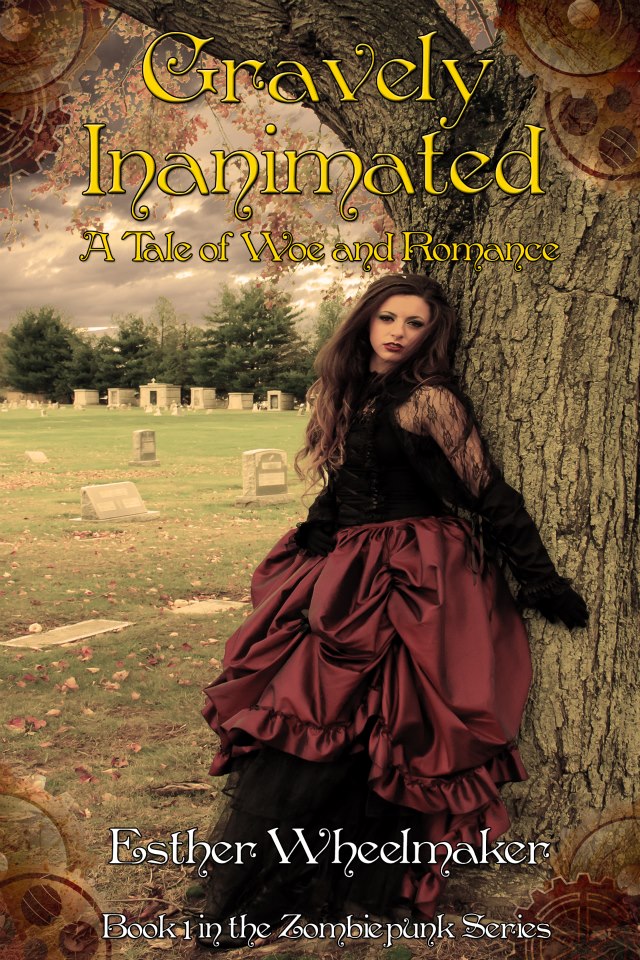
And so we step right into Gravely Inanimated, by Esther Wheelmaker, the first in a zombie-steampunk hybrid series. The author goes squarely into the zombie side of the horror-paranormal genre with this book, all the while putting her own spin on things. This is a good thing for me; normally I don't care for the zombie genre in film, television, or books, but when a good twist is added into the mix, it takes the theme in another direction entirely.

Lucille Knight is a young woman in Victorian England, though it's a very different England than the one we know from history books. In this world, the dead have been walking the earth for years, rumored to be the workings of a voodoo queen. Queen Victoria's armies do their best to keep the zombies at bay, as does an esteemed inventor, whose mechanical marvels and weapons, some of which are called automatons, are quite adept at zombie killing. 

We meet Lucy in the midst of trouble, on her way home in the evening when she is pursued by a pack of zombies. She is saved by a mysterious man calling himself Aeron, a masked fighter with a particular talent for bringing down the walking dead. She finds herself both drawn to and annoyed by her rescuer, and we begin to get to know her as a person; her relationship with her widowed father, who seems more anxious to see her married off to a respectable suitor, her close bond with her best friend Emily, and the fact that Lucy has been burned in love before. Burned is a vast understatement, all told. The cad and his new wife turn up in the book, and one feels compelled to strangle the jerk.

Lucy concerns herself more with her own amusements early on, and at a restaurant- and then a social party- meets Lord Garrett Ashdown, son of the Countess and the Earl Ashdown. The Earl is the aforementioned inventor, a genius with steampowered engineering, automated devices, and weaponry. The Countess at first seems emotionally distant. Garrett himself is a dashing and charming fellow, drawing Lucy's attention.

A pivotal moment changes everything, and Lucy finds herself given a new purpose in the wake of a tragedy, learning the ways of how to fight zombies. The book explores her growth as a character, her transition from being a society belle to a role she would have never expected. The bonds and relationships she has change fundamentally over the course of the book, and the changes she undergoes really form the core of the book.

As mentioned before, I don't normally care for the zombie genre... and yet in this case it works. Instead of the usual dystopian future of the genre, the author is wise to take us back in time and tell the story there. It's a good twist on the genre. And incorporating steampunk elements into the story is another good twist. The technology made by the Earl Ashdown feels both plausible in a Victorian era, and also feels capable of the task that it's required to undertake. And the author understands the essentials in the genre. Her zombie sequences have the attention to detail, the horrific and the dreadful as the hordes of walking dead advance on key characters or the passerby. There's not an excess of it, but just enough; it's grisly without being gory. By extension, the previously mentioned voodoo queen does finally turn up in the book, in control of the zombie hordes. The author wisely conceals the voodoo queen when the reader finally meet her, giving us shadowy glimpses, really, never quite the entire picture. She leaves that to our imagination, which when horror is done properly is much more effective.

Characterization throughout the book is strongly rendered. I felt sympathetic to Lucy very early on, when the writer shows us the circumstances of how she was badly hurt in love. Her transition from society belle to a fighter against the zombie curse is paced well, with her character developing naturally throughout. It never feels forced. She has a sparkling personality that undergoes trials, but that spark never goes out.

Emily is a character that's very likeable; she has a fierce loyalty and a bit of what in the current day we'd call a smartass personality. Lucy's father is an enigma, distant at times and cold... though it also makes him come across as authentic, particularly after a painful tragedy.

As the reader gets to know more about the Ashdowns, the characters come into their own. The Countess is initially hard to pin down, rather distant, but slowly the layers are revealed, and the reader gets to understand what makes her the way she is, and gets to like her. Earl Ashdown, the Inventor, is wonderfully eccentric. And Garrett himself is a charming sort of rogue with manners... and a few secrets. The bond that gradually forms between he and Lucille works well, developing at just the right pace.

Gravely Inanimated does a splendid job mixing together the zombies of horror with the tech of the steampunk genre in a Victorian world rather unlike our own. It's the first of a series, and while it brings its story to a close, it also leaves room for future revisitings. There's well drawn action, good characterization, a sense of humour, and a dash of romantic passion thrown in for good measure. As someone who'd normally avoid zombies in my fiction tastes, I enjoyed it.

***

You can find Gravely Inanimated at Amazon.com as an ebook for Kindle.


Wednesday, February 27, 2013

Penniless Hearts: It's Not The Destination, It's The Journey


“Well, it’s a long story, but generally if you listen to the National Geological surveyors, we are safe over here in Kauai. However, if you listen to Hawaiian folklore and the legends involving meles and chants recited by the islanders, you will learn that this area is the home of the restless goddess Pele. When her toes start tapping, I guess everyone has to watch out.” He smiled when he said the last part, almost as if he thought it seemed funny that modern day Hawaiians still believed such fantastical tales. ~ from Penniless Hearts

Penny Himmell, a graphic artist with a newspaper, is a restless young woman, looking for some excitement in her life when the reader first meets her. She's given to dreams and fantasies to escape from her sometimes drab life. She works under pressure from a rather overbearing and unappreciative boss Tina, while her father Carl seems content to overlook her. Her relationship with the man in her life, John, has lost much appeal; he seems entirely set in his ways, not particularly romantic, perfectly fine with things as they are. Penny finds herself at a crossroads, wanting something more. Be careful what you wish for; sometimes you get it.

On an impulse, Penny joins a flirtatious pilot on a trip to Hawaii for a few days, casting aside her expectations for a healthy dose of fun. Events go awry, however, as she quickly discovers what kind of man he is, and Penny finds herself drawn into misadventure and a journey of sorts with Hawaii as a backdrop, meeting new people, both good and not so good, along the way. Tina, meanwhile, ropes Carl and John into setting out to going after Penny, and their own stories, along with those of other characters, plays out as the stories converge. Carl and John have to come to terms with understanding what Penny means to them both, while Penny herself has to figure out what she really wants out of life.

Eve Gaal writes this book with strong characterization as a foundation. The characters each have distinct personalities, and once shaken out of the status quo that they're so used to come to life. Their personalities feel fleshed out, and most importantly, each of them have distinct voices. Penny as the core of the book is on a journey of discovery, a fanciful woman whose impulsive trip is completely understandable, and who she is by the end of the tale is someone who has changed. John and Carl, who start out generally taking this woman in their lives for granted, show surprising character growth. The character who sticks out as most surprising though is Tina. Overbearing and not terribly sympathetic at the outset, she changes over the course of the story, becoming steadily more likeable and more human.

The location itself takes on a life of its own as a character. Hawaii has a certain ethereal quality as a place, with its own pace of life, very different from the way things are on the mainland, and Penny finds herself immersed deep into it. From the culture to the scenery, the islands underlie everything, and the essence of this paradise soaks itself into the writing. The end result is that the reader finds themselves wanting to spend a few weeks- or months- soaking up the sun on a beach in Hawaii, or check out a lava field. Even if that means the locals will still see you as a tourist.

Penniless Hearts is a character driven romantic misadventure of sorts, a tale of growing and changing as people. It has a dreamlike quality to the writing, particularly Penny's inner voice. The plotlines tie together at their own pace, and the characters have a genuine sensibility to them, even the unpleasant ones. They feel real to the reader. The pacing of the novel works well, giving us a sense of fun, all while staying true to the journey.


Eve Gaal can be found at her blog, The Desert Rocks. Penniless Hearts can be found here at Amazon as an ebook. Eve herself lives in the Southwest with her husband Steve and a precocious dog named Fiona.

Wednesday, January 30, 2013

The Pollyanna Plan: Always Look On The Bright Side Of Life

Today we have ourselves a book review at hand, for The Pollyanna Plan, by Talli Roland...


Every once in awhile life throws us for a loop. The Pollyanna Plan starts off with its heroine getting thrown twice. Emma Beckett is a sensible underwriter in London, living her life in what she considers to be realistic expectations. Emma is strictly no-nonsense in her approach to life. She has a relationship with a boring fellow named George and a strained family life with her mother, in place following the death of her father. In short order though, Emma loses both the boring boyfriend and the job when she gets downsized. Her free spirit best friend Alice persuades her to start looking at life more postively, like the character Pollyanna, to find something optimistic in everything. Emma dives into the experience, which draws her to a karaoke evening with Alice.

The other half of the equation is Will Ballard, who's spending his time working at a home decorating store, though he in fact comes from a well to do family with a paint business. Will has retreated from the world, for the most part, dealing with a medical diagnosis that's changed his life. There's friction between he and his father, over his refusal to take the reins of the company. Will feels a sense of safety in isolation, not wanting the pity that will come with people knowing about his condition.

The pair meet when Emma comes to Will's shop looking for paint, and then when they turn up at the same karaoke establishment. There's a spark between them, definite chemistry from the start, and the story follows them both as they work through issues with family, and with their own wariness about trusting in love.

Talli Roland is a transplanted Canadian living in England, and she's obviously soaked in the British way of life. The dialogue and atmosphere of the book has a very British sensibility. It feels British, in other words. She has a talent for picking up on details, telling us a lot about a person from the way their home looks, or the way they pay attention to the world around them. She weaves these details, large and small, to give the reader a very strong sense of the world she's writing in. Much of that, of course, is in and around London, but even on a trip to Croatia, she makes the reader strongly see the place she's bringing a character to. Sometimes the detail is less tangible, but still very effective. A small moment that I enjoyed particularly demonstrates that, and it's a nod towards personality traits: Emma is spending time with her sister Meg, a child, and is struck by the fact that she doesn't know how to talk with kids.

The author has a light, deft, and funny style of writing, and it comes across in the sharp, clever dialogue a lot, and in characterization, which feels like the solid bedrock of her writing. Her characters feel grounded and real, like the sort of person you might meet in the park or at a pub. Alice is the funniest character of the lot, a firecracker sort of person who nonetheless has depth beneath the cheery and irreverent personality she shows the world. She has something of a mirror in Lou, Will's neighbour, who's a loyal and outspoken sort of person, watchful and still likely to say something off colour. Emma's ex George comes across, to use a Britishism, as a boring self involved prat, but that's what makes him work. We've all known a George in our life, if not more, and while the author doesn't employ such a technique, we've all been tempted to push a George into the Thames. When we meet Emma's mother for the first time, knowing she's remarried and has another daughter, we expect one thing to happen, and instead the author takes us in a different direction, and we end up understanding, just as Emma does, what her mother has felt in the aftermath of the death of Emma's father.

The two leading characters are of course the core of the book. Emma is a smart, likeable woman, torn between what's safe and realistic for her on the one hand, and hope and optimism on the other. She has to figure these things out for herself as she goes along, wavering between looking on the bright side of life and just going back to being cynical about life. She has a sense of humour, and the reader can really empathize with her. Her character voice is very distinctive, and true to life. Will feels just as real as Emma does. Coping with a medical diagnosis that's difficult, he's been burned before in love, wants to pull back away from the world, instead of dealing with it. There is a warm, playful chemistry between these two, and that's all to the credit of the writer. As the two characters embark on this journey through the book, the reader can't help but root for them. 


The novel has a brisk pace to it, clever banter, and strongly rendered characters who feel true to life. Talli has a winner with this book, and you'll enjoy reading it.

***

You can find The Pollyanna Plan and Talli's other books through Amazon.com or Amazon.UK. And you can find her at her blog, Talli Roland, as well as at Facebook.. She lives in London, with her husband and their new son, affectionately nicknamed Lobster Baby.

Monday, January 7, 2013

Always Listen To Your Ghostly Grandmother

Today I am turning my attention to reviewing Secondhand Shoes, the first novel by Shelly Arkon, a coming of age story for a young woman in the eighties, with a dash of humour and a pinch of paranormal tossed in for good measure.


Secondhand Shoes opens in an uneasy place, with the main character, Lila, an eighteen year old woman on her wedding day. Her bridal nerves are more than what might be expected; she's marrying a man she barely knows and doesn't particularly like, thanks to the pressure of her overbearing mother Babs. Lila has little say in the direction of her life, no respect at all from a mother who thinks that she's crazy, a father living far away in exile, and a step-father who bows to his wife's every demand and seems to have lost his spine. The only living person who seems to be on her side is her best friend Cynthia, and we can see this in her advice to run while she can. 

Then there are the ghosts. Just like a long out of work former child actor who shall remain unnamed, Lila sees dead people. One of the ghosts in her life happens to be her paternal grandmother, who has little patience for her former daughter-in-law's overbearing ways, and is at Lila's side through much of the story. Gram is a force to be reckoned with, a mixture of common sense and great wariness about the threats that exist in the world, particularly where her granddaughter is concerned.

Lila's ability isn't appreciated by most people around her, let alone her mother, who won't abide such nonsense. Instead Babs, who we learn has coerced her daughter into breaking off with a young man she did like, simply because of her own prejudice, has orchestrated a relationship with Max Butz (yes, that's his name), a dirtbag of the first order who thinks that turning up in a orange polyester suit for his own wedding is perfectly acceptable. Max runs with a similar pack of criminal degenerates, has a father with anger management issues, and a religious zealot for a mother (with a few hidden secrets of her own). It doesn't take long before the reader confirms that first impression: Max is a vicious bully with no respect at all for Lila, and nothing at all resembling scruples.

The story hinges on a decision Lila makes to take her life into her own hands, and it leads her into danger, both physical and supernatural. She has to confront her own fears and anxieties (fear of germs, insects, and other creepy crawlies plays big for this protagonist). She gets help along the way, from the living, the dead, and those who are, well, in between.

Shelly Arkon has done well with her first novel. She has a strong style, giving characters a voice that are distinctly their own, even minor characters who might only appear for a scene or two. And she pays attention to detail: scenes in a Southern swamp make the reader feel like they're right there; the same applies to sequences in a truck, a roadside dive, or even in an afterlife of sorts. The style draws the reader right in, and gives the narrative a touch of authenticity. The same applies for when the story is set. This is firmly set in the Eighties, and cultural references of the time abound, small touches that firmly ground the story.

As mentioned, there's a liberal dose of humour spread throughout the book. Some of it comes from the living characters, such as Lila herself (especially her paranoid germ phobias), Cynthia, or B.J., a trucker who turns up along the way. Much of it comes from the ghosts, particularly Gram, who is a wise sage capable of interacting with the world in a number of different ways; she can wreck havoc with electricity or make use of nature, and does so with regularity.

Characterization itself is the bedrock of the book, and this is the strength of the novel. I felt a particular dislike- and this shows the strength of the writing- for Babs, who comes across as a bully (including at times even physically) and a terrible mother. She's overbearing, difficult, temperamental, and bigoted. She might be Lila's mother, but at the same time, there's a toxic quality to her that was close to home for me. I've known a couple of Babs, and these are the unpleasant sort of people you wish you'd never known

Max and his cronies and relatives are memorable, if unlikeable. In different ways, their personalities come across as real, and sleazy. At least in some ways, I expect real people have inspired them. 

Cynthia is a strongly written character. She's absolutely supportive of her friend, fierce and courageous when she needs to be, and willing to prod Lila along when she needs it.

Gram is the scene stealer of the book, a wise woman with heart. For a ghost, she's more than lively, won't take nonsense from people she doesn't care for, and is protective of her granddaughter. She's aware of the world in a way that those who are living can't be aware of, including a lingering threat that might well be left for another novel.

The book is really about Lila's journey. It takes her from being meek and submissive to making choices for herself, to finding her own strength and resolve. It's understandable, given the way her mother is, that the character starts out as not wanting to rock the boat and refuse her mother's wishes. Over time she's gotten used to surviving what basically amounts to emotional abuse by just going along with everything her mother says. During the events of the book, Lila comes to terms with what it means to be an adult, to have to be responsible for her own decisions. It's character growth, and it helps that we're sympathetic towards her from the start.

Secondhand Shoes tells a story that is at times tense, at other times wry and mischevious. It wraps up the natural arc of the characters while leaving room for more, and provides its own good spin on the world of the paranormal. The pacing of the story keeps things moving along, and the characterization and attention to detail combine to make the book succeed.


***

You can find Shelly at her two blogs, The Life Of A Novice Writer where she writes regularly about family, life, and her two incorrigible dogs; and she can also be found at Secondhand Shoes, A Novel. The book is already up in paperbook format, with an ebook version to follow shortly. You can find the paperback version through Amazon.com.


Saturday, September 15, 2012

An Empire Of Secrets

Today I'm reviewing Alexander's Empire, by my good friend and partner in crime, Norma Beishir. The novel was originally published as Dance of the Gods during her days writing for Berkley. Norma is re-releasing the book on her own as an ebook, with a paperback to follow; the book is set to go active at Amazon this weekend, so keep an eye on her Amazon page. It'll turn up there, and it's well worth getting hold of... 


"There had been no letter, nothing to identify its sender—just a photocopy of a legal document that needed no explanation. Its message had been only too clear. Not knowing who sent it bothered Meredith most. It meant that someone knew the truth, someone who could turn it into a dangerous weapon... That single piece of paper, in the wrong hands, could destroy them." ~ Alexander’s Empire

The novel Alexander’s Empire is a tale of love, family, tragedy, secrets, power, and ambition. It brings together two leading characters, Alexander Kirakis and Meredith Courtney, from different backgrounds, and weaves an exceptional character story in the process, across the world and over a number of years from the late Seventies and into the late Eighties.
After a short prelude in the latter time frame of the book, we’re drawn back to 1979, meeting the two characters. Alexander Kirakis is the only son of Constantine and Melina Kirakis. He’s the heir to the family empire, a financial conglomerate that ranks as one of the premier companies in the world. Alexander heads the company’s North American operations, while his parents live in Greece, moulding him to eventually take the full reins of the company. Alexander is a troubled man, whose sleep tends to be disturbed by dreams he can’t understand, and whose personal life consists of bedding any woman who catches his eye; yet he seems unable to have a lasting relationship.
Meredith is an ambitious reporter in California, working her way up through television news. She has cut ties with her family, determined to make her reputation based on her own talents and merit.  She first meets Alexander in her capacity as a reporter, and there is a spark there between them, but she’d prefer to keep him at arm’s length, to get an interview with the young executive who has a reputation for avoiding the media at all costs. Alexander, in turn, sees her at first as someone he’d like to bed down with, the latest in a line of such women.
Their paths cross occasionally in the years that follow. Meredith gets involved in a relationship with a film director, which leads her to the story of another film director, a reclusive man with tragedy and secrets in his past. Alexander involves himself with a string of women, making mistakes in judgment along the way, which cause some friction between he and his parents at times. They in turn have secrets of their own hidden away from Alexander, things they don’t know how to reveal. Ultimately, Meredith and Alexander find their way to each other, set out on a new life together, and find themselves confronting hidden truths and secrets of the past, welling back up to the surface, posing a threat to them both.
The story is an intensely personal one, based deeply in characterization, and Norma Beishir gets us well inside the heads of these people. There are a number of supporting players I’ll first note. A man who must go unnamed appears relatively later on in the book, as an antagonist of sorts. His motivations for his actions are entirely understandable, his obsessive hatred coming from a place of anger. He is a ruthless, vindictive man, and drawn out well in that context, pulling strings and manipulating events in his favour. Tom Ryan, the reclusive director whose story intrigues Meredith, is a broken man, worn down by the heartbreaking tragedies of his past, and the reader empathizes with him as he drinks himself into oblivion. An Interpol inspector, Adrian Dessain, appears relatively late in the book, probing irregularities that raise his suspicions and send him along a path to determine the truth. Dessain reminded me of Columbo, methodically and doggedly searching for answers. And Constantine and Melina are very true to life. Constantine is at times hard and demanding, but that hides the softer side of the man, and ultimately we see him as a man who loves his son and his wife very much. Melina is very sympathetic, a warm and loving wife and mother who wants what is best for her son, and remains troubled by her conscience. These two characters particularly feel very grounded and real.
Meredith herself is a strongly written character. She brings a natural curiousity to the table, an essential quality in a reporter. Her personal drive to succeed comes out of her difficult background; it seems entirely appropriate that she wishes to get ahead on her own abilities. She keeps Alexander at bay for a long while, which feels just right; their relationship develops at its own pace, and how she comes to feel about him comes across as genuine and realistic. This gives the character much depth.
Alexander is a bit of a contradiction. It’s hard- at first- to find him likeable. He comes across as selfish, as a user. He’s a ruthless businessman, the sort who attracts enemies.  He has his way with any woman he wishes, disregards their feelings, seems to have no respect at all for boundaries. So for awhile, I found him hard to like, as compelling as he was. That changes during the course of the novel, first in terms of his reactions to the fallout of a mistake he makes, then in regards to events surrounding his parents, and finally in how he softens in the face of a slowly developing relationship with Meredith. As the reader slowly begins to see the reasons for his nightmares, and the answers to questions he has, Alexander becomes much more sympathetic. The events of the book change him for the better, making him a decent man.
Alexander’s Empire takes place across the world, from Greece and Switzerland to New York and Los Angeles, among other locales, and the pacing of the storytelling works just right. Attention to detail is meticulous throughout the novel. Events that take place during the course of the storyline feel very true to life, very set in the world as we know it- albeit one of the relatively recent past when the World Trade Center still stood. The book grounds itself in a very believable and tender relationship between two different people that we come to like. It has a bedrock foundation in strong characterization that serves to make the novel an outstanding achievement.  It’s a tremendously effective and poignant character study, all the more so for its humanity and depth.

The original cover to Dance Of The Gods