Faith Can Move Mountains... But Dynamite Works Better
Showing posts with label Steve Martin. Show all posts

Monday, April 13, 2015

And May The Best Scoundrel Win

I have another movie review today, something that is very different from the last two movies I have reviewed here in recent days.


“Listen. We’re the weaker sex. Men don’t live as long as women. We get more heart attacks, more strokes, more prostrate trouble. I say it’s time for a change. I say let them give us money. Let’s live off them for awhile. That probably shocks a guy like you, right?” ~ Freddy Benson 
“Well, it’s rather a revolutionary thought. Do you really think it’s possible?” ~ Lawrence Jamieson 
“Look what I did in the dining car! She gave me a hundred francs! That’s like, ah... twenty bucks! Do you have any idea what it feels like to take a woman for twenty bucks?” ~ Freddy Benson 
“No, I haven’t. I’m afraid it’s a little out of my class.” ~ Lawrence Jamieson

“We all have our limitations, Freddy. Fortunately I discovered that taste and style were commodities that people desired. Freddy, what I am saying is: know your limitations. You are a moron.” ~ Lawrence Jamieson


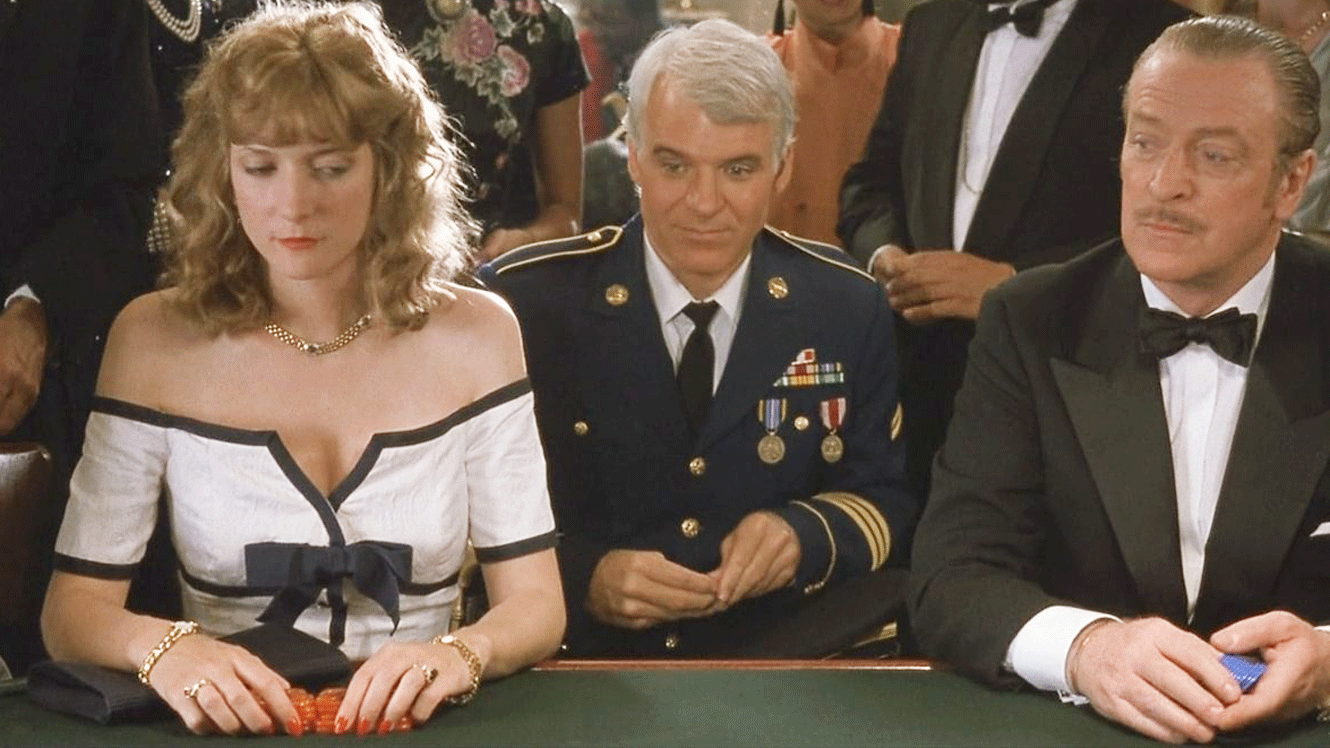
Dirty Rotten Scoundrels is a con man caper pairing two great actors, Michael Caine and Steve Martin, in brilliantly funny roles. A 1988 remake of the 1964 film Bedtime Story starring Marlon Brando and David Niven, it’s a light hearted and clever film set on the French Riviera, with two very different leads, a charming leading lady, and no shortage of laughs, some of them decidedly black and twisted in tone, so of course it would appeal to me. It’s one of my favourite comedies, and it comes to us from director Frank Oz, who, when he’s not directing, has spent a good deal of time voicing the Jedi Master Yoda. One must think that Yoda would not approve of con artists.


The film opens with the suave con artist Lawrence Jamieson (Michael Caine), a seductive man of taste and refinement. Lawrence has made a very good living swindling the unsuspecting rich and corrupt out of their money. His standard scheme is to pose as a deposed prince of an Eastern European nation, striving to unseat the Communists who took his country, acting the part of a freedom fighter. The women he seduces buy the story hook, line, and sinker, giving him money, jewels, anything to further his cause. His actual cause, of course, simply adding on to his own wealth. Still, he is a man with some scruples. He will not swindle the poor and virtuous, only those who are wealthy and eminently corrupt. In his opinion, they have it coming.


Returning home to the town of Beaumont-sur-Mer from one such successful con, Lawrence is in the dining car of a train when he notices the arrival of an American, Freddy Benson (Steve Martin). Freddy is brash, arrogant, not terribly bright, and without any scruples. He’s a con man who will sucker anyone he can to get a free meal, using the reliable sick grandmother story to gain sympathy. Lawrence recognizes him as a hustler, and the two chat, while Lawrence never once lets on that they share an occupation in common. He understands that the inexperienced and dimwitted Freddy might end up scaring off some of his usual marks, and so makes efforts to deflect him away from his home town.


Lawrence is more concerned with reports in the papers about a con artist known only as the Jackal fleecing Europeans. He admits to his friend Inspector Andre (Anton Rogers) that the Jackal can’t be that effective considering he’s made the papers. Andre may be a cop, but he’s a corrupt one, having had profited nicely by his business relationship with Lawrence. And into the midst of it all, Freddy turns up in town again, swindling a woman for what he can get. Lawrence arranges for his arrest and deportation... but things don’t quite go to plan. Soon enough, the two con men are working together, and then competing against each other. A visiting American woman by the name of Janet Colgate (Glenne Headly) becomes the focus of their competition.


The story was adapted from the 1960s film by two of the screenwriters of that film, Stanley Shapiro and Paul Henning, with an additional screenwriter, Dale Launer, brought in. It was at one time meant as a vehicle for Mick Jagger and David Bowie (one can only imagine how vastly different the film would have been), but ultimately Caine and Martin were cast in the roles. Filming was done along the French Riviera, taking full advantage of palatial estates, hotels, casinos, and the lush scenery. Oz, a puppeteer with the Muppets who would have a prolific directing career, including The Dark Crystal, Little Shop Of Horrors, What About Bob, In & Out, The Stepford Wives, and Death At A Funeral, would come in as director, He brought along a fellow Star Wars alumni, Ian McDiarmid (otherwise known as the Emperor), who played Lawrence’s butler. Oz brought a gift for comedy to his filmwork, and the story goes along briskly, with a rich sense of humour amid the games of two con men showing each other up. The result is a beautifully crafted caper with two leads who have terrific chemistry, as different as they are. It’s a great pleasure to watch Caine and Martin banter with each other throughout the film, and that’s as much on the performers as it is on the clever dialogue and the director.


The cast members are well chosen. Ian McDiarmid, who’s become most associated with the evil Emperor in the Star Wars films, shows a gift for dry humour as the butler Arthur. He doesn’t talk much, but when he does, it’s funny. His “welcome to Hell” greeting to Freddy is appropriately dark and twisted, and the character seems perpetually annoyed by the American.

Anton Rogers gives the corrupt policeman Andre a very French sensibility in how he plays the role. He might be corrupt, but he is an engaging character, loyal to Lawrence, even while technically breaking the law. He seems world weary and yet something of a schemer, resourceful in how far he might take his police powers in maintaining the status quo. His remark about cheating being very French and getting caught being quite American is hilarious- all the more so because of how dryly he delivers it, something common throughout the film.


Glenne Headly is delightful as Janet. She first appears in a clumsy moment arriving at a hotel, and Lawrence learns from a concierge that she’s the United States soap queen. What precisely that means is left for later, but it’s quite an entrance, and as the audience gets to know her, she comes across as wide eyed and naive, entirely trusting and virtuous- the sort of person Lawrence would refrain from swindling. There’s more to the character, though, and as time goes along, she has great chemistry with both con men, all while both swindlers maintain their personas in the midst of competition over her. This is Headly at her best, and a terrific role for her to play.


Steve Martin has a gift for physical comedy, and that certainly plays out throughout the film. He’d worked with Oz before, playing the deranged dentist in Little Shop of Horrors. He has a wiseguy sensibility in many of his films, and that does present itself in his performance as Freddy- though Freddy is a dimwit. He’s brash and obnoxious, a playboy who gets in over his head, and  he fails to get the notion of walking away while he still can. He’s arrogant and highly competitive, totally devoid of ethics, tends to get frustrated easily, and fights dirty. As the film goes along and Freddy is put into situations that require that strong physical comedy, Martin delivers. His frustrated attempts to remember Lawrence’s name while in jail is one such example, as is the persona he adopts for a time, playing the part of the prince’s mentally addled, socially inept brother Ruprecht. His performance is a strong match and a contrasting character to his co-star, and such a fun role to play.


Michael Caine was nominated for a Golden Globe as Best Actor for this role, and it’s a deserved nomination. Lawrence is a sophisticated man, refined, charming, and classic, a man who inhabits a role effortlessly. He slips in and out of accents with ease, and operates in a way that his marks never know they’re being scammed. He’s a resourceful con man, calm in a crisis and able to adapt to a problem with quick wit- the way he handles an encounter with a previous mark while out with Janet and Freddy is priceless, while how he deals with a trap Freddy sets for him involving sailors is inspired. He does fight a bit dirty- not in the same way as Freddy, but he relishes dishing out some punishment to his rival as the competition goes along. Lawrence is also a man of some principles, unlike his rival, and that relates to how he treats Janet, who he sees as less of a mark and more of a virtuous woman. She thoroughly charms him, and it’s not hard to see why. Caine successfully takes all of these elements into mind and brings that into his performance. It’s a pleasure to see him play this role.


Dirty Rotten Scoundrels goes against the usual trademark of the con man film- having a mark who deserves to get swindled. Instead it gives us a mark who seems virtuous, and so moves in a different direction, deriving its fun from these two swindlers working to outdo each other while the stakes change. It's a delightful comedy with wonderful twist endings, a dark sense of humour, and great lead actors playing off each other in the best of ways.


Monday, April 14, 2014

Can We Be Freed Without That Musical Number?

Some links before I get started. We had a Snippet Sunday post at the joint blog. Krisztina had suggestions for carrot cake at her blog. Cheryl has some shots at her page from an arts and crafts fair. This being A-Z Month among some bloggers, Shelly and Eve are both taking part. Gina took a look at the town of Toledo, Oregon at American Small Towns. Christine posted at her blog about going to an interactive history park. And have a look at what happens in the video link here about a moose that was freed after being stuck in snow.

It's Easter week, and Passover too, so I thought I would do two movie reviews in advance, both dealing with the theme of the Exodus. Today I'll be dealing with a more recent version of the story, and in my next post I'll be examining the classic version.


"I will not be dictated to, I will not be threatened. I am the morning and evening star, I am Pharoah!" ~ Rameses

"I seek to build an empire, and your only thought is to amuse yourselves by tearing it down! Have I taught you nothing?" ~ Seti

"Tell me this, Moses, why is it every time you start something, I'm the one who ends up in trouble?" ~ Rameses

"Pharoah has the power. He can take away your food, your home, your freedom. He can take away your sons and daughters. With one word, Pharoah can take away your very lives. But there is one thing he cannot take away from you. Your faith." ~ Moses


Back in 1998, Dreamworks Studios gave Disney a run for their money in the animation department with a different take on the familiar Exodus story in The Prince Of Egypt, telling the story of Moses rising up to lead his people from bondage. The film was done in the traditional style, enhanced by computer effects, and directed by a team: Brenda Chapman, Steve Hickner, and Simon Wells. True to most animated films, it was done as a musical, with songs by Stephen Schwartz, and a music score by the prolific Hans Zimmer. It featured an all star cast of A-list talent (with professional singers backstopping some of them).


The film follows the life of Moses, born at a time when Hebrew children are being killed at the orders of the Pharoah Seti (Patrick Stewart). The infant's life is spared as his mother gives his fate to God, and the baby is found in the Nile by the Pharoah's wife, Queen Tuya (Helen Mirren) and taken into their household. Years later, the baby has grown up to become Prince Moses (Val Kilmer), brother to the heir Rameses (Ralph Fiennes). The two brothers have a friendly rivalry, get into trouble on frequent occasions, and are cared for by their parents. Moses is something more of an instigator; not having to inherit the throne means he can be more carefree and find mischief, particularly at the expense of two of the Pharoah's court advisors (Steve Martin and Martin Short).

All is not well, however. A chance encounter leads Moses to learn the truth that he is the son of slaves, and circumstance drives him away from Egypt when a man dies at his hands. He finds a new life in the wilds, marrying into a nomadic family and finding happiness with Tzipporah (Michelle Pfeiffer). As time goes on, Moses finds himself confronting the god of his people, who has a purpose for him.


This is a very different take on the story than The Ten Commandments. As an animated film, it operates under different rules, and indeed, for a different audience. I don't think Cecil B. DeMille would have gone for a musical, and personally for the most part, the musical side of things I could have lived without. Most of the songs contained through the film could have been left aside (sorry, Mr. Schwartz), though a couple of them work very well, such as When You Believe, which accompanies the Exodus sequence. That said, however, the songs aren't gratingly annoying in the way that I found almost all of the songs in The Lion King (fans of Elton John may have me burned in effigy at their pleasure). Zimmer's score, on the other hand, is powerful and just right as it's needed, whether it accompanies a chariot race or follows the climactic sequence in the Red Sea.


The animation style fits the subject well. The characters look Egyptian or Hebrew (as opposed to other previous versions of the story where very white actors take on the parts). The characters have a bit of an angular, impressionist style in their appearance- Aaron, for example, as voiced by Jeff Goldblum, has a very animation style look, whereas Seti's appearance reminds us very much of the actor voicing him, Patrick Stewart. More importantly, the animators really convey the personalities of the characters, both in expressions and in attention to detail and body language. The animation extends to matters of place and clothing, conveying the sense of ancient Egypt, the lowly homes of slaves, and the wilds of the desert well. The advantage of more modern techniques, enhanced by computer, gives the viewer sequences that pay off better than the limitations of DeMille's time, but those techniques rightfully are only meant to aid the animation process, not supplant it. The burning bush, the parting of the Red Sea, and the final plague each have a very dramatic quality that uses current techniques to their full capabilities, and give the film a breathtaking kind of quality.


The screenplay is by Nicholas Meyer and Philip LaZebnik. Meyer, it turns out, had a hand in directing and writing two of the Star Trek films. Their screenplay works on multiple levels, a good thing in animation. While there's enough there to entertain children- though the theme is perhaps more mature than other animation- there's a lot in this story that adults will get that would just pass by children. The writers give the story just a hint of humour here and there to lighten up the mood- Moses falling into the well, for instance, or a mishap that results in major damage to a very large tribute to Seti. Largely, though, they deal with themes of freedom, family, ambition, faith, and fate as the story goes along. They weave in different takes on some of the character dynamics as well- Moses and Tzipporah start out in more of an antagonistic way, for instance, and Aaron is disbelieving and initially hostile to the presence of his brother when Moses returns from the desert. Perhaps the best of these different takes, and the real foundation of the film, is the relationship between Moses and Rameses. In earlier versions, the two are firm rivals, at odds with each other even before the truth is revealed. In this version the two brothers genuinely like each other and get along well. It makes it all the more painful when they find themselves on opposing sides- Rameses at one point asks in a mournful way why things between them can't be as it was.


The voice work by the actors brings the characters to life. Ofra Haza plays the biological mother of Moses early in the film, voicing and singing the character as she gives up her son to the uncertainty of the river. Patrick Stewart and Helen Mirren as the parents who take him in and make him a prince are well cast. Stewart's voice brings authority to the role of Seti, a man trying to rule his kingdom and thinking of what's to come for his people after he is gone. He does terrible things, and dismisses those terrible things by saying, "they were only slaves", but at the same time, the man is considerate and thoughtful. Mirren voices his wife as the only mother Moses has known, fiercely loving of both of her sons. Danny Glover turns up briefly as Jethro, voicing the role of Moses' father in law somewhat more for laughs than you might expect. Steve Martin and Martin Short, who have worked together before, voice the two courtiers as conniving weasels and disapproving irritants. They're both comic relief, which is to be expected given that's the strong trait of both actors. Jeff Goldblum gives Aaron an interesting turn, not as the stoic figure we might expect, but one who's deeply distrustful of his brother and seemingly resigned to his place in life. He needs to move past that, and in time does. Their sister Miriam is voiced as an adult by Sandra Bullock, after a brief appearance voiced by another actress, Eden Riegel, as a child, and sung by Sally Dworsky. Her take on the character is that of a strong, opinionated person with a basic faith that her people will be led out of bondage. The dynamics Moses has with these two birth siblings is as different as those with his adoptive family, but still critical in what drives him forward.


Michelle Pfeiffer voices Tzipporah, and sings the role as well (anyone who's ever seen her in The Fabulous Baker Boys knows she can sing). The character has a modern sensibility to her. She can take care of herself, is resourceful and aggressive when she needs to be. She doesn't back down, can be stubborn, and is sure of herself. Pfeiffer conveys all of these qualities in her vocal performance. Sure, she and Moses seem to fall in love thanks to a montage in a song (curses to the person who first came up with the idea of musicals, by the way), but the relationship feels grounded. Ralph Fiennes has played the villain on more than one occasion, and yet his Rameses is sympathetic. There is a proud arrogance in him, a dark streak at times, and at the same time, there's the side of him that deeply misses his brother. It gives him depth, and makes him a character we can relate to. Kilmer's take on Moses is also interesting. Freed from the unenviable fate of ruling Egypt as a young man, he's carefree and full of mischief, a refreshing take on the character. As the story moves along, Kilmer's voice takes the character from shock over the truth about himself, to personal doubt, to strength of will, never losing track of the humanity of the man.

The Prince Of Egypt is an interesting counterbalance to The Ten Commandments. It mostly takes itself seriously, given the seriousness of the subject matter. It grounds itself in a story of brothers torn apart, of the meaning of freedom, and uses animation to depict an epic, familiar story in a new way. Despite the presence of most of the songs (have I mentioned I don't like musicals?), the movie works very well indeed.