Faith Can Move Mountains... But Dynamite Works Better
Showing posts with label Jonathan Hyde. Show all posts

Monday, October 24, 2016

Ancient Curses And Grumpy Egyptians


“It is better to be the right hand of the devil than in his path.” ~ Beni

 “I only gamble with my life, never my money.” ~ Rick O’Connell

“You lied to me!” ~ Evelyn Carnahan 
“I lie to everybody, what makes you so special?” ~ Jonathan Carnahan 
“I am your sister!” ~ Evelyn 
“Yes, well, that just makes you more gullible.” ~ Jonathan

“We are part of an ancient secret society. For over three thousand years we have guarded the City Of The Dead. We have sworn at manhood to do any and all in our power to stop the high priest Imhotep from being reborn into this world.” ~ Dr. Bay

“This creature is the bringer of death. It will never eat, it will never sleep, and it will never stop.” ~ Ardeth Bay

“By the way, why did you kiss me?” ~ Evelyn 
“I dunno, I was about to be hanged. It seemed like a good idea at the time.” ~ Rick


With the walking ego otherwise known as Tom Cruise starring in a new Mummy film next year, it seems appropriate to review two of the films from some years ago, which didn’t take themselves too seriously and odds are will prove to still be more entertaining when compared to Cruise’s film. In 1999, director Stephen Sommers brought The Mummy to the big screens. It was a loose remake of the 1932 original, stressing action, adventure, and fantasy with a rich sense of humour in a tale of a cursed Egyptian high priest coming back to life in the 20th century.


The film opens in ancient Egypt, where the high priest Imhotep (Arnold Vosloo) has a secret romance with Anck-su-Namun (Patricia Velasquez), the mistress of Pharoah Seti. Their relationship is exposed, the  lovers kill the Pharoah, and while his love takes her life rather than be captured, Imhotep is ultimately punished with an ancient curse and buried alive with flesh eating scarab beetles. The order of bodyguards who have carried out the punishment at Hamunaptra, the City of the Dead, vow to guard the site forever.


In the wake of the First World War, members of the French foreign legion are bracing themselves for battle with desert raiders at the ruins of Hamunaptra. Among them is an American, Rick O’Connell (Brendan Fraser) and a cowardly soldier, Beni (Kevin J. O’Connor). During the skirmish, Rick sees something disturbing amid the sand. Several years later, Evelyn and Jonathan Carnahan (Rachel Weisz and John Hannah), a sister and brother pair of Egyptologists living in the country, meet Rick at a prison where he’s due to be hanged; Rick knows where the City of the Dead is, and his life is worth saving. And so the three are tied together in a journey to the city... where the cursed dead still waits in his sarcophagus.


The idea of an updated version of The Mummy had been around for a few years, starting in the early 90s. At one point Clive Barker had been on board to direct a pure horror take on the concept. At another point, George Romero was attached. Finally Stephen Sommers came on board with a premise that was along the lines of an Indiana Jones film- the serial style adventure film with a sense of humour, swashbuckling more than horrific. Sommers had done a number of different projects before- The Jungle Book, Tom and Huck, and Oliver Twist. His previous film prior to The Mummy was something that had a similar sort of tone. Deep Rising had featured horror, action, adventure, humour, and rogues as characters. The studio liked his proposal, and brought him on board to direct what would end up being a film that had fun with itself- something one doubts we’d ever see out of Tom Cruise.His style as a director, which admittedly can be up and down in terms of quality, works well here, as the film flows swiftly and he invests a good sense of humour into his directing style. For a look at the down side of his work, try wasting two hours of your life by watching one of those G.I Joe films, though as I said... it would be a waste.

The screenplay by Sommers has nods towards the original 1932 classic- the alias Boris Karloff’s Imhotep uses in the modern day matches the name of one of the characters in this film, and resurrection from the dead using the Book of the Dead is revisited here. So too is the idea of the villain single-mindedly pursuing the resurrection of his lost love. Where the original film stressed horror and suspense, this remake goes off in different directions, mixing action and adventure into the tale, as well as a rich sense of humour. There’s a lot of the influence of Indiana Jones in the story, with the setting in Egypt and the idea of tomb raiding and ancient mysteries, as well as the swashbuckling aspect of the characters.


Production took place primarily in Morocco and the United Kingdom, as Egypt at the time was deemed too unstable for filming. Location shooting involved exterior settings, while a good deal of underground chambers and passages, in which the film indulges in with regularity, was done in studio settings, with setwork taking on the look of ancient Egypt, both in terms of that time period and in terms of ruins in the modern era. There’s a lot of attention paid to detail in terms of set work, costuming, and props that give both periods- ancient Egypt and the 1920s era- a sense of reality. One feels they’re dropped down into the desert with period clothing and vehicles.


The CGI and special effects of the film do as they’re required. Much of that revolves around Imhotep himself, as well as the use of the various powers the curse has given him. It’s probably most spectacularly seen in his use of a sandstorm to thwart the heroes in the latter part of the film, but reflects as well in his appearance as his body regenerates, or other techniques he uses along the line. The CGI is also used in other resurrected mummies- Imhotep’s fellow priests- and in the periodic use of scarab beetles, who have a way of picking a body clean within seconds, which the real scarab beetles don’t do, but it looks good and horrific on screen. Throughout the film, the CGI does look real and effective- something that went slightly awry with one of the special effects in the sequel. The score by the late master composer Jerry Goldsmith is one of my favourites by him, filled with themes that stress adventure, romance, mystery, humour, and the exotic themes of a place not our own.


I like the choice in casting throughout the film. That goes from the major players to relatively minor ones. Bernard Fox, the British character actor who’s been in countless movies and television series, has a fun but poignant role as Winston Havlock, an acquaintance of Rick and military pilot who’s gone to seed in the desert, drinking his way into oblivion and lamenting the fact that he didn’t go down in glory like the rest of his friends in the Great War. Erick Avari, who came to North American attention first as a tribal leader in Stargate, plays the curator Dr. Bay, first coming across as a fussy and humourless bureaucrat before we learn that he’s also the leader of the Medjai, and a courageous man of knowledge. Jonathan Hyde often gets cast as unlikable stiff necked characters, which applies here. He’s an Egyptologist, Allen Chamberlain, leading a group of Americans. The character is dismissive and haughty, which Hyde plays to.


Patricia Velasquez appears in the prologue as Anck-Su-Namun, the object of Imhotep’s affections. We can see what the villain sees in her, though she’s as treacherous as he is, willing to do whatever she must to free herself of the position she’s in. There’s a boldness in her that matches Imhotep’s own. Boldness is something we can’t see in Beni, the lowlife henchman in the modern era. Kevin J. O’Connor had worked with Sommers in Deep Rising, and while the snarkiness carries over into this character, he’s less sympathetic. His Beni is a greedy, opportunistic coward, the sort who runs from danger but bargains with the devil; it’s hard to feel sorry for him when he’s getting his butt kicked around.


Arnold Vosloo is perfectly cast as Imhotep. His performance may be augmented by special effects, but it’s strongly grounded in him as an actor. He plays Imhotep as determined and ruthless, single-minded in his quest to resurrect his lost love. Thus from his point of view, he’s not the villain, which makes the role work so well. There’s a strong sense of menace in his performance, and while everyone else in the film seem to be playing their parts with a wink in the eye, Vosloo plays the role completely straight. His character, caught up in this supernatural curse, is a formidable adversary.


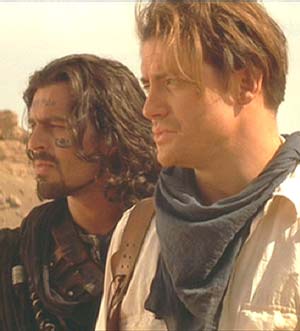
Oded Fehr was well chosen to play Ardeth Bay, a warrior leader of the Medjai who comes into contact with the main characters. He and his order, a secret society of desert warriors, have sworn to protect the secrets of the City of the Dead, and that first brings them into conflict, and then alongside, the three main characters. Ardeth is humourless at first, though we do catch a dry sense of humour as things go along. And he’s courageous, formidable, and decisive as a leader of men, though he does defer to Doctor Bay- one assumes they’re son and father, though the film doesn’t touch on that.


John Hannah is one of those actors who can make a role interesting just by talking. His Jonathan is a fun role for the actor; while he’s apparently an Egyptologist, he doesn’t take the job that seriously. Jonathan is something of a bumbler, a greedy sort of fellow with few scruples. He’s not that interested in history, more in just getting rich, and that drives him. Jonathan is also something of a grifter and thief, a man fond of lying, especially if it gets him out of trouble. Fortunately he’s also a whole lot of fun, and while he’s not above taking advantage of his sister’s good nature, he’s fond of her too.


Rachel Weisz was perfectly cast as Evelyn. The first impression she makes on the audience is of a bookish but clumsy librarian, eager to prove herself to fellow Egyptologists, who dismiss her as a woman. She’s peevish at times, particularly with her brother, and then early on with Rick, who she dismisses as arrogant and rude, even though she has need of information he knows. And yet the bickering dynamic she has with him gives way to a bond, and we can believe the chemistry between Evelyn and Rick, because it develops as the film goes along.


The leading role had been offered to various actors at one point or another- Cruise himself, as well as Brad Pitt or Matt Damon had been offered the role. Fraser got it, and was well suited to the role. He brings to Rick the sort of swashbuckler sensibility that Errol Flynn would have gotten, and the actor doesn’t take himself too seriously, which is vital for Rick’s world view. Rick is a scoundrel and a rascal, which makes him a fun character to watch, but he’s also courageous and finds a reason to see things through as the film develops. Fraser makes the role fun, and his Rick is a convincing leading man.


The Mummy might be a loose remake of the original film, but it goes off in its own direction and takes on a life of its own. It’s a satisfying adventure with a lot of humour, finding a balance between horror and thriller. In some ways it is a comic book tale or a roller coaster story, but the pace always moves along well, and the characters are memorable and fun. Add to that a formidable adversary, and the resulting film is an enjoyable one. Even though it’ll leave you shuddering at the very words scarab beetle.

Tuesday, April 10, 2012

Stop The Titanic, I Want To Get Off


"No, really, I've got a bad feeling about this voyage. Look, the coast is just two miles over there, we've only just left port, and I've swum in the Channel plenty of times. Hell, I'll jump overboard, you don't even have to lower me down. Cheerio, old chap!" ~ Charlie O'Dowd, the first survivor of the Titanic, 1912


"I'm not sure if I should go with the star crossed lovers angle for the film, or with plan B, where I retcon the whole tragedy by revealing that a Terminator from the future has been sent back in time to kill Sarah Conner's grandmother, who just happens to be on the Titanic on its maiden voyage. What to do, what to do..." ~ James Cameron, in personal journals, 1994


How does one review a film that was released fifteen years ago? Well, if the film gets re-released to theatres in glossy 3D fashion, that's all the excuse one needs. And this is actually the second of two reviews. Check out our joint blog Basking In The Afterglow, where our alter egos are getting a bit frisky whilst reviewing the film.

 Titanic is back in theatres, of course. In 1997, the film was released, thought to be James Cameron's folly after the director spent two hundred million dollars on making it. Instead, the film took in nearly two billion dollars in repeat business, winning a whole mess of Oscars, and becoming a classic. I first saw it a few days after its release, on the last day of the year, with my dad, who's a Titanic nut. He stayed awake through the whole film (he does tend to have a problem with falling asleep through a film, but not this one). And obviously it was a bit awkward sitting through a certain scene or two with him right there. I'll let you guess which one.


Well, just in time for the hundredth anniversary of the sinking of the ship itself, the film is back in theatres, and in 3D. As mentioned before, I hate 3D, but there was no alternative venue, so I went in fully expecting to get a headache out of the experience. Fortunately I had tylenol close at hand.

The film retells the story of the sinking, which we all know how it ends (spoiler alert if you're one of the six people on the planet who have never heard about the incident: the ship sank. Lots of people met a bad end. Edwardian-era hubris took a big hit). It superimposes a love story against the sinking, a meeting of two people across class lines, both heading home to America. And the film makes use of CGI, elaborate sets, fine details, and spares no expense in bringing us back in time to a tragedy that still draws our attention. 


The film begins in the present day, with Brock Lovett (Bill Paxton), a somewhat disreputable deep sea salvage expert who's busy searching the legendary wreck for a safe that is thought to contain a priceless necklace that once belonged to a passenger. He finds it, but not the necklace, and his work draws in a survivor (Gloria Stuart), who comes out to the site and begins to tell him, his team, and her granddaughter a story she's kept to herself all these years.

The young Rose (Kate Winslet) is on her way home to America with her mother (Frances Fisher) and her fiancee Cal (Billy Zane). Cal seems to be charming and ideal, but we the audience quickly get to see things about him that start setting off alarm bells. He's condescending, possessive, and arrogant. Rose herself comes across as trapped by circumstance into an impending marriage. She seems, at first, to be detached, almost as if she's withdrawn into herself, dreading the fate that awaits her.


The other lead character, of course, is Jack Dawson (Leonardo DiCaprio), an American who's been wandering Europe for awhile, drawing pictures of naked Frenchwomen in his spare time (yes, it's a tough job, but someone has to do it). He and a friend win a game of cards that includes third class tickets on the Titanic, and off they go, boarding the ship. One of the things that I often think about with this film is that you could have easily told a story about the people who, by chance of fate, didn't get onto the ship. Lucky sods, though they might not have thought it...


Jack and Rose are from two worlds, and the social class rigidity of the time means that they're not meant to associate. Cameron works that side of things early on, clearly sympathizing with the third class passengers over the snooty wealthy first class passengers (despite the fact that he's filthy rich himself). Still, fate intervenes when Jack saves Rose's life as she tries to end it. The two get to know each other. Things get more complicated as they start to fall for each other. Rose's mother disapproves of the disreputable boy. Cal sneers at Jack, continues to affirm the audience's general opinion of him, and twirls his invisible mustache (Zane is channeling his inner Snidely Whiplash in this role), and plotting with his valet and personal muscle Lovejoy (the always interesting David Warner). Oh, and then there's a pesky iceberg that decides to go out of its way to hit the ship. Or is it the other way around?


The entire sequence from the iceberg to the final sinking is very well done; you can certainly see that the entire budget of the film was well used. It's dramatic, frightening, and conveys the differences and similarities in reactions to the sinking. There are tidbits of historic fact that are followed through on; we know that society barons like John Jacob Astor and Benjamin Guggenheim stayed on board and went down as gentlemen. We know that ship's owner Bruce Ismay (Jonathan Hyde) got onto a lifeboat, sealing his fate as a coward. We know that the ship designer Thomas Andrews (Victor Garber) quickly understood the magnitude of the situation, explaining it to Ismay and Captain Smith (Bernard Hill) and accepted his own fate, going down with the ship. The distinctions between classes is stark in its treatment; steerage class passengers are locked below decks waiting while first class passengers are boarding under-capacity lifeboats. Panic builds on itself as the situation worsens. And through all of this, there's Jack and Rose, who, after a bout of backseat sex in a car in the cargo hold, find themselves promising to get off the ship together. At least until that evil iceberg changes everything. They spend the sinking dashing about through the ship, occasionally in freezing cold water (hypothermia, anyone?), and in regular outbursts of danger, before the ship itself plunges into the Atlantic.


Yes, the ship sinks. If I've ruined the ending of the film you've been avoiding seeing for the last fifteen years, well, I'm sorry. You can take out your frustration on my idiot ex-brother-in-law.

Obviously Rose survives. Jack doesn't. She goes on to live a very full life, free of the expectations and demands she would have been living under. She marries a decent guy, has children and grandchildren, and gets to be a centenarian who dies quietly in her sleep after getting rid of a certain priceless artifact (Lovett would be shocked, shocked I say!). The film is very much her story. Jack saves her life, and saves her capacity for living.

Now then, to my opinions. First, the two leads. Kate Winslet is fine as Rose, and shows real spark as the film goes on and the character breaks out of the mold she's been cast into. She takes fate into her hands, becomes bold, decisive, and courageous. The direction she ultimately goes in makes entire sense for the person she becomes as the film progresses.

I can't say quite the same for DiCaprio, and allow me to explain. I've got a rather longstanding dislike of him as an actor, and it goes back to Romeo and Juliet, which I find an abominable adaptation of the Bard's work (strangely, the same dislike does not apply to his Juliet, Claire Danes). It was all too fresh when Titanic came out, and so I went in with a general hostility to the actor. That impression has never really improved, and in fact, the only film I've seen him in that didn't leave me feeling the same was Inception, which would have been improved somewhat with a different lead actor (not that I'm saying that's a bad movie). His Jack Dawson seems to be a modern character thrown back in time. I still find the character distracting.


The supporting cast tends to be more hit then miss. The dastardly Cal seems too one-note, too much of a caricature. His right hand man Lovejoy is much more interesting, I think. David Warner plays him as contemptuous and suspicious, but at the same time, as someone who holds much of what he thinks in reserve. He's an enigma, and as such, I found him much more compelling then Cal.

Frances Fisher serves the role well as a mother who has little regard for what her daughter is going through, only for her place in society and securing her status. She conveys an arrogance in her performance. This is a contrast to Kathy Bates, playing Molly Brown, a wealthy woman who's nonetheless salt of the earth, the sort of no nonsense, likeable person who the real Molly Brown might well have been like. It's easy to like her, and Bates does a fine job with the role. Paxton, always a good Everyman, plays the cocky, fortune and glory seeking Lovett well as he gradually becomes humbled by Rose's story, making a connection with the human scale of the disaster for the first time in his life. Gloria Stuart, playing the elderly Rose, has a quiet strength and spirit, weaving the story and reflecting on the past as she does so. It's a fine late-career role for her.


Jonathan Hyde has been playing character roles for years, and he plays Ismay to perfection, giving the audience a sneering, arrogant man who defies the heavens and ultimately turns out to be a very small, cowardly man. Bernard Hill, one of my favourite actors, plays the doomed captain with grace- and ultimately in the end, indecision. True to history, he still goes down with the ship (Captain Schettino, you could have learned a thing or two about seamanship from Captain Smith). And Victor Garber, another favourite actor of mine, plays Andrews very sympathetically. I found his performance to be one of the true gems of the film; Andrews has none of the arrogance of Ismay, is direct and matter of fact when the disaster begins, and as his fate is certain, there's a sad resignation about him. I would have liked to see the film from his point of view.


The production values, filming, and so on are top notch, of course. Cameron got the right people together in the crew, and the end result is a film that conveys the painstaking fine details of the time, the class struggles, and the sheer panic that must have grown that night a century ago (no masses of doomed men singing Nearer My God To Thee in this version). I don't really think the 3D makeover was needed; personally, it gives me a headache, and I find the format to be little more then a gimmick. The film remains as fresh and crisp as it was when it was first released, even if we have to put up with Celine Dion breaking wine glasses over the end credits. I swear, the woman has never heard of singing in an understated way.


On a closing note, three complete asides. First, if Stephanie Meyer wrote the screenplay, Jack Dawson would have lived. This despite the fact that any logical person seeing the film for the first time knows he's doomed. No, in the world of She Who Created The Twilight Menace, we can't have a little thing like death come between two star crossed lovers, can we? Second, there's that scene that always intrigued me, with the elderly Rose telling the group about the final fate of Cal. He puts a gun to his head when his business interests went south after the stock market crash... "Or so I heard." That look in her eyes at that moment suggests to me that we could have had a Rose kills Cal and makes it look like a suicide for revenge thing going on.

You'll never look at that scene quite the same again, will you?

Finally, coming in 2014, from director Michael Bay, the true story of what happened that fateful night...

Godzilla Versus The Titanic!!!