Faith Can Move Mountains... But Dynamite Works Better
Showing posts with label Greece. Show all posts

Thursday, May 3, 2012

Musings Of An Eccentric Rogue

A bit of business to see to today before I get started. I probably won't be blogging again until after the weekend, and on Monday I've got a post by Glynis Smy, who has her release date for her book that day. I've got company coming into town, so I'll likely be quiet for a couple of days. Hopefully I can catch up afterwards!

Oxfordshire, Great Britain


I thought I might go on a bit today about the writing process, and about the odd thing or two I've found while polishing up Heaven & Hell. I've been keeping my beta readers waiting while I've been doing a few things to the manuscript. After I was done, I think I set it aside a bit longer then I should have, and I realized that I've been going over it too much with a fine tooth comb rather then making the adjustments that have to be made now. Anyway, the touch ups are proceeding quickly now, and soon enough, the book will be off in the hands of beta readers. After that, I can start with the whole fine tooth comb thing.

One of things I've been keeping in mind as I've been going back through has been two things I'll add onto the book: acknowledgments and writer's notes. The acknowledgments will to be various people; first, there are those like Norma, without whom the book would still be locked away in my head. Second, a number of professionals in museums, embassies, or other occupations have lent some expert advice along the way. And there are other people who live in the places in question and to whom I've known. Selene, for example, lives in Greece and was very helpful in her knowledge of the country. And a good while back another online compadre who lives in England helped out with little things like the travel time between Oxford and Essex. In addition, of course, there are items here and there through the book that I'd like to add into a writer's notes postscript, complete with an apology to the odd real locale for staging meetings between terrorists or protagonists in their facilities. Daniel Silva likes to do the same in his books, apologizing to a real-life hotel for running a field operation out of their premises, and it's a good touch.

I recently had a moment in which I thought of making an alteration to the book, one that would have required massive overhauls, and work that I quickly realized wasn't needed. The reason? The F-35 fighter jet. The project is currently in perpetual delay, with several client nations waiting on delivery, but it appears that the fighters won't be actively in use for several more years. As I originally wrote Heaven & Hell, I incorporated the use of the F-35, as if for all intents and purposes the plane would already be in use. The research I've done was based on that type. The planes are a critical factor in the book. And yet... the program is plagued by delays. I was almost set to switch over to older models as an alternative, but I've realized just how much overhauling would have to be done. I also realized that in a case like this, particularly because I'm not incorporating dates, the writer (also known as me, myself, and I) can use dramatic license.

Lockheed Martin F-35

One of the things that I've been mindful of while writing was creating a very real world sensibility about the book. It had to feel plausible, as if the events of the book could happen. In the last year, we've seen uprisings in the Middle East and beyond, and that's certainly had an influence on my writing. In particular, the situation in Syria- given that Syrian military forces play a part in the events of the book- has been something I've been paying close attention to. Anyone paying attention to the news these days knows full well that the situation remains unresolved. Assad has made a point of butchering those who have risen against him, and has pretty much earned himself a spot in hell reserved for dictators, tyrants, mass murderers, and vacuum salesmen.


I've built it into the background of the book, featuring a possible path that the uprising might take in time. For the most part, however, this is where the story diverges from the real world. I knew that writing Assad himself into the book was not possible, given where I wanted to take the story. I wanted a scenario where the tyrant has been overthrown, where the nation is in a state of transition. Will that happen? We can only hope for the best, and expect the worst.


Lastly, the Lucky Seven meme has been going around for a little while, so I thought I'd take part. The idea is simple. Go to page seventy seven of your manuscript, go down seven lines, and copy the next seven sentences to the blog. I was tagged for this by Lena and Cheryl, and I've also seen this done by Cynthia. Of course, at our joint blog, our alter egos also played along. So with that, I'll leave you with the sentences in question, from Heaven & Hell....(at least until any further adjustments are made!)

            Malach smiled. “Splendid. See you later.” I’m on my way.
            He ended the call, replacing the phone, finishing the tea. Leaving a decent tip, he paid his bill, smiling pleasantly at the waitress as he left, and walked out towards the waiting Land Rover. One part of the operation was done.


Sunday, April 1, 2012

Wrath Of The Cheesy McCheese


When I was a child, I was fascinated by the stories of Greek mythology. It probably started with a book on the subject by Ingri and Edgar Parin D'Aulaire, a husband and wife pair who wrote and illustrated children's books on myths and legends, among other things. I devoured as much as I could on the subject of Greek gods, heroes, and monsters, and the fascination has continued on ever since. I remember occasional visits to the Royal Ontario Museum (a place I really must revisit post haste) and peering at old Greek vases with imagery out of mythology etched onto each of them.


Well, let it not be said that Greek mythology isn't a source for Hollywood inspiration. It's a trend that comes and goes; the films which owed much to the work of special effects master Ray Harryhausen mined the stories decades ago, and in more recent years, we've seen a bit of a return to the genre. Not always for the better, however. Troy refashioned the story of the Trojan War. 300 mixed together history and ridiculousness (believe me, I hate that movie) to tell a story based loosely on the last stand of Spartan warriors against an invading army. And Clash Of The Titans was a remake of the original, the last major work done by Harryhausen himself.


Zeus, not releasing a Kraken


Both versions were loose adaptations of the Perseus myth, the more recent version even looser. By the end of that film, Perseus (Sam Worthington), having slain the Medusa and the Kraken, turns his back on his godly father Zeus (Liam Neeson), not to mention the mythological bride he was meant to be with, Andromeda, for a quiet life with Io (Gemma Arterton). In the myth, of course, this was pretty much the last we really see of Perseus, settling down to a life with Andromeda as a king and queen. Instead, the demonic studio executives (homo studious demonicus) decided to mess with the myth and make a sequel. The first film, cheesy and overblown, got something of a mixed reaction among audiences and critics back in the day; it got a quick glossover in the 3D format at the time (damn you, 3D technojunkies, why can't you just crawl back into the hole where you came from?). The studio execs figured, hey, why not bring it back again?


Why can't the Chimera just finish him off fast?

The result is Wrath Of The Titans. The film picks up several years later. Perseus (still Worthington, more's the pity) is living a quiet life as a widower with a son, Helius. His erstwhile dad comes to see him, telling him that the power of the gods is decreasing, thanks to all those thoughtless mortals not paying much homage as they used to. Perseus, who's had a mad-on for the gods and his dad most of his life, doesn't really care. Zeus and Poseidon (Danny Huston) descend to meet with their brother Hades (Ralph Fiennes); the three brothers  have the look of Jerry Garcia going on with the whole long hair and scraggly beard thing. You're half expecting a Grateful Dead reunion. Zeus and Poseidon are betrayed by Hades and the war god Ares (Edgar Ramirez), who plot to remain immortal by draining Zeus to revive the father of the gods, Cronos, one time leader of the Titans back in the day before Zeus beat down his daddy....

Confused yet? You will be....


Zeus, Hades, and Ares

Zeus is held captive. The wounded Poseidon escapes. Lots of Big Bads start to escape from the underworld, including one that destroys Perseus' village. Poseidon fills in his nephew on what's happening, and insists that Perseus must stop the machinations of Hades and Ares. To do so, he needs help, enlisting Queen Andromeda (the lovely Rosamund Pike, in a recast), Poseidon's son Agenor (Toby Kebbel, channeling the world's most annoying man, Russell Brand), and Hephaestus, the ingenious engineer of the gods, the lord of the forge. It's the last one of that trio who knows the way down into Tartarus, and who's all too briefly played by the always outstanding Bill Nighy. Perseus, Andromeda, Agenor, and a team of soldiers (soon to be monster fodder) are kitted up and led to the entrances into the underworld by Hephaestus, and down they go to their destiny.

No, this isn't the X-Men's Cyclops....

Really confused yet? Join the crowd. The film works, I suppose, as pure fluff and popcorn entertainment. Beyond that, it's not to be taken seriously. Director Jonathan Liebesman steps up to helm the sequel, and it's a bit of a muddle and a mess, with some assets and some liabilities. First, the liabilities: the special effects are a clutter, feeling not particularly well done. I chose not to see it in 3D, a format that frankly leaves me with a headache. It's a bloody annoying gimmick, and Hollywood really, really has to stop using it. The special effects themselves were inconsistent, and that's headache enough.


Poseidon and Perseus

There are a series of monsters and beasts throughout- chimeras, cyclops, and a minotaur, for example (what with Perseus' story ending after saving Andromeda, for the most part, they had to borrow beasties from other myths altogether). Sometimes these creatures worked well. Other times, their sense of scale or design was completely off. The minotaur, for example, didn't work at all for me; compare it, for example, to the minotaurs we see in the Chronicles of Narnia films. I can't recall offhand how much of the Narnia minotaurs were CGI as opposed to elaborate costuming, but those ones looked exactly like you'd expect them to look. Not so with this film, where the look of the minotaur just doesn't pass muster; it's quite disappointing. Another problem I had was the sheer amount of noise through the film. It felt overwhelming at times to say the least. Are the sound mixers trying to make the audience deaf? And the musical score, as in the first film, was undistinguished. I'd have to listen to it isolated to see if it has any merit.


You'd look cranky too if you were the god of the dead.

The trip down into the underworld felt interesting at times and at other times jarring and claustrophobic, a dizzying maze of special effects that at times felt a bit too much (I'd feel sorry for anyone watching it in 3D) like a Michael Bay film (and pretty much everything Michael Bay has done in the last decade is obnoxious). And by the time we finally see Cronos, a mountain of smoke and volcanic fire who's been held captive for however long, the Big Bad just doesn't work. I found myself contrasting what I was looking at with Lord of the Rings. Where the Balrog demon in the first film, a creature of fire and shadow deep in the mines of Moria, was a CGI effect that nonetheless felt very real, very much there in the moment with the members of the Fellowship, that's not at all the case in this movie. Cronos as a Big Bad never feels as if he's occupying the same space as our hero. That's a CGI special effect gone terribly wrong.


Perseus and Pegasus take on Cronos the cranky crankmeister lava mountain

The other outstanding liability lies in one cast member: Sam Worthington. He made it big because of Avatar (a film that I hate far more then 300; it makes my dislike of that film feel like affection by contrast). And since then he's been in a number of high profile films, including the first of the Titans films. This is an actor who's so painfully one note that he can bring a film crashing to a halt singlehandedly. He's a wooden actor who looks perpetually confused (not a difficult prospect for him, I'd reckon). He has no sense of presence in a film, just an empty cipher. I kept thinking back to Terminator Salvation, where his character is surrounded by better actors, and how outclassed Worthington is in better company.  As with the first film, the pattern repeats itself here. Worthington looks confused, blank faced, or annoyed through the whole thing. He's just not believable in the role... let alone any role. He's dull and completely uninteresting, and Hollywood needs to stop giving this guy roles. I mean right now.

"Um, is it time to start shooting the next Avatar yet?"


I did say something about assets, and so the film does have that. Liam Neeson and Ralph Fiennes chew the scenery as well as ever, playing out their sibling issues as brother gods on opposing sides. Ramirez is a suitable choice for Ares, who tends to be a sneering, ruthless sort of war god in the original myths as it is (and regularly a whining, overbearing brat, at that). Nighy and Huston are, as is so often the case, consummate professionals who are typically the most interesting parts of a film. It's a shame we don't see more of them. And Rosamund Pike is, as ever, fascinating to watch on screen.

"At least I'm not in a Twilight sequel."


Whether or not you want to see the film depends on your mindset. If you can put up with Worthington of the Blank Faced Expression, or the dizzying and inconsistent CGI. If you can find a version in regular 2D. If you go in with no real expectations of film genius. If you don't mind a cheesy film every once in awhile. This one will do it for you.


Just trust me. It is cheesy, and it does get messy. Especially with cranky lava Titans getting all fussy and annoyed with blank-faced heroes who have less personality then the winged CGI horse they're riding in on...

Tuesday, January 10, 2012

An Island Castle, An Italian Harbour... Oh, Yes, That's Really Roughing It


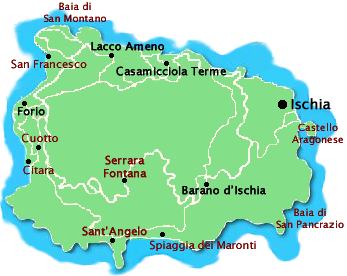
This place turned up in the travel section of one of the newspapers I read during the holidays. I was, of course, intrigued and fascinated. It's a beautiful spot, after all. The location is Ischia, a volcanic island paradise near Naples. The castle above on the small island (with a causeway) is Castello Aragonese, which first has its roots in the fifth century BC. Today it's become a destination for tourists and religious pilgrims alike.


The island itself is quite mountainous, and makes its living from tourism, who come for the thermal hot springs, the beaches, the history, and the scenery. The volcano itself hasn't erupted for the last seven hundred years (cross your fingers, in geological time, that's a millisecond). It struck me as an astonishingly beautiful spot. Just the sort of place one could write into a novel.


In Heaven & Hell, location has often come across as a character in and of itself. I've paid close attention to- and made use of- the places my characters have passed through. The history and scenery of places throughout Israel- Jerusalem, the Masada, Tel Aviv, the Golan Heights- and beyond into Syria have been very much on my mind throughout the book. And in the final phase of the book, on the island of Andros in Greece, the topography of the island and the achingly beautiful location (I could spend months in the Aegean, just saying... and I'm not even Greek) have certainly been influences on me. And down the line, in future books like Sword of the Faith and A Cold Day In Hell, location will continue to have an influence on my writing, to the point where the land takes on a character of its own.


Ischia and particularly that castle fortress are certainly inspiring for a location. As a writer in the spy genre, I could see using it for a meeting between adversaries. Yet it lends itself well to so many other possibilities. The romance genre would practically salivate at such a location. And I imagine at night, the grounds of that island castle would be just the perfect place for a murder in a mystery novel. And just think... wouldn't it be the perfect setting for a ghost story?

What would you do if you had the chance to use this place in your own writing?


Sunday, January 8, 2012

Six Sentence Sunday

Today I thought I would do another Six Sentence Sunday blog, from Heaven & Hell. The following passage features the very start of the assault on a villa in the Aegean. The passage is from the perspective of two members of the counter-terrorist team sent in to take down the Covenant. Yes, I know, blasting the hell out of a villa in such a lovely place is a cardinal sin, but considering what I did earlier in the novel, that's comparatively little more then kid's games....


No, this isn't the villa in question, but a nice spot in Greece, don't you think?


Tarif and Kalvos had started moving when they heard the explosives charges go off. They bolted out from behind the cypress tree to head for the terrace, and saw the columned arch around the front door to the villa. Tarif recognized the shapes of Devon and Stryker there, along with the momentary light of the small detonation fading into the night. He and Kalvos were both sprinting, aiming their MP5s as they went. Both men opened fire at the terrace windows. The glass began to shatter.

Sunday, October 2, 2011

Six Sentence Sunday

Andros, Greece

It's been awhile since I've done one of these, so I thought I'd run with one today. In the past, I've tended to select sentences at random from across my upcoming Heaven & Hell, but these six sentences come from the same place in the manuscript. They're the end of a late chapter in the book, featuring a conversation between my two main characters, Stryker and Devon, en route to Athens, and a final reckoning with my antagonists, the terrorist group called the Covenant...


“Preaching to the choir, Devon,” he told her, half smiling, setting his head back.
“You were never in a choir,” she remarked in mock annoyance.
He closed his eyes. “No, but I dated a choir girl years ago.”
She smirked. “I’m not interested in your tawdry social life.”

Monday, August 15, 2011

Endgame

Andros, Greece

I'm now closing in on the end of Heaven & Hell, at long last. Admittedly, it has taken me longer then I expected. First off, it's my first solo novel, so it took longer then I estimated. Second, not having a computer close at hand at all hours of the day meant that my writing time was curtailed. And lastly, well, there have been times in the last year that I haven't been up to writing. On a personal level, I've had a difficult year at times, and trust me... when you've got a proverbial black dog looming right in front of you, telling him to bugger off doesn't always do the trick. So the writing gets put to the side.

I've been writing lately what's basically a transitional pair of chapters. The Very Bad Thing (no, I'm not telling) has long since happened, and the truth has been exposed. Now everything is about the final act of the book, moving the action from Israel to Greece, where I have a final reckoning to come on the island of Andros between my protagonists and the terrorists they've been after. Incidentally, I'd like to apologize to the citizens of Andros in advance for setting a battle on their lovely island.  

Late in the book, I've introduced the final players in the book, members of the Greek counter-terrorism unit. The following is a passage introducing their commander. Tell me what you think.

The man sat in his office that day, a comfortable though utilitarian room in the Hellenic Police headquarters in Athens. He needed little more then what was already there: a desk, chair, shelves, and two chairs for visitors. There was also a safe for any sensitive documents, hidden behind a landscape charcoal sketch of the isle of Santorini on the wall behind him. The man was in his mid-fifties, and had a full head of neatly cropped black hair mixed with some grey, brown eyes, a moustache, and a typical Greek look. His eyes were constantly scanning when he was outdoors, tracking each face he saw, comparing them to faces in his memory. He wore khaki trousers and a tan dress shirt, open at the neck. At five feet eleven, he was tall and lean- that despite being in management these days- and in good shape, a holdover from his Army days.
            His name was Stavros Maras, and he was the director of E.K.A.M., the division known in English as the Special Suppressive Anti-Terrorist Unit. His officers all had backgrounds in the military and police, just like him, and trained and drilled constantly as counter-terrorism specialists. They were posted across the country, their drills taking place at a variety of locations, including ports, train lines, and airports. Their opposition remained far left revolutionaries, for the most part, and their duties also included rescue operations and hostage situations. They cross-trained regularly with various agencies, including the FBI, and they were the elite in the Hellenic Police.
            Maras had taken part in the dismantling of terrorist groups like November 17, the ruthless leftists who had waged their violent private war on his country. The groups that had followed in that path remained a thorn for his agency, as did the growing problem of Islamic radicals. Still, he had confidence in the abilities of the men and women under his command, and knew they were more than a formidable challenge for any of those who might launch an operation within his country.
            There was a television on in the room while he worked at his computer, on a low shelf on the other side of the room. One of the local television stations had been on the air since the explosion yesterday, reporting on the latest developments in the region. The statement from Nahas had been a surprise; the Covenant exposed as being behind the attack even more so. Maras was well acquainted with the group’s history, though they had never operated in Greece. He was half-listening as he typed, scanning reports on leftist groups in the country. Maras found himself surprised by the ringing of the phone. It was the secure phone, directly bypassing his secretary. There weren’t many people who had that number.  He reached over, pressing a button on the console, and picked up the receiver, answering in Greek. “Yes?”
            “Stavros, it’s Udi,” a familiar voice replied in the same language.
            Maras glanced at the screen, and saw a familiar Greek reporter speaking from Tel Aviv. Small world, he thought to himself. This wouldn’t be a social call, not with all that’s been happening. “Udi,” Maras said, changing over to English. He knew Zahavi’s grasp of Greek was limited, so it was polite. “Good morning. What can I do for you?”
            “Obviously you’ve been keeping up with the news,” Zahavi remarked.
            “I have. The Covenant is responsible, I understand.”
            “They are. And they’re in your area.”
            That surprised him. “Tell me, Udi.”


And this is a brief snippet I thought you ought to get a look at. It's my Four Musketeers moment, with my protagonists about to head off into battle. It's a quiet moment for them, and I think it needed a dash of humour.


Zahavi lingered a moment, Eli coming up beside him. He looked at them, one by one, and nodded, as though confirming what he already thought of each of them. “Give them hell,” Zahavi told the foursome.
“We intend to,” Stryker replied.
Zahavi walked out, followed by Eli, the two men following Nahas and Singer. Devon and Stryker stepped out after them, turning to go another way, back towards the helipads. Sabra and Tarif joined them in the corridor. They walked in silence, and Tarif spoke, asking, “Is there some appropriate saying for a time like this?”
“We few, we happy few, we band of brothers,” Stryker noted.
Sabra smiled despite herself. “You know your Shakespeare.”
“I always liked that one,” Tarif remarked. “Seems appropriate.”
“Fortune favours the bold comes to mind,” Devon suggested.
Stryker smirked, saying, “Or the slightly deranged.”


Now that I'm getting near the end, I've found myself in a bit of a quandary. The characters Sabra, Tarif, and Udi Zahavi were always meant to appear in just one book, and one book only. And yet here I am, getting towards the end, and I've gotten to really like them. So, the solution to the quandary? Bring them back. It can always be done down the line.


A couple of things left to keep in mind before I write the final words: I still haven't made up my mind just who will speak a certain bit of dialogue in regards to going to interesting places (it'll be whoever feels right for it as I'm writing it). And the final conversation of the book, I think, will only take shape when I get there. I know who has to speak... but the words will come when I get there. I've already experienced that in the writing, and I expect the same when I reach that point. Besides, I can't just impulsively bring in the police out of nowhere to arrest everyone for no reason. That's already been done before.

I can promise you, however, that the ending of the book will not turn out like this. Though I wouldn't mind borrowing one of those to use on my idiot ex-brother-in-laws' car....  


Thursday, June 23, 2011

X Marks The Spot


"Forget any ideas you've got about lost cities, exotic travel, and digging up the world. We do not follow maps to buried treasure, and X never, ever marks the spot." ~ Indiana Jones

"You call this archaeology?" ~ Henry Jones


Like pretty much everyone else who watched the Indiana Jones films as a kid, I entertained the notion of going into archaeology. Harrison Ford made it look cool. Mind you, real archaeology is about taking years to complete an excavation. It's about using tools that are far more likely to be fine brushes then shovels. It's about carefully cataloguing and surveying of an excavation, and methodical, meticulous documentation. And it's about knowing that you're very slowly putting together a puzzle. It usually doesn't involve a gun, whips, or a golden chest that melts people's faces.


To this day, I'm still fascinated by the field, by ancient history, particularly Egypt and Greece. I spent a good amount of time as a kid wrapped up in reading about expeditions and digs decades in the past, the discovery of tombs and lost worlds in places as far flung as the Valley of the Kings or Machu Picchu.


I've been fascinated by the mystery of Oak Island, which for a couple of centuries has been dug up repeatedly by treasure seekers convinced there's a cache of pirate treasure hidden away, but to no avail. My thought? The whole island is one gigantic decoy meant to confound treasure hunters, and the pirates themselves are still to this day laughing their asses off in their graves.


I've spent time in museums staring at mummies wondering if they ever thought they'd end up in a glass case being stared at by visitors. I've read the myths and legends of Greece, been fascinated by the artifacts and the stories, and been drawn to the notion of visiting that country (maybe when things settle down a wee bit... it's a bit tense at the moment). Santorini, which may have once inspired the legend of Atlantis, is a particular place that appeals to me.


So yes, it's fair to say that archaeology interests me. Even if it started with a film character whose unique methodology would frankly horrify every single curator and practicing archaeologist in the world today.


And so it is that archaeology has infiltrated its way into my writing, even though my area is the spy thriller. In Heaven & Hell, one of my lead characters, Tom Stryker, is a former archaeologist who, after an incident that will be written about in the next book, went to work as a spy. In doing so, he made a choice that's cost him the respect of his mentor, teacher, and father figure. Another character is an archaeologist whose life and work become caught up in the events of the book. Given that most of the book takes place in Israel, I touch on the history of the place, bringing my characters to various places in the country, from Masada to the Western Wall, and from the Church of the Holy Sepulchre to the stark Golan Heights. History is embedded in this place. And ultimately, I've brought my characters into a place that's the very essence of history, a secret place where few have ever stepped. Writing that moment of discovery (and at two different places in the novel) brought up the thrilling sensation for me as a writer that I imagine an archaeologist must feel when they know they've just made an astonishing discovery.


Down the line, as I go along, this interest in the ancient and in discovery will return. The next book, of course, is a prequel that I'm thinking of calling Sword of the Faith. It'll be set primarily in Egypt, and it'll tell the tale of how my two main characters first meet, and the events that change their lives. Oh, and lots of people are going to meet a bad end.


On one level, I'm almost tempted to have a discovery made in that book, a cache of ancient treasures hidden by the pharoahs. If I were to do that, however... it would make Stryker famous. Not the sort of thing that would work for the life of a spy. Perhaps it's enough that the reader knows just how close the dig came... before events conspire to bring it to an end. Is that cryptic enough?


In that book, of course, I'd also really bring out his mentor as well. I've mentioned him already in passing during Heaven & Hell. Telling how the two men have a falling out is essential, and I can also see bringing that character back a few books down the line. Perhaps to finish making that discovery that his former student came so close to uncovering?


There are always other finds, hidden away in unexpected places, of course. Awhile back I happened to come across a mention of a sword. Crocea Mors, or Yellow Death, was lost during Julius Caesar's time in Britain. It may have been buried with a local prince, taken by him during battle against Caesar. It may have ended up in the Thames. It may have given rise to the legend of Excalibur itself. What sort of events could bring such an artifact into the hands of spies in the modern day?

Of course, the Indiana Jones influence would still have me write a sequence some day about putting my lead characters into an ancient death trap of a tomb or lost city. We can chalk that up to Spielberg, Lucas, Ford, and that thrilling Raiders march from John Williams. Come on, you've been humming it in your head since you saw that picture, haven't you?


On a related topic... what was Spielberg thinking when he cast Shia leDoofus in the last film? We're really supposed to believe this dimwitted moron is the offspring of Indy and Marian?

Friday, January 7, 2011

A Pleasant Evening In The Aegean

Earlier today I finished a chapter in the ongoing work in progress, with an appropriate cliffhanger point: a terrorist pressing the button on his laptop to set off the Very Bad Thing (no, I'm not telling you). I thought I'd jump ahead a bit now. The last act of the book is set on the island of Andros, in the Aegean. It's a lifelong fascination with Greece that probably made me set the action there, and I know someone in Athens who's been a source of good information on the island (thanks, Selene!). And so I thought I'd gather some images, show you what the place is like... just so you can see for yourselves.