Faith Can Move Mountains... But Dynamite Works Better
Showing posts with label David Strathairn. Show all posts

Monday, May 19, 2014

Revenge Of A Giant Cranky Lizard Part Two

Business to see to first. Yesterday was a Snippet Sunday, so check out the post by Norma at her blog and the joint blog for something from our manuscript. And Shelly has some advice for writers at her blog. Last time I reviewed an earlier movie in the Godzilla franchise. Today I'm taking on the new one just out in theatres.


"The arrogance of men is thinking nature is in their control and not the other way around." ~ Ichiro Serizawa
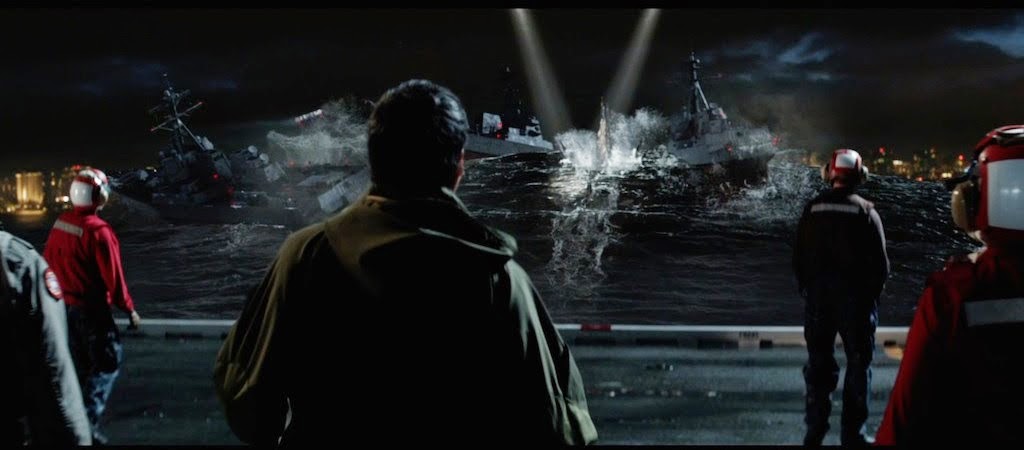

Rising up from the apocalyptic murk of nuclear testing, the new Godzilla opens with a bang and leads into a prologue years in the past involving a nuclear plant manager, Joe Brody (Bryan Cranston) and his wife Sandra (Juliette Binoche) having a bad day in Japan when a disaster strikes at the plant they work in. In the present day, their son Ford (Aaron Taylor-Johnson) is in the Army, married to Elle (Elizabeth Olsen), and living in San Francisco. Fate draws Ford to his father in Japan, still searching for answers about what really happened all those years ago.

They make some discoveries, leading to two scientists, Ichiri Serizawa (Ken Watanabe, Batman Begins) and Vivienne Graham (Sally Hawkins) who are overseeing something at the site of the plant. It's something big, and it being a monster (not the title character, mind you) soon conveniently breaks free, hungry for some nuclear radiation. And so the stage is set for a confrontation between monsters, one of which is a gigantic cranky lizard who hasn't had his morning cup of coffee.


The director of this new version is one Gareth Edwards, who previously debuted with a well regarded film called Monsters. Edwards gives the film a stylish feel, with a story delving into the arrogance of men, the power of nature, and the theme of family ties. There are times, mind you, when the spectacle of the monster overwhelms the human element, but that's to be expected in a monster film. The story presents the gigantic beast not as an out of control juggernaut that must be stopped, but more of as an antihero. It is neither friend or enemy to humanity so much as a reminder of what can happen when humanity disregards the limits of nature. Wisely, Edwards chooses not to give us a really good look at Godzilla until well into the film. It's a good decision to pace things like that, actually.


The special effects crew do better with this than the crews for the Emmerich version in 1998. Their design of the monsters that Godzilla duels with looks interesting on screen- the creatures are winged insects, but on a massive scale. They look creepy (those with phobias about insects might want to avoid this film), and the effects involved in bringing them to life actually work well. The same goes for Godzilla, who looks more like the classic version of the character without having to be a guy in a rubber suit as was so often seen in the Japanese films. When we finally see the big guy, and he starts to roar, we can feel the sound of the roar. The visual effects, in short, are stunning. I also liked the camera work- early scenes set in the past feel like period footage, in fact, but Edwards gives us enough of a distance that we can keep track of things as we go along. That's a good thing in an action film.


The human element of the story does get overwhelmed by the monsters, mind you, but that's to be expected. Humans in these kind of stories are merely there to bear witness or run for their lives. Cranston's a well respected character actor just coming off several years in Breaking Bad. I haven't seen that series myself, but I've seen him in a lot of other things down through the years, and I like what he's capable of. Here he plays a man obsessed, shattered by grief and consumed by the certainty that things are being hidden away. Juliette Binoche playing his wife (however briefly) is a good choice as well. Much of her work has been in France, but American audiences will know her best from Chocolat. They're both good actors, and I'd quite prefer to see them in something more conventional.


The same applies for another actor. David Strathairn (Lincoln, Good Night And Good Luck) has an excellent track record as an actor. Here he plays an admiral overseeing the hunt for the creatures, responding to a dire situation as you'd expect a military officer to react- with blunt force. He plays the part with gravitas and conviction, even though he has to blurt out some peculiar expository dialogue. That's also the case with Watanabe and Hawkins, both of whom are playing characters who are reluctant to give out information. They're believable as scientists, and burdened with expository dialogue.


Elizabeth Olsen happens to be the younger sister of a pair of nitwit twins who have grown up literally in the spotlight. Strangely, this is not a bad thing- this is the first thing I've seen her in, but she comes across as grounded, as opposed to flighty and self absorbed in the fashion of her sisters who got their start in that dreck called Full House. She's sympathetic and supportive of her husband. Strangely enough, the actor playing her husband will be playing her brother when the two co-star in the next Avengers film. Aaron Taylor-Johnson comes across as believable in the role of a military officer. He grounds his performance as a man who's had the effect of an absent father in his life, and his reactions emerge from that. His character is also asked, for the sake of the story, to be courageous (or reckless, depending on your point of view), and he accomplishes that.

The new Godzilla succeeds where the Emmerich version did not. While the human element of the story is overwhelmed at times by the monsters- to be expected in something of this scale, and while there is a somber tone to the story, Edwards has crafted a film that still touches on the central themes of the franchise- man's arrogance and the punishment nature can inflict in the face of that arrogance. It gives us a monster we can still cheer for, and as a disaster flick, it rampages gleefully. 

Somewhere, Roland Emmerich is no doubt wondering if he can have a do-over.


Monday, November 19, 2012

The Great Emancipator


Some scholars of history refuse to play the What If game. I rather like it. In regards to the American Civil War, we can ask ourselves what might have happened if John Wilkes Booth might have decided to call it quits and leave the country in April 1865 instead of choosing the path he did... or if he had missed his one shot that night in Ford's Theatre, and President Lincoln had lived. Reconstruction would have taken a very different path, civil rights would have been in place firmly as part of it nearly a century earlier... and Martin Luthor King Jr. would have been merely a particularly eloquent preacher.

Director Steven Spielberg has long sought to film a biography of the sixteenth President of the United States; he has had the project in mind for years on end, and finally the film itself has been made and released. Lincoln examines the final months of the President's life, and the final portions of the horrendous Civil War, on a very different battlefield: politics.


The film is drawn from the book Team of Rivals, by historian and writer Doris Kearns Goodwin, with a script by Tony Kushner. It revolves around the fight to pass the thirteenth amendment, abolishing slavery once and for all. The President, played masterfully by Daniel Day-Lewis, struggles to keep the country together in the final months of the war, while his commanding general, U.S. Grant (Jared Harris) works to force the surrender of Confederate forces near Richmond.

The struggle to pass the amendment presents its own challenges in Congress. On one side, fervent abolitionists like Thaddeus Stevens (a scene stealing Tommy Lee Jones) demand the immediate abolition of slavery. On the other, Democrat representatives who are openly hostile to abolition refuse to budge. In the middle are a swirl of voices, such as Francis Blair (the magnificent Hal Holbrook) and Secretary of State William Seward (the always outstanding David Straithairn) trying to find a path to peace- one that might mean setting the amendment aside.


Lincoln argues for the amendment, among his cabinet and among his opposition. He copes with the turmoil in his marriage to Mary Todd Lincoln (Sally Field) and worries about his son Robert (Joseph Gordon Levitt), a staff officer in the army. He's a father who has already buried children, and this- along with his worry for Robert- reflects in his relationship with the remaining son, Tad, still a boy. He finds himself trying to coax, cajole, twist arms, even using political favours in the efforts to bring about the end of slavery once and for all, feeling that a just peace can only happen if slavery is ended forever.


Spielberg is often known for bombast in his films, but here that isn't the case. With few exceptions- early sequences of battle, for instance- the bombast is turned off. He lets the story tell itself, and he assembles the ideal crew for it. The film feels like a Washington of the 1860s, from the look of buildings, the lighting of homes and offices, and the clothing and accessories of people to the infighting and volatile nature of the political atmosphere. Tremendous attention to detail has been shown by the crew. Cinematography seems to carry us into the midst of the political field of battle, drawing us back in time. Spielberg's frequent cinematographer Janusz Kaminski outdid himself with his work on the film, and deserves an Oscar. And John Williams gives an indepth, stirring musical score, once again living up to his reputation as the best Hollywood has to offer in film composers. 


Spielberg has assembled an extraordinary cast for the occasion. Holbrook, a legend on stage and screen, gives yet another fine performance as a voice of reason and elder statesman. Straithairn, who always brings depth and layers to a performance, does so again as Seward; I was reminded several times of how in history, Lincoln and Seward started out as rivals for the nomination, and only later became friends. Bruce McGill, a character actor who often appears in the most unlikely of roles, has a fierceness in his role as Secretary of War Edwin Stanton; the performance is similar to Kevin Kline's take on the man in The Conspirator. Harris, previously seen  in Sherlock Holmes: A Game of Shadows gives the right amount of gruffness to the exceptional General Grant.


Sally Field, who's actually two decades older than Mary Lincoln was at the time, and ten years older than Day-Lewis, nonetheless is right for the role. She looks younger than she is, and Mary, in all pictures of the time, looks older than she was. She plays the part as you'd expect; occasionally very difficult in personality, probably hard to live with, and with traces of the unstability that was to dominate the rest of her life. There's also a warmth and protectiveness at times in the character, as Field and Day-Lewis come across as very natural together. Joseph Gordon-Levitt playing their son Robert does well in the role. As a young actor, he's continuing to grow in interesting roles. As Robert, he plays the young man chafing at the bit, and it's one of the cruel ironies in life that Robert was touched by assassination again, later in life, witnessing the assassination of President Garfield.

Tommy Lee Jones steals pretty much every scene he's in (he's good at that), and should be a lock for Best Supporting Actor at the Oscars. His take on Thaddeus Stevens is that of a passionate, ferocious man of principle. He's a crafty politician, yes, but he's also one of integrity. Jones breathes fire and life into the character.


I have long thought that Daniel Day-Lewis is the best actor around today. My favourite of his roles must be Hawkeye in Last of the Mohicans, and I had thought that his lead role in the film In The Name of The Father was him at his best. Playing the President is a performance that matches, if not exceeds both of them, and he should be given the Leading Actor Oscar right now. Day-Lewis has a talent for disappearing into the role, and only takes roles he finds interesting. I've heard he stayed in character even off the set, typical of his methods as an actor. Here he conveys a peculiar sounding voice that is nonetheless the sort of voice commanding attention- something that history records Lincoln himself had. 

He plays the President as a man given to making a point through telling a story, a rough around the edges Mid-Western politician, a frontier man. His Lincoln is true to what the man himself would have been like: a highly capable political operator, very intelligent, cunning and crafty, with great instincts about human nature. There are times he comes across as aloof or distant, qualities that feel true to what we know. And there is a strong sense of humour, integrity, and principle to the man. Day-Lewis shows us a man who's exhausted by years of war, but still firmly dedicated to the cause. Close your eyes for a moment, listen to the voice, and you'll wonder if you're listening to the actor, or the man himself. The performance is that good.  

This is the best film of the year.