
“I have no idea to this day what those two Italian ladies
were singing about. Truth is, I don’t want to know. Some things are best left
unsaid. I’d like to think they were singing about something so beautiful, it
can’t be expressed in words, and makes your heart ache because of it.” ~ Red
“The funny thing is, on the outside, I was an honest man,
straight as an arrow. I had to come to prison to be a crook.” ~ Andy
“I believe in two things: discipline and the Bible. Here
you’ll receive both. Put your trust in the Lord. Your ass belongs to me.
Welcome to Shawshank.” ~ Warden Norton
“Let me tell you something, my friend. Hope is a dangerous
thing. Hope can drive a man insane.” ~ Red
“Couldn’t play
somethin’ good, huh? Hank Williams?” ~ Heywood
“They broke the door down before
I could take requests.” ~ Andy
“You’re that smart banker who killed his wife, aren’t you?
Why should I believe a smart banker like you? So I can end up in here with
you?” ~ Captain Hadley
“There’s not a day goes by I don’t feel regret. Not because
I’m in here, because you think I should. I look back on the way I was then: a young,
stupid kid who committed that terrible crime. I want to talk to him. I want to
talk some sense to him, tell him the way things are. But I can’t. That kid’s
long gone, and this old man is all that’s left.” ~ Red
“Remember, Red, hope is a good thing. Maybe the best of
things, and no good thing ever dies.” ~ Andy

In 1994, director Frank Darabont released The Shawshank Redemption, a prison drama
based on a novella by horror master novelist Stephen King. It is a character
study featuring Tim Robbins and Morgan Freeman, and deals with themes like
hope, the meaning of freedom, the depth of despair, and the power of
friendship. The story, which for once was not
a horror tale by King, nonetheless follows the writer’s tendency to set his
narratives in Maine. The film opened to great acclaim, getting numerous Oscar
nominations, but was a box office disappointment. However, in the years that
followed, home video and cable viewings fuelled a second life for the film,
which has become a beloved film among audiences, regardless of its dark subject
matter.

In 1947, Maine banker Andy Dufresne (Robbins) is convicted
of the murders of his wife and her lover and sent to Shawshank State
Penitentiary for life. He seems certain to break- some of the convicts place
bets on which of the newcomers will be the first to fall apart on their first
night behind bars- and yet he doesn’t. Andy makes friends with other convicts,
chiefly Ellis “Red” Redding (Freeman), who knows how to get just about anything
smuggled into the prison. Heywood (William Sadler) and Brooks Hatlen (James
Whitmore) are two more convicts that Andy befriends. Life in prison is hard,
and the brutality is not glossed over- Andy is initially the target of a gang,
while the warden (Bob Gunton) and the chief of the guards (Clancy Brown) are
both corrupt and ruthless. And yet in his own way, Andy’s spirit and integrity
aren’t imprisoned, and he comes into his own.


Hope is a strong theme throughout the film- in a status
where one is surrounded by the hopelessness of spending life in prison,
particularly wrongfully, the story strongly plays off the concept of
maintaining a person’s sense of self worth. Where Red is cynical about the idea
of hope, Andy believes that hope is something that can’t be caged up, that
can’t be taken away, and that theme strongly underlies the entire film. Even in
moments of seeming despair- Andy being at a low point nineteen years into his
sentence and speaking of a dream of a Mexican coastal town- that sense of hope
prevails. As harsh as a film about life in prison is, the story is uplifting,
with an ending that just brings out a smile every time.

Darabont secured the
film rights from King for the story, and wrote the screenplay, investing the
themes of the story into the screenplay. It turns out that Rob Reiner, who had
adapted a King story into Stand By Me, had
wanted to helm the tale, with Tom Cruise and Harrison Ford in the leading
roles. I could see Ford as Red, but Cruise as Andy Dufresne would have been a
disaster. Darabont filmed a good part of the movie in an Ohio reformatory,
which does a good job of conveying the bleakness of prison life. Other
sequences were done on soundstages, but the locations and staging all come
across as authentic in detail, evoking a twenty year period in the mid-twentieth
century, as well as the harshness of life in prison. This extends to things
like props, clothing, and vehicles, all of which are of the time, and
particularly to the movie pin-up girl posters which end up providing such a
vital plot element as the story unfolds. Darabont also chose the ideal composer
for the score; Thomas Newman’s music for the film has taken on a life of its
own, infused with themes that are strongly character based, filled with humour,
and celebrating freedom.

The cast is one of the best you can think of assembled for
any film. James Whitmore, the late character actor, gets the part of the
elderly convict Brooks, a prison librarian who’s spent most of his life behind
bars. There’s wisdom and frankness in the character, a friendly sort of man
who’s become institutionalized behind bars and doesn’t know what to do with
himself on the outside. Gil Bellows appears as a young convict, Tommy Williams,
a brash talker who joins Andy and Red’s circle of friends and as it turns out
has prior prison time and information that proves vital to a great turning
point in the story. As cocky as the character comes across, there’s an
underlying sense of principle in him too. William Sadler has a terrific role as
Heywood, a convict who tends to be rougher around the edges than Brooks, but
also an inherently decent man.
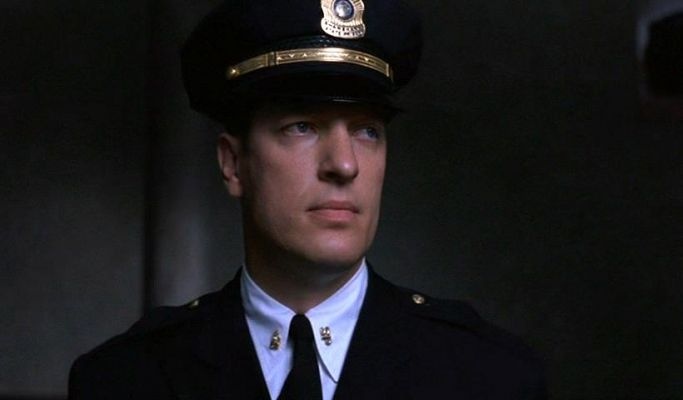

Clancy Brown, who’s spent a good part of his life as an
actor playing villains, gets a good role as the nasty Captain Byron Hadley, the
chief of the guards at Shawshank. He’s brutal, sadistic, corrupt, and sees
nothing wrong with administering beatings (or worse) to convicts to keep them
in line. The character’s a bully and a thug, a thoroughly unpleasant person.
While he’s entirely unsympathetic, Hadley’s a memorable character for the actor
to play. Bob Gunton is another character actor who’s spent his career playing
various roles, including strict and authoritarian people, which certainly
factors into his role as Warden Samuel Norton. The character presents himself
as a pious, devout Christian, but the man is deeply corrupt, ruthless and
vindictive. He’s a sanctimonious, self righteous hypocrite, and one of the
great joys of the film is watching things go completely upside down for him.

Morgan Freeman plays the pivotal role of the convict Red,
who narrates the film and gives the audience their point of view character.
It’s the perfect casting for the role (aside from Ford, Clint Eastwood, Paul
Newman, and Robert Redford were also considered for the character’s casting).
Freeman gives the character authority, warmth, and authenticity. Red has a
richly developed voice, a bit of cynicism in his outlook on life, and a whole
lot of depth. Because he serves as our point of view, his worry at a critical
point in the film- he believes Andy to be suicidal- becomes our worry as well,
and Freeman plays into that, bringing the character so strongly to life.

Tim Robbins is perfect as Andy, a laconic man through much
of the film. He doesn’t know if he’s a murderer- the night of the murders he
got himself so drunk he doesn’t remember- but he comes across as what he is- an
inherently decent person who doesn’t lose hope or his own integrity as he faces
life behind bars. His defiance is expressed more in a subdued way. There are
moments that he seems to be drifting into despair, and it’s a wise thing as it
turns out to not really see Andy’s inner thoughts- the payoff late in the film
is all the better this way. He expresses his thoughts in his behaviour and his
words, and so we get to know him more at a distance than we do with Red. When
we see that payoff play out, in an ingeniously crafted way, it becomes all the
more satisfying. Convict or not, Andy is a man whose spirit can’t be caged, and
Robbins brings that throughout his performance.


While The Shawshank
Redemption brings across life in prison in its brutality, with the language
and violence one would expect of that, it is ultimately an uplifting,
tremendously satisfying film about the power of the human spirit, the strength of
friendship, and hope in humanity. It’s become a favourite of viewers after the
fact, and has taken on a reputation as one of the best films ever made.
Which would have never
happened had Tom Cruise been cast as Andy Dufresne, so we really dodged a bullet.


