"The Hatfield-McCoy War has broken out fresh in the newspapers. The Hatfields and McCoys, however, know nothing about it." ~ Logan County Banner, 1894
Last year I wrote a
humorous blog on vendettas, specifically on the story of the Hatfields and McCoys. I thought I'd revisit that somewhat today, as the story of the Hatfields and McCoys has come back along as of late. A miniseries on the feud has aired recently, and a fresh book on the story has recently been published. I thought I'd take a look at both, review each in turn.
Hatfields & McCoys is the recent miniseries, headlined by Kevin Costner and Bill Paxton as the patriarchs of the two clans, telling the story of the vendetta from the end of the Civil War to its conclusion in 1891. The two start out as young men, and we follow them through to old age in the series, along with their families and the various people who played a part in the events of the vendetta.
 |
| Devil Anse (Kevin Costner) and Levicy Hatfield (Sarah Parish) |
 |
| Sarah (Mare Winningham) and Randall McCoy (Bill Paxton) |
Devil Anse Hatfield (Costner) and Randolph McCoy (Paxton) are both soldiers in the Confederate army until Hatfield abandons the field to go home to the borderlands of Kentucky and West Virginia, to his wife Levicy (Sarah Parish). McCoy comes home to his wife Sarah "Sally" McCoy (Mare Winningham) at war's end to a world changed, where his brother Harmon has been killed by Jim Vance (Tom Berenger), an uncle to Devil Anse. This is what most consider to be the beginning of the feud, an act of anger over Harmon McCoy having had served as a Union Soldier.
The years go on. While the Hatfields seem to prosper with timbering in the area, Randall McCoy and his relations fall behind, and the unresolved death of one of their own festers in the McCoys. The theft of a pig and subsequent trial of a Hatfield more than a decade later creates more tensions between the families. The relationship of two of the children, Johnse Hatfield (Matt Barr) and Roseanna McCoy (Lindsay Pulsipher) makes things worse. Where Randall tries to use the law to air his grievances, Devil Anse is more likely to take the law into his own hands. On both sides, the tensions deepen, fighting breaks out, lives are broken, and people are killed as revenge becomes absolute. By the end of the feud, two families have been hit hard, the story has made national headlines, and two hardened enemies find themselves at a crossroads.
 |
| The Hatfields |
 |
| The McCoys |
The miniseries does justice to the story, particularly with respect to what I've later read about the feud. It tries to be historically accurate, much more so than previous film or television versions of the story, which veered wildly off the rail. There are a few glitches- the historical record, for instance, is uncertain as to if Randall McCoy even fought in the Confederate Army, Costner and Paxton are roughly around the same age and in reality, Randall was older than Devil Anse, Roseanna McCoy was a blonde- but these are relatively minor. The filmmakers wanted to keep as close to the original narrative of history where possible, and the production values really pay attention to the finer details, in costuming, music, sets. While the filming itself was done in eastern Europe, the setting in the film ends up feeling very much like a place in the backwoods of America, like the Kentucky and West Virginia borderland must have been like.
The pacing of the story works well. It slowly builds up the tensions, conveying the events as they go along, bringing the feud to a boil, to the point where it finally explodes. We, the audience, can believe the animosity that we've seen growing in these characters. The casting, for the most part, works well. The exception would have to be Matt Barr and Lindsay Pulsipher, neither of whom have much in the way of gravitas for the parts. There are some who look at the story of these two as a Romeo and Juliet sort of story; I didn't sense that. To begin, there were already a number of Hatfields and McCoys marrying. And it felt more like Johnse Hatfield was an irresponsible, womanizing drunkard who threw away what might have been a good thing just by being himself. Barr doesn't bring much weight to the role, and seems more like he's channeling Ryan Gosling (a bad thing, since in my opinion, Gosling sleepwalks his way through every role he takes). Pulsipher as Roseanna is more or less the tragic character, doomed to a bad end, but she just doesn't feel like we should take her seriously.
 |
| Roseanna McCoy (Lindsay Pulsipher) |
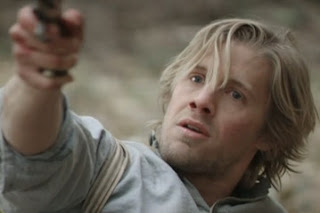 |
| Johnse Hatfield (Matt Barr) |
Okay, that's the bad casting choices out of the way. Now the good, and there are a number of standout performances. Boyd Holbrook plays Cap Hatfield, another of Devil Anse's sons, and he gives the part a vindictive, ruthless streak, much like the original man might well have possessed. Jim Vance is the sort of sadistic, vicious pitbull that history seems to suggest he is, and Berenger perfectly plays those qualities. Powers Boothe, playing "Wall" Hatfield, an elder brother, gives the role a certain dignity and strength throughout. He's the voice of reason, reluctant to get involved in the feud, though the feud leads him to a bad end anyway. Andrew Howard plays a man named Bad Frank Phillips, a gun for hire brought in by the McCoys to go after the Hatfields, and though he's older than the actual man himself was, he plays the role with a vicious rattlesnake sort of quality, a thoroughly dangerous man.
 |
| Cap Hatfield (Boyd Holbrook) |
 |
| Jim Vance (Tom Berenger) |
 |
| Wall Hatfield (Powers Boothe) |
 |
| Frank Phillps (Andrew Howard) |
There are several women in the cast who stand out. Jena Malone, who's been acting since childhood, plays a McCoy cousin, Nancy, who gets involved with Johnse after the breakdown of the relationship with her cousin. She brings a conniving, manipulative quality to the role, effectively playing both sides against each other, though her loyalties remain to her family. Sarah Parish as Devil Anse's wife Levicy is a voice of reason, drowned out by violence, watching her family tear itself apart for the sake of retribution. And Mare Winningham plays Sarah McCoy, one of the more tragic characters of the story, who loses most of her family, and ends up broken emotionally and physically. She too watches her family implode from within, her husband becoming increasingly bitter, and the performance is haunting.
It's the two leads in the cast that make it come together. They carry the weight of the series, and they do not disappoint. Bill Paxton is one of those actors who just gets better with age. He plays McCoy's gradual decline from a reasonable man into bitter anger, finally into a state where he's shattered by all that has happened to him. Randall McCoy spent the rest of his life in complaint, never really getting over the feud, the anger still festering in him, and Paxton perfectly conveys that. He's a man whose eyes are very expressive, and two emotions that come across that way throughout are pain and the notion of being haunted. He moves from being a man who believes in God and the law to becoming a man who has lost all that matters to him in the end, leaving him unhinged, deeply bitter, and cynical. Not unlike the real McCoy, who by all accounts came apart after the feud.

Costner too is an actor who, given the right role, really can shine. He plays mean and cruel very well, and Devil Anse certainly qualifies. There's a ruthless, calculating streak to the character, a stubborn quality that's not willing to let go of an argument. He also feels plausible as the leader of a large extended family, though the man himself was not the eldest in the clan; Costner carries enough dramatic weight that the audience can believe people around him would follow him. I was reminded of my favourite Costner film
Wyatt Earp, where he plays the lawman as the driving force of a family, similarly moved to wage a personal war against people he deems the enemy. In Wyatt and in Devil Anse, there's something of the same mean streak. There's a darkness that particularly comes out at times in this series, to the point where he's willing to take extreme action against a member of his own family he thinks may have betrayed him.
There's a moment, late in the series, when the two come face to face again. It's a confrontation that's not quite what it seems. Costner and Paxton spar with each other in that scene, which really comes across as a crossroads. It also brings into question the issue of mental stability, but it perfectly conveys just how deeply the loathing had cut into both men. It might well be the pivotal moment of the entire series.
The series leaves us with questions. Are there any of these people we should feel sympathetic about? Yes. The women are, for the most part, more sympathetic than the men, which I think transfers as well over to the real story. They watched as their families destroyed themselves, as their men went to war with each other, as stubbornness and hatred dominated their actions. And they paid dearly for it. The series sheds light on this chapter in American history, reminding us of just how badly anger can dominate, can get out of control, and how hard the consequences of that can be. And in the end, it's compelling and entertaining... and dark.
The writer Lisa Alther has recently released
Blood Feud, a new look at the facts of the vendetta. Alther counts among her ancestors a McCoy family member, a forebear who refused to take part in the feuds. Alther, who comes from a background as a novelist, brings that quality to the narrative of history, laying out the story of the feud. She acknowledges a problem in telling the story straight off; the poorly kept records and contradictory accounts of the events in question from previous books make it difficult to determine at times what really happened. Earlier books were written by family members on both sides, collecting the accounts of their relations and told in such a way to deflect responsibility for crimes and to cast themselves in a positive light. The truth, she stresses, must lie in between, and through the book she often notes of an incident having more than one version, either in the drafts or the narrative itself. Another thing she stresses is that many of the people taking part in the fight weren't members of the families, but were tied to the clans by friendship or employment; indeed, there were more than a few Hatfields and McCoys who refused to take part in the vendetta.

Alther lays out the background of the families and the region first, exploring things like why vigilante justice might appeal to such people, to the family hierarchy of the day. In large extended families, for example, one might have cousins sharing the same name, since the habit of the time was to name a son after a father, or an uncle or brother. This is the case with Devil Anse, who shared his proper name William Anderson Hatfield with a cousin. The tendency of the time was to nickname children, often based on personality at some point; while the cousin ended up being referred to as Preacher Anse, and Devil Anse... obviously got it for other reasons. Alther gives several explanations for the nickname (as is the case of so much in the story, there are conflicting reasons); I rather prefer Randall McCoy's take on the name, that Devil Anse was "six feet of the Devil and a hundred eighty pounds of Hell."
 |
| Devil Anse Hatfield and Randall McCoy |
The chronology of the feud is laid out in detail, the crimes, the killings, and the underlying factors driving hostilities. Where there are conflicting accounts of what actually happened, Alther points them out, using her skill as a novelist to keep the pacing of the narrative going. With the end of hostilities, she turns somewhat to discuss other items, putting the story into a greater context. Underlying cultural, physical, and social elements that might have played a role in the way the feud developed are explored. Other feuds in the region- some of which lasted longer and resulted in much higher death tolls- are detailed. And the aftermath and legacy of the feud itself, particularly in how it lingers in our collective memory in a way that other feuds have never achieved, are examined.


I cannot understate the value of Alther's background as a novelist in writing this book. It gives her the ability to breathe life into the story in a way that some historians might be lacking in (believe me, I've read more than enough historian's tomes that serve as a good cure for insomnia... Eric Hobsbawm, I'm looking at you). She has the right touch in keeping the reader's attention, and she brings balance to the story; she places the responsibility for the feud on both sides. She even brings a sense of humor to the table, which I obviously appreciate.
If you've found yourself curious about the real story after watching the miniseries, get hold of
Blood Feud. You'll find yourself enlightened.


